

nowing what customers want is only useful when the operation can deliver it consistently. Convenience retailers may understand that shoppers value quality, speed, freshness, availability, cleanliness, and a reasonable price, but those expectations ultimately have to become specific store-level behaviors.
That is where foodservice strategy becomes execution. A promise such as “fresh food, fast” depends on recipes, equipment, prep schedules, merchandising, staffing, replenishment, training, and communication all working together. Customers experience the result—not the strategy behind it. The challenge for operators is to translate broad consumer expectations into processes that can be repeated during every shift, including the busiest and least predictable parts of the day.
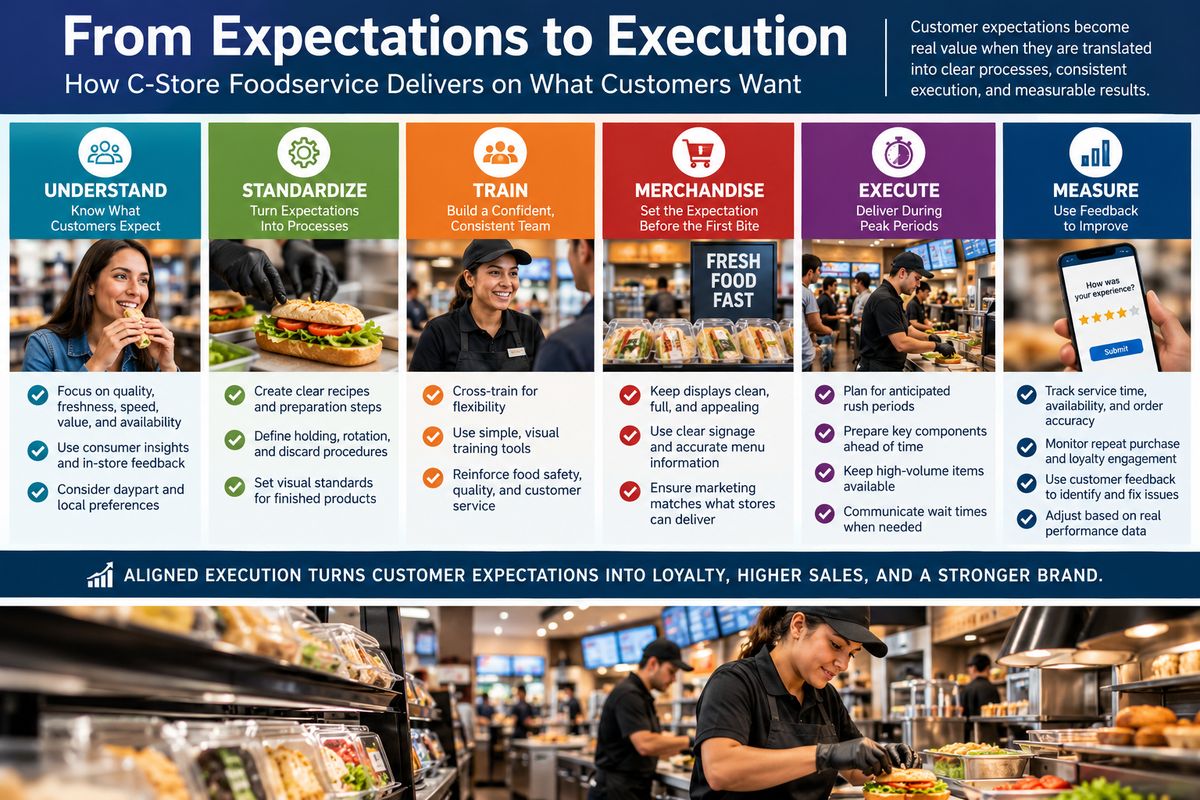
Customer expectations can sound abstract until they are converted into operating standards.
If customers expect freshness, the operation needs clear production, holding, rotation, and discard procedures. If they expect speed, workstations, menus, equipment, and staffing need to support reasonable service times. If they expect availability, forecasting and replenishment practices must keep popular products in stock. If they expect value, portions and presentation must consistently support the price being charged.
Menu development should begin with that same discipline. Rachel Saddler, senior manager of foodservice innovation at Tri Star Energy, told NACS Magazine that her team starts with the customer and focuses on what customers want and how the operation can meet that need quickly and consistently. From there, operational fit and profitability become part of the decision.
“What they want and how we can meet that need quickly and consistently.”
— Rachel Saddler, Senior Manager of Foodservice Innovation, Tri Star Energy
That framework is valuable because it prevents operators from treating customer research as a separate marketing exercise. The customer expectation becomes the starting point for menu design, staffing, equipment, sourcing, and training.
A product that customers want but stores cannot execute reliably is not fully aligned with customer expectations. Neither is an operationally easy item that customers do not value. The strongest programs find the overlap.
Consistency is where many good foodservice concepts become vulnerable.
A sandwich prepared at 8 a.m. should not be noticeably different from the same sandwich ordered at 5 p.m. A grab-and-go case should not appear full and appealing during breakfast but nearly abandoned late in the afternoon. Cleanliness, portioning, ingredient availability, packaging, and customer interaction should not depend entirely on which employee happens to be working.
Consumers increasingly notice those differences. Industry operators interviewed by NACS Magazine have emphasized that customers expect both consistency and availability across dayparts, particularly as c-stores compete more directly with QSRs for prepared-food occasions. NACS Magazine’s examination of foodservice leakage shows how inconsistent assortment or execution can send a shopper to another foodservice destination even after the customer has already visited the store.
Consistency starts with eliminating unnecessary interpretation.
Recipes should specify portions and preparation. Holding standards should be clear. Opening, peak-period, shift-change, and closing responsibilities should be defined. High-volume items should have predictable replenishment triggers. Store teams should know what an acceptable finished product looks like rather than relying solely on written instructions.
Cross-training also matters. Foodservice execution becomes fragile when only one employee knows how to operate a station, prepare a specialty item, or troubleshoot a piece of equipment.
The goal is not to remove employee judgment. It is to ensure that routine execution does not require employees to reinvent the process on every shift.
Customers begin forming expectations before they taste the food.
The condition of the foodservice area, menu boards, grab-and-go displays, packaging, signage, digital ordering screens, and promotional materials all communicate what kind of experience the retailer intends to provide.
That means marketing and operations have to agree.
A sign promoting a premium sandwich creates an expectation about appearance, quality, portion, availability, and price. A mobile-app offer creates an expectation that the product will be available when the customer arrives. A photograph of a well-stocked fresh-food case creates a promise that the real case will not look neglected.
Rutter’s provides a useful example of this alignment. Philip Santini, senior director of advertising and foodservice, has described how the retailer combines high-quality foodservice with digital ordering and loyalty programs as consumers increasingly expect the convenience, speed, and quality they also encounter at QSRs.
The broader lesson is that communication should make the operating promise clearer—not create a promise stores cannot reliably keep.
Simple merchandising often works best. Customers should be able to understand what is available, where to order it, how much it costs, and how long the process is likely to take without studying the store.
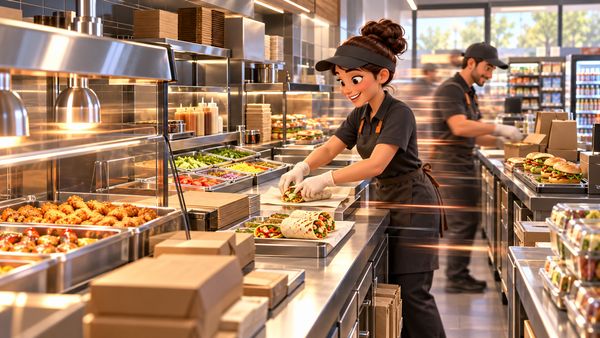
Peak periods reveal whether customer expectations and operating reality are truly aligned.
A foodservice program may perform exceptionally well when two orders are in the system and struggle when twelve arrive within several minutes. During those periods, customers evaluate more than the final product. They notice the line, the pace, whether employees appear organized, whether popular items are available, and whether anyone communicates when a delay occurs.
Retailers therefore need a peak-period plan rather than relying on employees to improvise.
That can include preparing appropriate components before the rush, increasing grab-and-go availability, assigning employees to defined stations, replenishing packaging and ingredients before demand peaks, limiting unnecessary production changes, and ensuring that the highest-volume equipment is ready.
Expectation management matters when delays cannot be avoided.
A customer who waits five minutes without knowing what is happening may perceive the experience very differently from a customer who is told immediately that a made-to-order item will require five minutes. Accurate digital order times, visible pickup processes, and simple employee communication can reduce uncertainty even when the actual production time does not change.
Retailers should be careful, however, not to solve peak demand by lowering quality standards. Speed that produces inaccurate orders, poor presentation, unsafe holding, or inconsistent portions simply replaces one customer problem with another.
Customer feedback has limited value if it stays inside a survey platform or monthly report.
Useful feedback should eventually produce an operational response.
If customers repeatedly complain about an unavailable breakfast item, the question may involve forecasting or replenishment. If mobile orders are frequently late, production sequencing may need attention. If customers like an item but rarely reorder it, operators may need to examine price, portion, consistency, or ease of purchase.
Feedback also comes from behavior.
Repeat purchases, loyalty activity, sales by daypart, item abandonment, stockouts, refunds, complaints, digital-order times, and product waste all reveal something about whether execution is meeting expectations.
Current NACS consumer research provides a useful example: among shoppers who purchased prepared food, 41.5% said they had previously purchased and liked the food, suggesting a meaningful relationship between a successful prior experience and repeat traffic. NACS’ look at today’s convenience shopper also notes that nearly 30% of shoppers identified hunger as the primary reason for choosing a particular store.
Those numbers reinforce why execution matters. The first purchase may come from convenience, promotion, or curiosity. Repeat purchase depends more heavily on whether the experience delivered what the customer expected.
Sales are essential, but they do not explain the entire customer experience.
A strong sales day may conceal long waits, employee strain, stockouts, or excessive waste. A weak day may reflect poor visibility rather than poor product acceptance. Operators need enough information to distinguish between customer demand and execution problems.
Useful measures can include service time, product availability, order accuracy, waste, complaints, repeat purchase, loyalty engagement, average ticket, attachment rate, and sales by daypart.
The measures should connect to the promise.
If the brand emphasizes freshness, operators should monitor rotation, holding, and waste. If the promise is speed, service time and queue behavior matter. If value is central, repeat purchase and price sensitivity deserve attention. If made-to-order quality is the differentiator, accuracy and consistency become especially important.
The purpose of measurement is not to create more reporting. It is to identify where the experience customers expect diverges from the experience stores actually deliver.
Customer expectations become commercially valuable only when they influence how the foodservice operation works.
The strongest convenience retailers translate customer insight into clear processes, dependable products, consistent execution, effective merchandising, realistic peak-period planning, and measurable operating standards. That alignment allows stores to deliver what the brand promises without relying on exceptional effort from individual employees on every shift.
Customer expectations will continue to change. The operating discipline required to meet them is more durable: understand what matters, define what successful execution looks like, measure whether stores are delivering it, and adjust when the customer experience says otherwise.
Start by translating each expectation into a specific process. Freshness may require production and holding standards, while speed may require workflow, equipment, and staffing changes. Availability requires forecasting and replenishment discipline.
Customers generally expect the same product and service regardless of when they visit. Standard recipes, procedures, training, and shift responsibilities reduce variation and help protect trust.
Signage, menu boards, displays, packaging, and digital promotions establish expectations before the customer receives the food. Marketing should accurately reflect what stores can consistently deliver.
Prepare before the rush, assign clear responsibilities, keep high-volume ingredients and packaging replenished, and communicate realistic wait times. The objective is to manage demand without sacrificing quality or accuracy.
Service time, availability, order accuracy, repeat purchase, loyalty engagement, complaints, waste, average ticket, and sales by daypart can all help identify gaps between the intended experience and actual execution.

Subscribe to receive latest news
12968 Vallejo Circle, Westminster CO. 80234
Phone: (303) 604-1064