

peed has always been part of the convenience-store promise. Customers stop because the location is convenient, the transaction is straightforward, and they expect to be back on their way quickly. As foodservice becomes a larger part of the c-store business, that expectation does not disappear simply because the order now includes a freshly prepared sandwich, pizza, chicken meal, or specialty beverage.
Speed of service is therefore more than a customer-service metric. It affects how many orders a store can process, how efficiently employees use their time, how customers perceive the experience, and ultimately how much foodservice volume a location can handle. The goal is not to rush employees or sacrifice food quality. It is to design an operation in which unnecessary delays have already been removed.
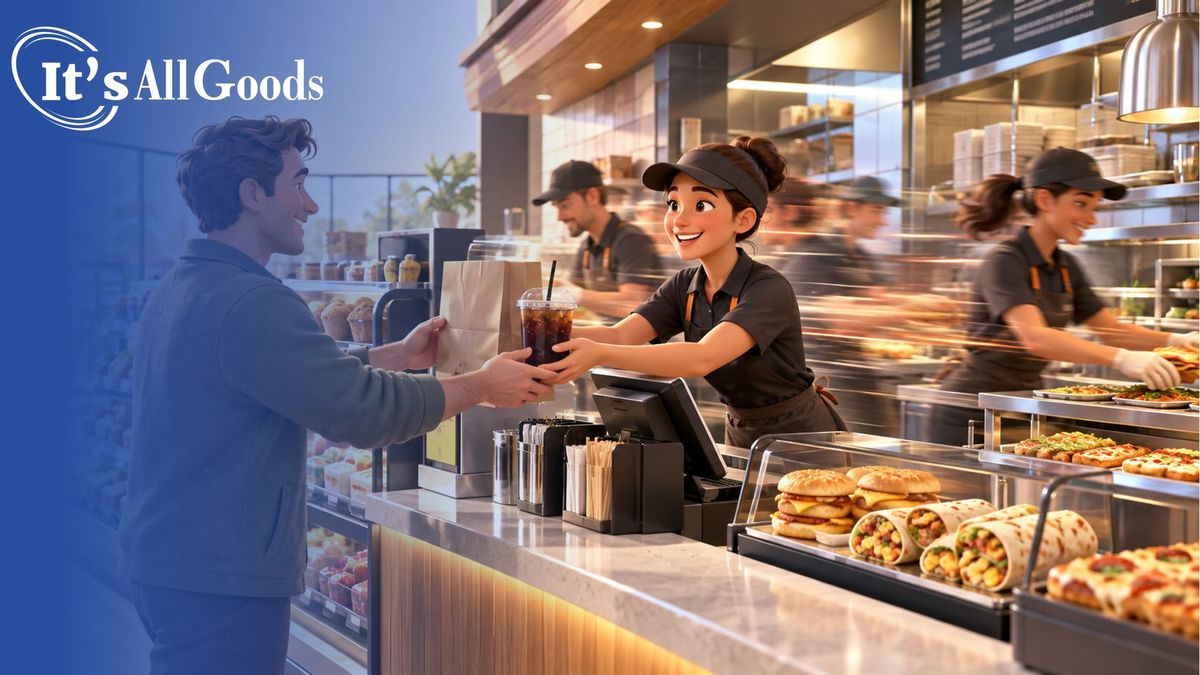
Convenience customers bring a very different time expectation than customers entering a traditional sit-down restaurant. Even when they are purchasing a meal, they are still buying convenience.
NACS research on the modern convenience-store experience notes that its Speed Metrics Study measured the average trip—from leaving the vehicle to returning to it—at just three minutes and 33 seconds. More recent NACS research indicates that most transactions still take less than four minutes, even with the growth of foodservice and the additional preparation time it can require.
That creates a demanding operating environment. A customer may appreciate a made-to-order product, but the added preparation cannot make the overall experience feel inconsistent with the reason the customer chose a convenience store in the first place.
Customers also judge speed comparatively. A c-store meal may compete with a QSR drive-thru, mobile ordering, grab-and-go food, a grocery prepared-food counter, or simply skipping the purchase altogether. When a customer sees an unexpectedly long line or a complicated ordering process, the perceived cost of waiting can outweigh the desire for the food.
Speed, in other words, becomes part of the product.
The financial importance of speed becomes clearer when it is viewed as throughput.
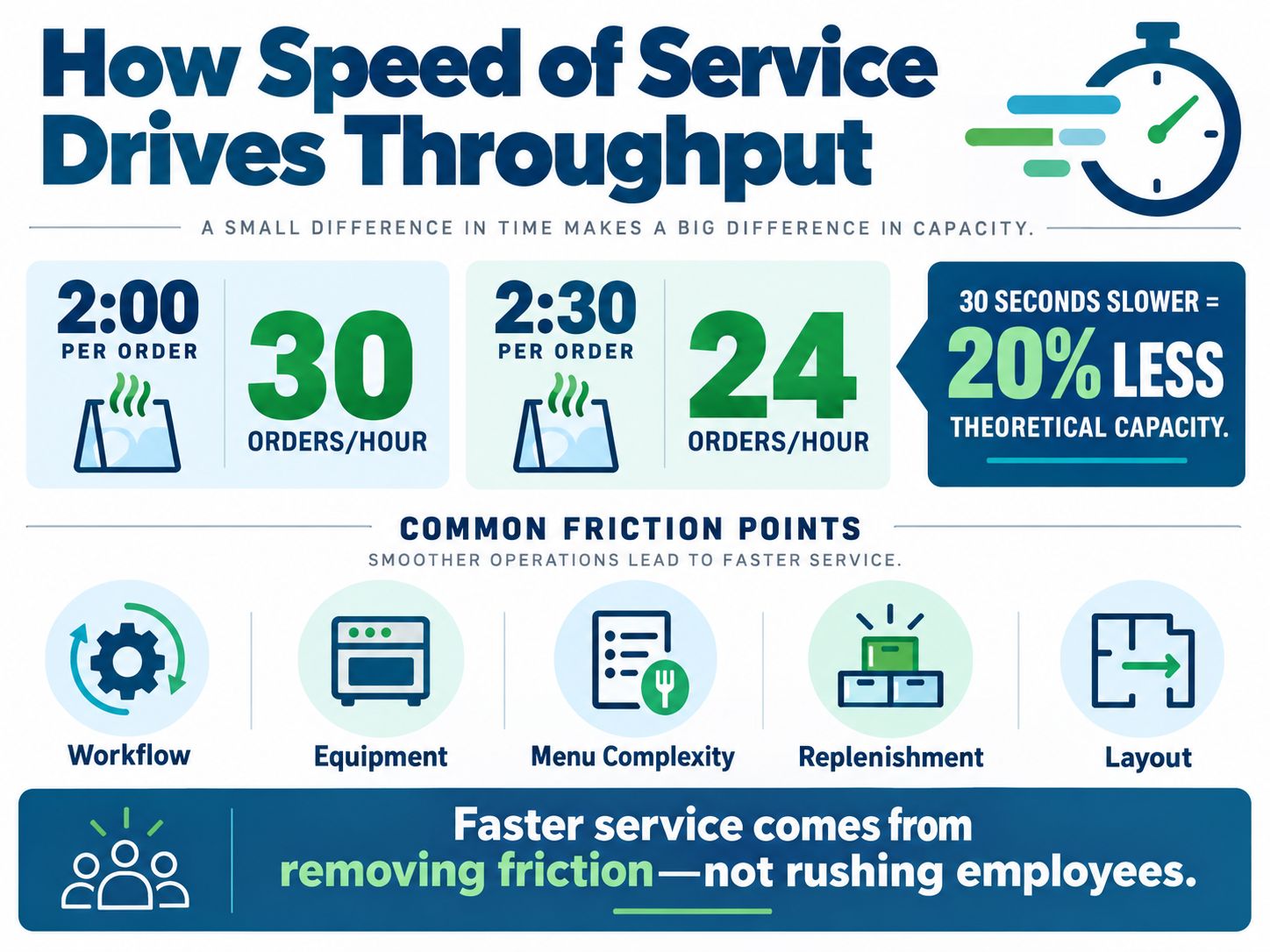
Imagine a made-to-order station capable of completing one order every two minutes. Under ideal conditions, that station has a theoretical capacity of 30 orders per hour. If repeated delays add only 30 seconds to the average order, theoretical capacity falls to 24 orders per hour—a 20% reduction in theoretical capacity.
The effect becomes most important during the periods when demand is highest.
Outside a peak period, an extra minute may simply mean a customer waits a little longer. During the breakfast or lunch rush, however, the same delay can create a queue. Once a queue forms, each additional order enters an already constrained system. Employees may begin working around one another, customers wait longer, mistakes become more likely, and some potential buyers decide not to enter the line.
This is why the economics of speed extend well beyond labor productivity. Throughput determines how much customer demand a store can accommodate while that demand exists.
That matters because foodservice now represents a substantial portion of convenience-store economics. According to NACS 2025 industry performance data, foodservice accounted for 28.5% of in-store sales and 38.9% of in-store gross profit dollars. Prepared food alone represented nearly three-quarters of foodservice sales.
When that much gross profit depends on foodservice, the ability to process customer demand efficiently becomes an economic issue rather than simply an operational preference.
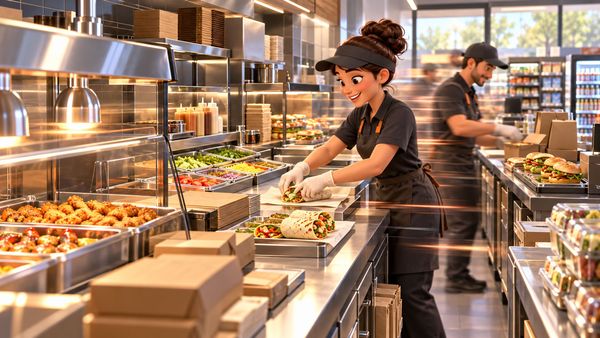
Slow service is often attributed to staffing, but labor is only one part of the equation.
Delays can originate almost anywhere in the operating system. An employee may have to walk across the preparation area to retrieve packaging. A high-volume ingredient may be stored beneath less frequently used items. Two menu items may require the same piece of equipment at the same time. A customized order may introduce several additional decisions. Employees may need to stop production to replenish ingredients, print labels, find utensils, or clarify an order.
None of these activities appears especially significant by itself. Together, they determine the pace of the operation.
The important distinction is between productive time and friction. Cooking a product for the time necessary to achieve the desired quality is productive time. Walking repeatedly between poorly positioned workstations is friction. Completing a required food-safety step is productive. Searching for the correct package is friction.
Retailers that want faster service should therefore resist beginning with the instruction to simply work faster. A more useful question is: What is preventing the work from flowing naturally?
The answer may involve layout, equipment capacity, replenishment practices, menu complexity, order sequencing, packaging, communication, or the number of decisions employees must make during each transaction.
One of the most persistent misconceptions in foodservice is that speed and quality sit at opposite ends of a scale.
Poorly designed speed initiatives can certainly damage quality. Eliminating necessary cooking time, holding food beyond acceptable limits, assembling products carelessly, or pushing employees beyond a sustainable pace may reduce service time temporarily while creating larger problems.
But well-designed speed works differently.
Standardized preparation can make an operation both faster and more consistent. Ingredients positioned at the point of use reduce employee motion without affecting product quality. Batch preparation based on predictable demand can make popular items available quickly while still maintaining freshness standards. Better equipment can shorten production time while improving repeatability.
Menu design plays a role as well. As CSP has reported in its coverage of convenience-store menu simplification, simpler menus can reduce operational complexity, training requirements, and inventory sprawl while improving consistency, speed, and the customer experience.
The real tradeoff is therefore not speed versus quality. It is uncontrolled complexity versus deliberate execution.
Strong throughput begins before the first customer places an order.
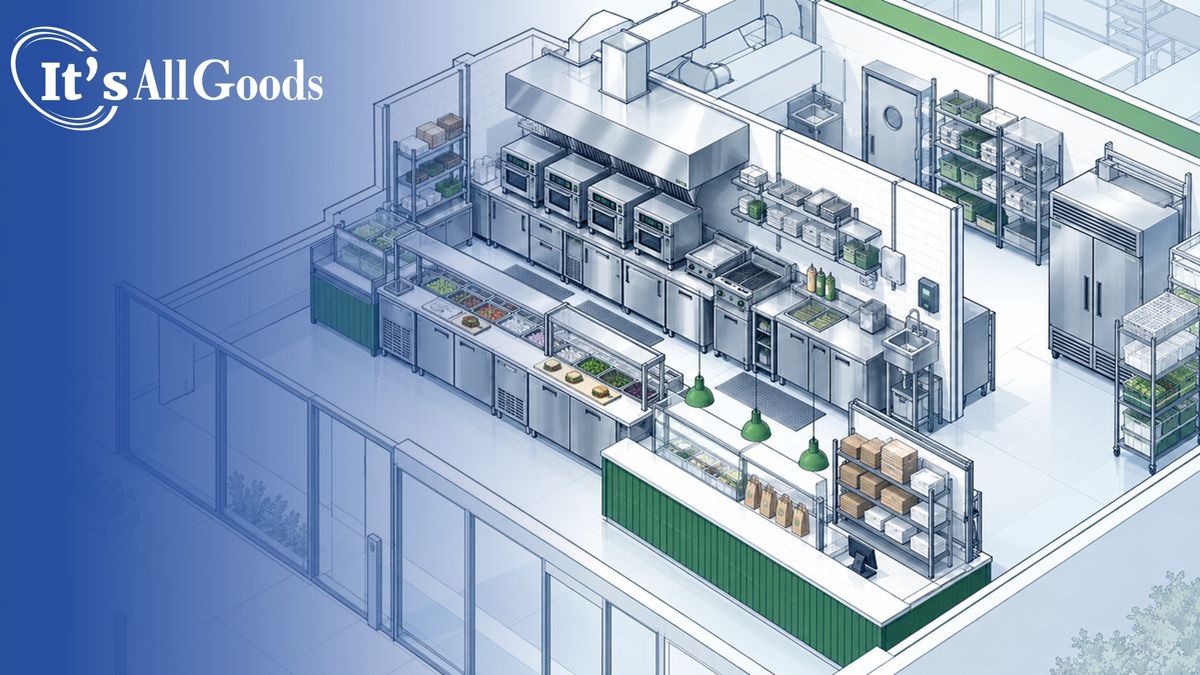
The physical layout should follow the sequence in which work actually occurs. High-use ingredients, packaging, utensils, and equipment should be positioned to minimize unnecessary motion. Prep work that can safely be completed before peak periods should be moved out of the rush. Replenishment should occur before critical ingredients reach empty. Menu items should be evaluated not only for customer appeal and food cost, but also for the amount of operational friction they introduce.
Retailers should also examine how different orders interact. A menu may contain several items that are individually easy to prepare but collectively overwhelm one oven, fryer, toaster, or assembly station during peak demand. In that situation, equipment capacity—not employee effort—sets the upper limit on throughput.
Technology can help when it simplifies the process. Kitchen display systems, mobile ordering, self-checkout, predictive preparation, and automated equipment may remove friction. Technology that adds additional screens, alerts, exceptions, or workarounds can simply move the bottleneck somewhere else.
Building these processes into a repeatable operating system becomes even more important as a foodservice program expands across locations, a challenge examined further in Executing Proprietary Food Programs at Scale.
The broader objective is flow: work entering the system, moving through a predictable sequence, and reaching the customer with as few unnecessary interruptions as possible.
Wawa provides a particularly useful example of treating speed as a design problem rather than an employee problem.
When the retailer was developing its first standalone drive-thru, it used virtual simulation to model the operation before the physical store opened. The model examined process flow, production times, staffing responsibilities, equipment placement, product mix, customer order times, and maximum vehicle capacity during the busiest breakfast and lunch periods.
The simulation exposed operating and design conditions that could slow throughput. Wawa could examine employee movement, workstation assignments, equipment cycles, lane configurations, and product flow before those problems became part of the live operation. The modeling also helped identify menu items that placed disproportionate demands on production and allowed alternative configurations to be tested virtually.
“Wawa hopes to learn from the layout, workflow and traffic flow at this location.”
— Terri Micklin, Director of Construction, Wawa Inc.
That approach illustrates an important principle for any convenience retailer: a bottleneck does not necessarily mean more labor is required. It may mean the work itself needs to be redesigned.
A retailer does not need sophisticated simulation software to apply the same thinking. Observing a lunch rush, timing individual steps, tracking employee movement, identifying equipment queues, and noting when employees stop to replenish supplies can reveal many of the same constraints.
The value lies in diagnosing the system rather than assuming the employee is the problem.
Average service time is useful, but an average can hide the periods that matter most.
A location might post an acceptable daily average while struggling significantly during breakfast and lunch. Those peak periods deserve separate attention because that is when throughput capacity is most likely to affect sales.
Retailers may benefit from tracking several related measures: orders completed during peak periods, average and longest wait times, order accuracy, abandonment or walk-away observations, equipment utilization, and the frequency of production interruptions.
Those measures should be considered together.
A dramatically faster service time is not a success if order accuracy falls. High throughput is not sustainable if employees cannot maintain food-safety or quality standards. Conversely, excellent product execution has limited commercial value if the operation cannot serve enough customers during the periods when demand is strongest.
The objective is reliable capacity: the ability to process the expected volume at an appropriate speed while maintaining the food and service standards customers expect.
Speed of service should be treated as an operating outcome rather than an instruction to employees.
Retailers can improve throughput by examining how orders enter the system, where employees move, which equipment constrains production, when ingredients need replenished, how much customization the menu requires, and where customers encounter unnecessary waiting.
The greatest economic opportunity is often at peak demand. Saving seconds when only one customer is waiting may have little effect on sales. Removing the same delay when ten orders arrive within a short period can increase available capacity, shorten queues, and reduce pressure throughout the operation.
The strongest improvements also tend to reinforce one another. Simpler workflows are easier to train. Better workstation design reduces both movement and mistakes. Appropriate equipment supports more predictable production. Better preparation planning reduces interruptions. A more deliberate menu can simplify inventory as well as service.
Speed works best when it is engineered into the operation.
Speed of service is one of convenience retail’s fundamental competitive advantages, and foodservice must operate within that expectation. As menus become more sophisticated, retailers cannot assume customers will simply accept slower execution.
The strongest foodservice operations create speed through design: simpler workflows, appropriate equipment, thoughtful menus, logical layouts, advance preparation, and fewer unnecessary decisions. When those elements work together, stores can increase throughput while protecting quality—and turn convenience itself into a measurable foodservice advantage.

Subscribe to receive latest news
12968 Vallejo Circle, Westminster CO. 80234
Phone: (303) 604-1064
Contact Us