


trong supplier partnerships are not measured only when shelves are full, deliveries are on time, and demand is predictable. Their real value becomes visible when conditions change: an ingredient is short, a promotion exceeds forecast, a case configuration changes, a truck arrives late, or a retailer begins opening stores in new markets.
For convenience retailers, the goal is to build supplier relationships that reduce the number of problems stores have to solve on their own. That requires more than good communication or favorable pricing. Retailers and suppliers need shared specifications, clear substitution rules, useful demand information, defined escalation paths, and performance measures that connect supply decisions to store execution.
Every dependable supplier relationship begins with a shared definition of what the retailer is buying.
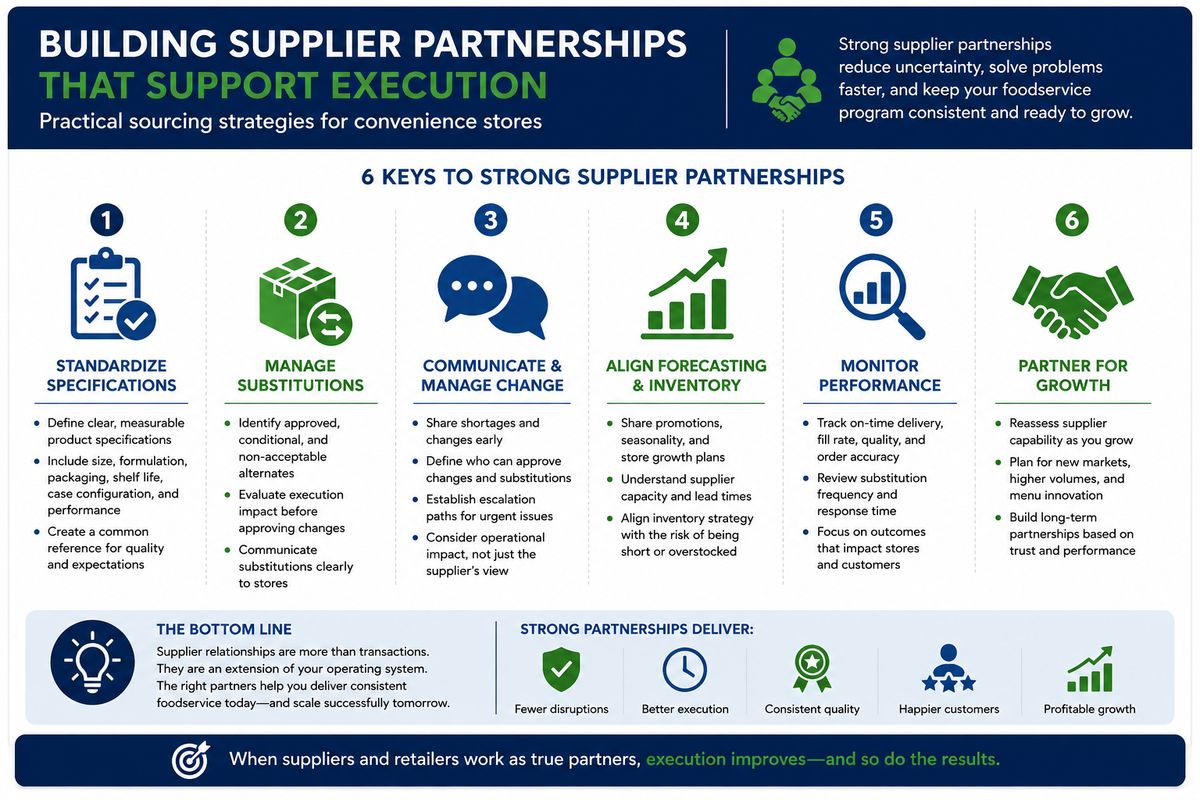
A useful specification describes more than an item name and unit price. Depending on the product, it may include size, weight, formulation, appearance, case configuration, shelf life, storage temperature, preparation requirements, cook yield, portion performance, labeling, and acceptable tolerances. The purpose is to make expectations measurable rather than interpretive.
That matters in foodservice because small product differences can create larger operating effects. A bun that is slightly larger may no longer fit the approved package. A protein with a different cook yield can affect portion cost. A sauce with a different viscosity may change application and finished appearance. A new case pack may consume more refrigerated space than a store can reasonably accommodate.
Specifications also give retailers and suppliers a common reference when something changes. Instead of asking whether a replacement is “close enough,” both sides can determine whether it meets the operating requirements already established.
This discipline is particularly important for proprietary products, where the retailer owns the customer experience and supplier variation can quickly become brand variation. It’s All Goods explores that relationship in Executing Proprietary Food Programs at Scale.
Clear specifications do something else as well: they make supplier performance easier to evaluate. When requirements are written and measurable, a quality discussion can focus on whether the product met the agreed standard rather than on competing interpretations of what “acceptable” means.
Substitutions are sometimes unavoidable. Unplanned substitutions are not.
Retailers should decide in advance which products can be replaced, what constitutes an acceptable alternative, and who has authority to approve the change. A common commodity item may have several acceptable sources. A signature sauce, proprietary bakery item, allergen-sensitive ingredient, or product designed around specific equipment may require much tighter control.
The most important question is not whether the substitute can be purchased. It is whether the substitute can be executed.
A replacement can affect preparation time, portion yield, packaging, labeling, food-safety documentation, shelf life, storage, or the way the finished item looks and tastes. Those effects should be evaluated before the product reaches stores whenever possible.
A practical substitution system can place products into three categories: approved alternates that may be used immediately, conditional alternates that require review, and items for which no substitute is acceptable. That gives procurement flexibility without shifting uncontrolled decisions to store employees.
Retailers should also decide how stores will be informed when a substitution is approved. If employees need different preparation steps, portioning instructions, storage procedures, or labeling information, those changes should arrive with the replacement product rather than after employees discover the difference themselves.
The objective is not to eliminate variation from the supply chain. It is to control how that variation reaches the customer.
Supplier problems often become store problems because information arrives too late.
Retailers should establish clear communication expectations for shortages, discontinued items, formulation changes, case-pack changes, delayed deliveries, quality concerns, and other events that can affect execution. Suppliers, in turn, need to know who within the retailer can approve changes, revise forecasts, authorize substitutions, or escalate operational issues.
Change management should focus on operational impact. A manufacturer may view a packaging revision as minor, while the retailer discovers that the new case no longer fits a shelf or that a different label placement slows production. A delivery-window adjustment may look insignificant at the distribution level but interfere with a store’s production schedule.
Strong partnerships therefore need both routine communication and an escalation process. Routine updates can follow normal purchasing and account-management channels. Events that threaten availability, food safety, product quality, or store execution should move through a faster path with clearly identified decision-makers.
The earlier those effects are communicated, the more likely the retailer can solve them centrally rather than asking individual locations to adapt independently.
Communication is especially important when several companies participate in the supply chain. Manufacturers, distributors, brokers, and retailers may each see a different part of the problem. The strongest supplier relationships create enough visibility across those roles to keep an issue from disappearing between organizations.
Suppliers cannot plan effectively when important changes in demand remain invisible.
Convenience retailers should share information that materially affects volume: promotions, seasonal changes, store openings, new menu launches, local events, limited-time offers, and major assortment changes. Suppliers should provide comparable visibility into lead times, manufacturing constraints, order minimums, available capacity, and known supply risks.
The goal is not perfect forecasting. It is fewer avoidable surprises.
Wawa offers a useful current example. In 2025, the retailer selected RELEX to deploy machine-learning-based forecasting and replenishment capabilities across approximately 1,100 stores. The initiative was designed to support growth, automate manual processes, maintain product availability and freshness, and reduce spoilage. Explore Wawa Selects RELEX Solutions to Boost Forecasting and Replenishment Effectiveness for additional insight.
The example connects forecasting directly to foodservice execution. Better demand signals can help retailers carry enough product to serve customers without creating unnecessary fresh-food waste.
Forecasting becomes most useful when it influences actual decisions. A high-volume core ingredient may justify additional safety stock or supplier capacity planning. A short-life fresh product may require tighter replenishment and smaller buffers. A limited-time item may need explicit exit planning so the retailer does not solve an out-of-stock problem by creating a waste problem.
Inventory strategy should reflect the operational consequence of being wrong in either direction.
Wawa also illustrates how a supplier relationship can evolve with the retailer rather than remain static.
In April 2025, Wawa and McLane expanded a partnership that had already lasted more than 20 years. McLane was servicing more than 1,100 Wawa stores from distribution centers in Kentucky, Virginia, New Jersey, and Florida, while additional capacity was being used to support Wawa’s growth in the Midwest, Mid-Atlantic, and Northeast. NACS reported that the expanded relationship was intended to support on-time deliveries, order fill rates, cold-chain performance, and expansion into new markets.
“As Wawa expands into new markets, our partnership with partners like McLane helps us scale our best-in-class foodservice program, support our growth.” — Brian Schaller, President, Wawa
The lesson is not that every convenience retailer needs a national distributor or a sophisticated technology platform. It is that supplier capability has to grow with the operating model.
A partner that performs well for 20 stores may not automatically be the right fit for 100. Geographic coverage, manufacturing or distribution capacity, technology, lead times, contingency plans, delivery frequency, and communication requirements should be reconsidered as the food program expands.
A strong supplier partnership is therefore not static. It should develop alongside the retailer.
Supplier relationships improve when both sides can see what is actually happening.
Price should remain part of supplier evaluation, but it is only one measure. Foodservice retailers may also need to monitor fill rate, on-time delivery, order accuracy, product defects, shelf life remaining at receipt, substitution frequency, response time, credits, recurring shortages, and store complaints.
The best measures are the ones that reveal operating consequences.
A supplier can technically fulfill an order while consistently delivering product with too little shelf life. A distributor may post strong overall service levels while one critical foodservice item repeatedly shorts. A lower-cost product may generate more waste or require more labor to prepare.
Those issues can disappear when supplier reviews focus primarily on annual volume and purchase price.
Performance reviews should be collaborative enough to identify causes rather than simply assign blame. A recurring shortage may reflect supplier capacity, but it may also result from inaccurate forecasting or late promotional communication from the retailer. A quality problem may be a manufacturing issue—or evidence that the specification itself is unclear.
Retailers should also look for patterns across stores. One isolated complaint may require a local correction. The same complaint appearing repeatedly across multiple locations suggests a system problem worth addressing with the supplier.
The purpose of measurement is not to create a punitive scorecard. It is to make recurring problems visible early enough to fix them.
Practical Takeaways
Retailers do not need an elaborate supplier-management bureaucracy to improve execution. They do need a few disciplines that are applied consistently:
These practices turn supplier management from a series of purchasing transactions into a repeatable operating system.
They also make the relationship more useful to the supplier. Clear expectations, better forecasts, and direct performance feedback give manufacturers and distributors better information for planning capacity, inventory, and service improvements.
Strong supplier partnerships make foodservice easier to execute because they reduce uncertainty. Stores receive more predictable products, substitutions are controlled, changes are communicated earlier, inventory decisions are better informed, and recurring problems become visible before workarounds become normal procedure.
The best supplier is not simply the company that offers the lowest price or the broadest catalog. It is the partner that can reliably support the retailer’s specifications, operating realities, growth plans, and customer promise.

Subscribe to receive latest news
12968 Vallejo Circle, Westminster CO. 80234
Phone: (303) 604-1064