


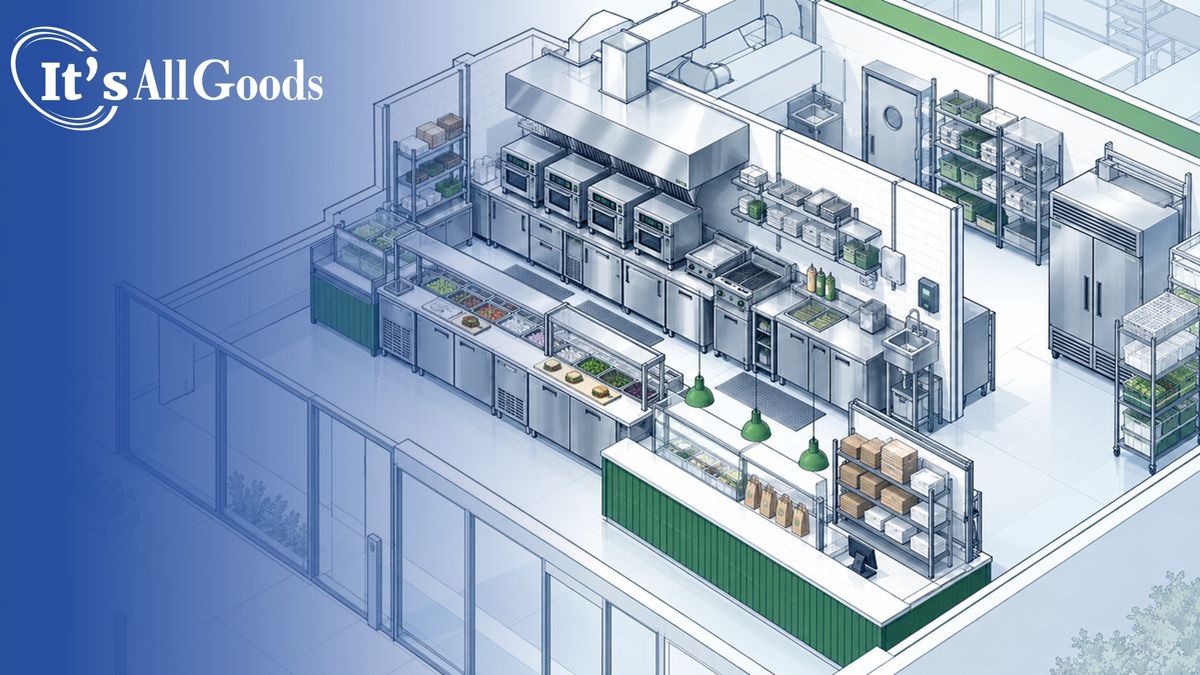
lunch rush can overwhelm a convenience-store kitchen even when every employee is working continuously. One person searches for packaging, another waits for an oven, and a third interrupts assembly to answer a pickup question. The team is busy, but completed orders leave the counter unevenly. Adding another employee may provide relief, yet the underlying interruptions remain.
Improving throughput begins with understanding how work moves through the store. Operators can often recover capacity by removing unnecessary steps, preparing stations more effectively, and matching menu demands to available equipment. The objective is more accurate, completed orders from the labor hours already scheduled. That requires examining the process closely enough to distinguish avoidable delays from a genuine staffing shortage.
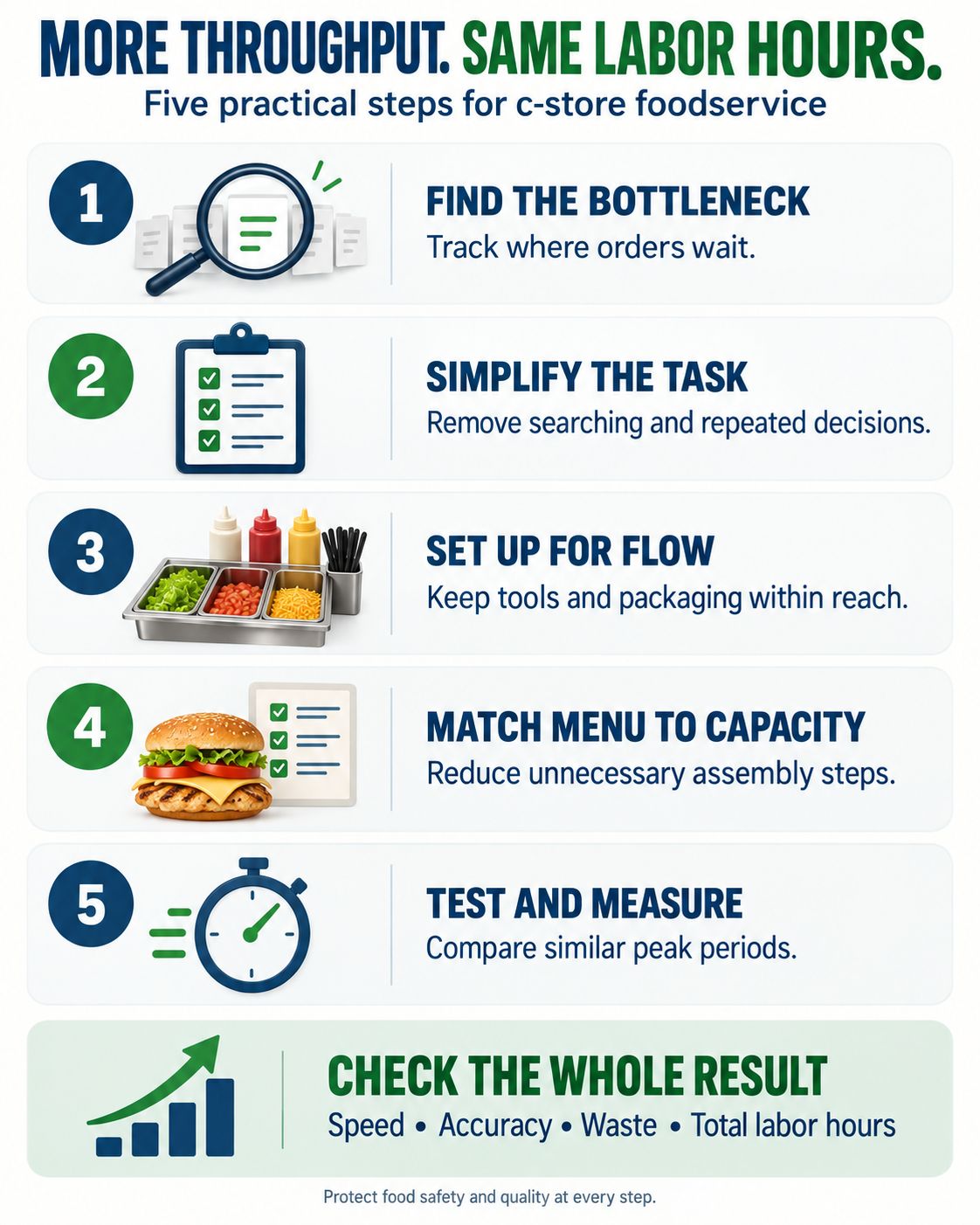
Start by observing a complete peak period. Follow orders from acceptance through preparation, cooking, assembly, packaging, and handoff. Record where they wait, what employees are doing during those waits, and which interruptions recur. Include mobile orders and delivery pickups; the physical queue rarely represents the entire workload.
The bottleneck is the stage that limits completed output under those conditions. It may be a shared oven, a crowded assembly station, or an employee handling both payment and final packaging. A visible line at the register does not automatically mean checkout is the underlying problem.
Separate active work from waiting. An order that takes six minutes may require relatively little hands-on preparation but spend several minutes awaiting equipment or missing ingredients. Improving a task elsewhere in the kitchen will accomplish little if every order still reaches the same blocked station.
Ask employees what repeatedly forces them to stop. Their answers help explain timing observations and identify fixes that a manager watching briefly might miss.
Once the constraint is clear, examine the work surrounding it. Can packaging be replenished before the rush? Are frequently used ingredients positioned in assembly order? Does each employee know who handles restocking, exceptions, and final handoff?
The Lean Enterprise Institute describes standardized work through work sequence, the pace required to meet demand, and the inventory needed to keep operations moving. Its value includes reducing variation and creating a baseline for improvement. Applied to c-store foodservice, the principle supports a repeatable method that employees can learn and refine.
Create short, visual instructions for high-volume items. Show ingredient quantities, assembly sequence, packaging, and the final accuracy check. Keep the instructions at the workstation where they are used.
Then remove repeated decisions that add little customer value. Consistent utensil locations, clearly identified containers, and a standard place for completed orders reduce searching and clarification. Preserve necessary sanitation, allergen, and quality steps. A process is only simpler if employees can execute it reliably without creating downstream corrections.
Evaluate equipment as part of the full production sequence. A fast cooking cycle offers limited benefit if loading is awkward, the landing area is congested, or finished food waits for packaging. Observe loading, unloading, recovery between cycles, and cleaning requirements alongside nominal cook time.
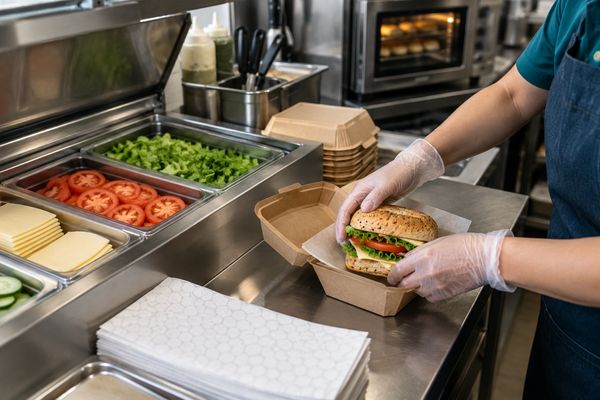
Trace employee movement during a representative order. Repeated trips for bags, lids, or utensils reveal opportunities to reposition supplies. Keep frequently used materials near their point of use while maintaining appropriate storage, separation, and access.
Protect the constrained station from avoidable interruptions. If the oven operator repeatedly leaves to replenish containers, assign replenishment to a defined moment or another existing role when workload permits. Check that this reassignment does not create a new queue elsewhere.
Maintenance also belongs in the throughput discussion. Before considering another machine, verify that existing equipment performs as intended and that approved operating programs match the menu. Capital investment should address a demonstrated capacity problem.
Review menu items according to their demands during peak service. Sales volume and ingredient margin matter, but so do assembly touches, specialized packaging, unique ingredients, and time occupying shared equipment.
An item with modest sales can still disrupt the line if it requires employees to leave their stations or change an established sequence. Compare its contribution with the work it creates before deciding whether to simplify, reposition, or remove it.
Customization deserves the same scrutiny. Clear choices and shared ingredients can preserve customer flexibility while making orders easier to interpret. Review combinations that routinely trigger questions, remakes, or additional preparation.
Preparation timing matters as much as menu size. Move suitable replenishment and setup work ahead of predictable demand within established food-safety and quality procedures. Account for those hours when measuring productivity. Moving work earlier can protect the rush, but it does not make the work disappear.
Chipotle offers a documented example of coordinating incoming orders with production capacity. In its 2017 announcement about digital order wait times, the company described technology that monitored digital order capacity and scheduled pickup times around work flowing into a second make-line.
“We have been evaluating all of our digital offerings with an eye toward removing friction,” Curt Garner, then Chipotle’s chief information officer.
The company reported digital wait-time reductions of as much as 50% in tests. That result was specific to Chipotle’s initiative; the announcement did not establish that it occurred without additional labor.
For convenience retailers, the transferable lesson is to coordinate order commitments with kitchen capacity. A store may not have space for a second line, but it can establish clear order sequencing and a designated pickup location. Where ordering systems support it, realistic pickup estimates can help prevent incoming digital work from overwhelming an already committed station. These practices should be tested against each store’s actual workload.
Establish a baseline before making changes. Track completed orders during comparable peak intervals, elapsed time from order acceptance to handoff, and foodservice labor hours. Define each measure consistently so a faster result reflects an operational improvement rather than a different counting method.
Look beyond average ticket time. Track the slowest orders or the 90th-percentile time—the point at or below which 90% of orders are completed. An average can improve while a meaningful group of customers still experiences excessive waits.
Pair speed measures with order accuracy, remakes, waste, and customer complaints. Include preparation and cleanup labor, and note whether the menu mix or order volume changed. Otherwise, a quieter day or simpler tickets may appear to validate a weak intervention.
Test one meaningful change at a time across several comparable shifts. Review the findings with employees, adjust the method, and document what works. If the bottleneck moves, observe the new constraint before starting another improvement.
Improving throughput without adding labor starts with making existing work easier to complete. Identify the limiting station, remove recurring interruptions, simplify execution, and align the menu with available capacity. Judge the result through completed orders, dependable service times, accuracy, and the full labor requirement.
These changes have limits. If demand consistently exceeds a well-organized kitchen’s safe capacity, additional staffing, equipment, or a narrower offer may be necessary. Careful process improvement gives operators the evidence to make that decision—and helps ensure any investment supports a workflow that already makes sense.

Subscribe to receive latest news
12968 Vallejo Circle, Westminster CO. 80234
Phone: (303) 604-1064
Contact Us