

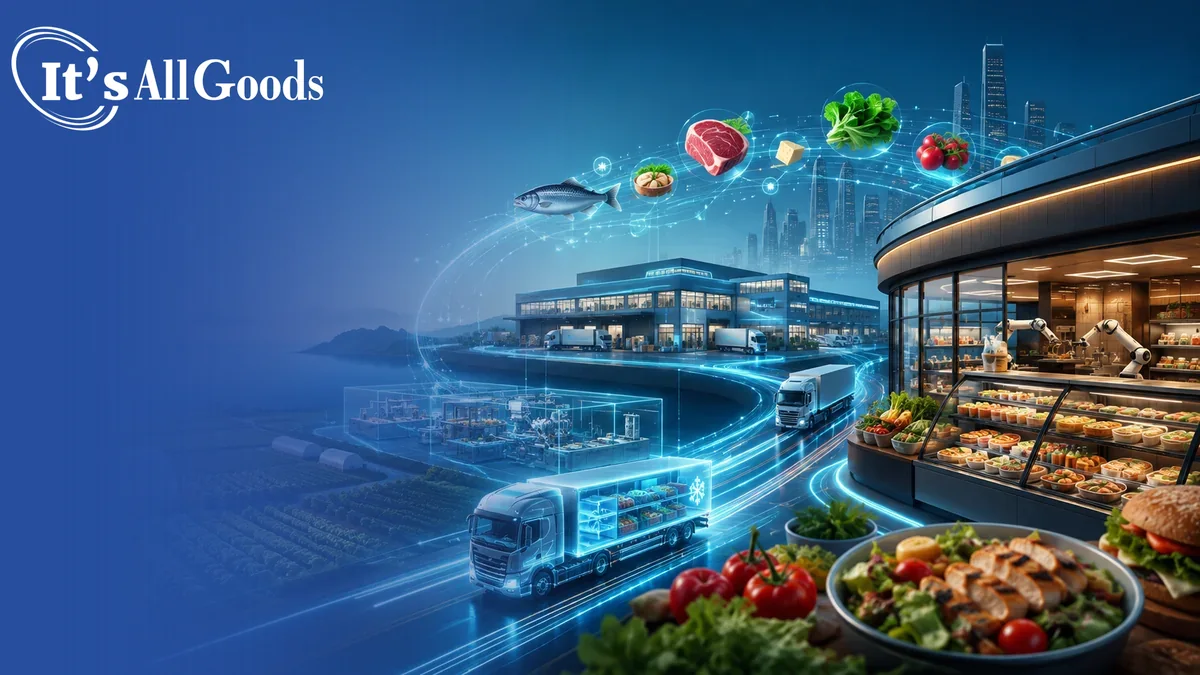
oodservice performance begins long before an employee assembles a sandwich, portions a bowl, or places a pizza in the oven. Behind every menu item is a chain of sourcing decisions involving ingredients, packaging, distributors, manufacturers, delivery schedules, specifications, substitutions, and contingency plans.
For convenience retailers, supplier strategy is therefore not simply a purchasing function. It is an operating decision. The suppliers a retailer chooses—and the way those relationships are structured—can determine whether stores receive the right products at the right time, whether employees can follow standardized procedures, and whether customers receive the same experience from one location to the next.
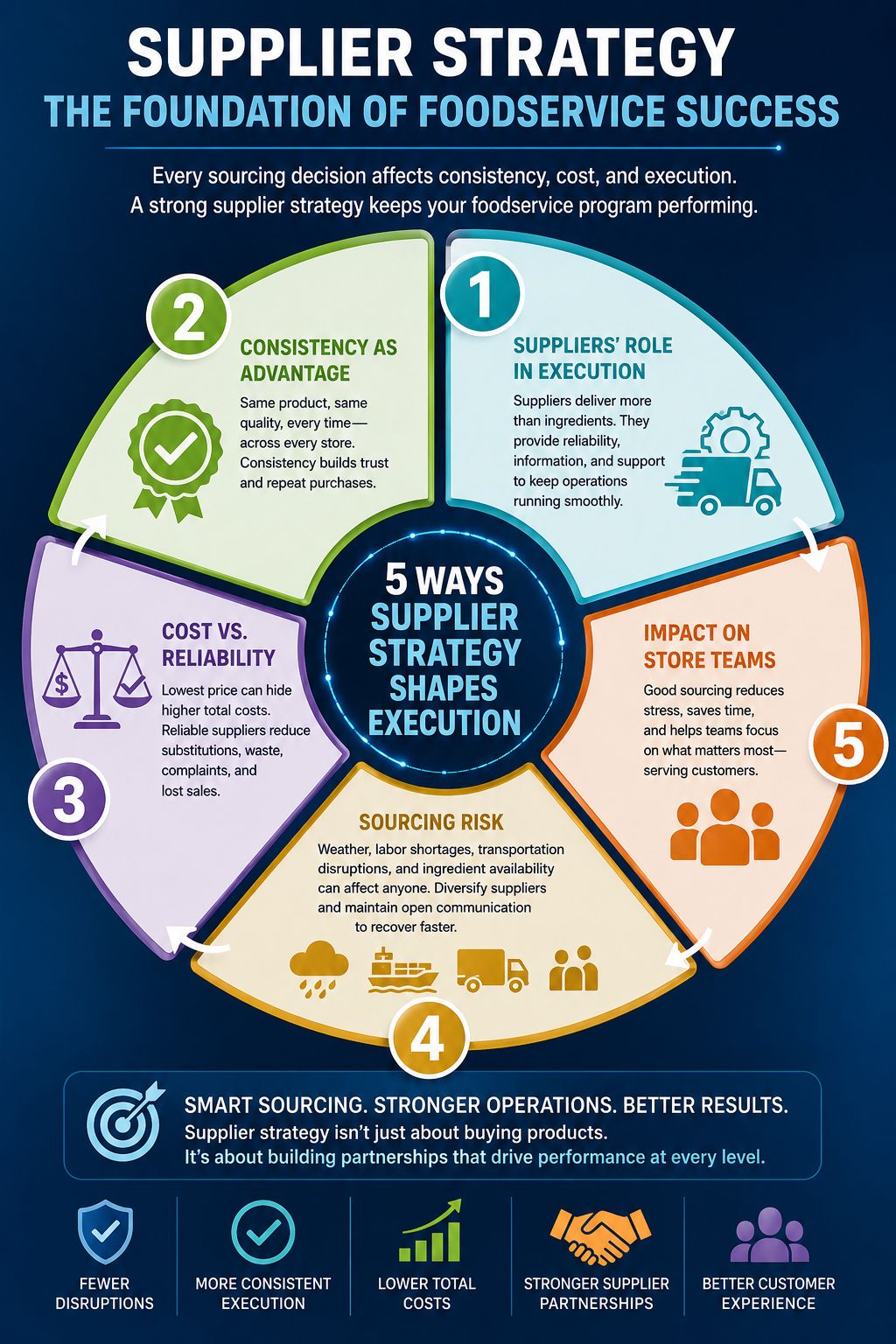
Suppliers influence far more than ingredient cost. They affect availability, product quality, package performance, shelf life, delivery frequency, storage requirements, preparation procedures, food-safety documentation, and the amount of flexibility stores have when demand changes.
A foodservice program can be well designed on paper and still perform poorly if the supply system behind it is unreliable. A breakfast sandwich that depends on a particular bread, protein, cheese, wrapper, and preparation format becomes difficult to execute when one component repeatedly arrives late or varies from specification.
The same problem becomes more significant across a multiunit network. One substitution may look insignificant to procurement but create additional prep work in hundreds of stores. A different case configuration may no longer fit existing storage. A packaging change may interfere with labeling or holding procedures.
Understanding the different responsibilities of manufacturers, distributors, and brokers is part of that system design. It’s All Goods explains how a broker and distributor play distinct roles in bringing products to market in What Is the Difference Between a Food Broker and a Food Distributor?
The supplier relationship is therefore part of the operating system. Strong suppliers help retailers translate menu standards into repeatable store-level performance.
Customers generally do not know which distributor delivered the ingredients or which manufacturer produced a component. They simply know whether the food tastes the same as it did last time.
That makes sourcing consistency a customer-facing issue.
Standard specifications help define what an approved product should be, but supplier capability determines whether those standards can be maintained in practice. Size, weight, formulation, packaging, shelf life, cooking performance, and portion yield all influence the final product.
In a convenience environment, those variables also affect labor. Employees working under time pressure need predictable ingredients and packaging. If products arrive with inconsistent dimensions or preparation characteristics, store teams compensate manually. The more compensation required, the harder it becomes to maintain speed and consistency.
Reliable sourcing therefore protects more than quality. It protects the simplicity of the operation.
Purchase price matters, but the lowest invoice price is not always the lowest operating cost.
A supplier that saves a few cents per unit but produces frequent out-of-stocks, short-dated inventory, inconsistent case packs, or emergency substitutions may create expenses elsewhere. Stores may lose sales, increase waste, spend additional labor adapting procedures, or disappoint customers when advertised products are unavailable.
Freight is another factor. So are minimum orders, lead times, storage requirements, spoilage, credits, administrative effort, and the amount of safety stock required to compensate for inconsistent delivery.
This is why supplier evaluation should consider total value rather than unit cost alone. NACS’ discussion of Krispy Krunchy Chicken’s operating model shows how menu simplification, logistics, sourcing, labor pressure, and food waste can be tightly connected rather than treated as separate issues in Optimizing the Foodservice Formula
The strongest sourcing decision is often the supplier that produces the best combination of price, reliability, product performance, responsiveness, and operational fit.
No supplier network is immune to disruption. Weather, transportation interruptions, labor shortages, manufacturing problems, raw-material constraints, equipment failures, regulatory issues, and sudden demand changes can all affect availability.
The objective is not to eliminate every risk. It is to prevent foreseeable disruptions from becoming store-level crises.
That may mean approving alternate suppliers in advance, defining acceptable substitutions, maintaining clear specifications, understanding lead times, monitoring critical ingredients, and knowing which menu items depend on a single source.
Diversification can help, but more suppliers are not automatically better. Multiple sources may increase resilience while also increasing complexity, variation, and administrative work. The correct balance depends on the importance of the item, the availability of substitutes, geographic coverage, volume, and the consequences of interruption.
Krispy Krunchy Chicken offers a practical example. The company moved from 14 independent distributors to one national distribution partner supported by approximately 70 local suppliers. NACS reported that the change moved product closer to individual markets, improved shelf life, reduced freight pressure, and made recovery from disruptions easier in Enhancing Foodservice Through a Streamlined Supply Chain
“One of the things we heard from operators was that our model just had to be simpler.”— Jim Norberg, CEO, Krispy Krunchy Chicken
That statement captures an important point: supply complexity eventually reaches the store.

When suppliers perform consistently, stores can focus on customers.
When they do not, store teams become the last line of defense for problems created elsewhere in the system.
A missing ingredient may force a manager to remove an item from the menu. A substitute may require employees to change portions or preparation steps. A late truck may interfere with production planning. Damaged or short-dated product may create waste. Packaging inconsistencies may slow assembly.
These are not abstract supply-chain problems. They consume store labor.
The burden is particularly significant in convenience retail, where foodservice employees may already be balancing preparation, cleaning, customer service, stocking, and other store responsibilities. Every sourcing exception introduces another decision.
Good supplier strategy minimizes those decisions by establishing clear specifications, dependable communication, and defined responses before problems reach the store.
Supplier strategy is not only defensive.
Strong relationships can help retailers identify better ingredients, improve packaging, test new concepts, simplify preparation, respond to market changes, and find alternatives when an existing product becomes difficult to source.
An experienced manufacturer may understand formulation or production constraints that are not obvious to the retailer. A distributor may recognize that an item will be difficult to handle efficiently at the case level. A broker may help coordinate communication among manufacturers, distributors, and retail buyers.
That collaboration can be especially valuable as convenience retailers expand fresh-food assortments and proprietary programs. The earlier suppliers are included in operational planning, the more likely a new product is to be designed for actual execution rather than merely approved as a concept.
Supplier strategy quietly shapes almost every part of convenience-store foodservice.
The right sourcing system helps retailers maintain product consistency, protect availability, manage cost, reduce store-level exceptions, and respond more effectively when disruptions occur. The wrong system can make even a well-designed menu difficult to execute.
Retailers should therefore evaluate suppliers as operating partners rather than simply sources of product. Price remains important, but so do specifications, delivery performance, contingency planning, communication, geographic coverage, responsiveness, and the ability to support the food program as it grows.
The best supplier strategy is not necessarily the least expensive or the most complex. It is the one that makes consistent foodservice easier to deliver.

Subscribe to receive latest news
12968 Vallejo Circle, Westminster CO. 80234
Phone: (303) 604-1064