

proprietary food product can be distinctive, appealing, and profitable in a test kitchen and still fail when it reaches a network of convenience stores. The challenge is not simply creating a product customers want. It is creating a system capable of producing, distributing, merchandising, preparing, and selling that product consistently across locations with different volumes, staffing levels, equipment, and operating conditions.
That distinction becomes increasingly important as convenience retailers build food identities around products customers cannot purchase elsewhere, a strategic advantage explored in Why Private Label Food Matters in Convenience Store Foodservice.
Scaling proprietary food therefore requires more than a strong recipe. It requires disciplined sourcing, clear specifications, reliable distribution, practical store procedures, effective packaging, food-safety controls, and continuous measurement.
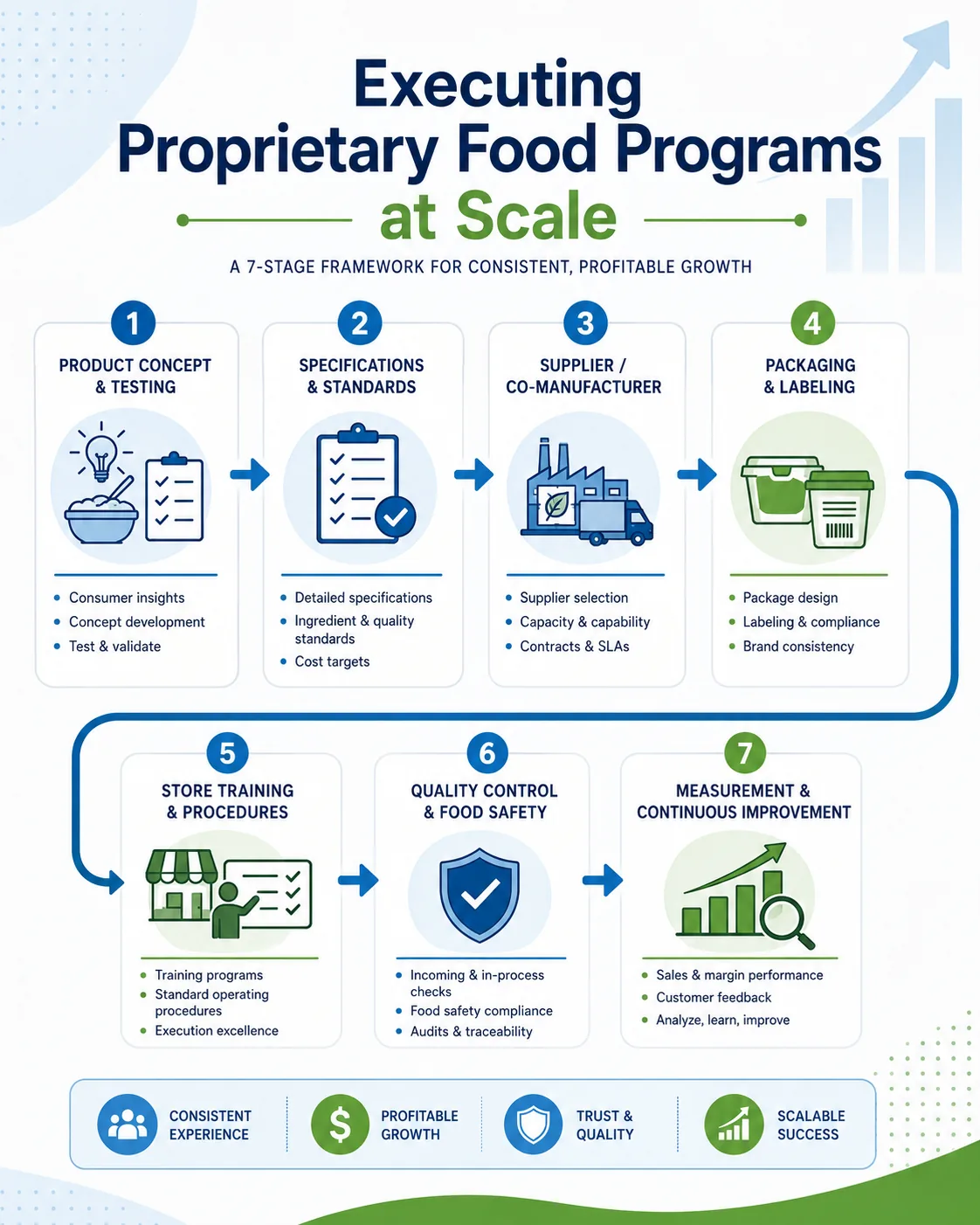
The first question in proprietary product development should not be whether an item works under ideal conditions. It should be whether it works inside the actual convenience-store environment.
Stores operate with limited labor, changing dayparts, small preparation areas, varying demand, and employees managing several responsibilities simultaneously. Products requiring too many preparation steps, specialized skills, difficult cleanup, or narrow holding windows can become inconsistent quickly.
Successful proprietary products are designed with those realities in mind.
That may mean simplifying ingredient assemblies, using pre-portioned components, designing processes around existing equipment, or creating different preparation methods for high- and low-volume stores. Retailers should also evaluate how long an item can maintain acceptable quality after preparation and whether its appearance, texture, temperature, and portion remain consistent through the full customer experience.
Testing should involve actual stores rather than only culinary development environments. Pilot locations reveal operational problems that are difficult to anticipate on paper: an ingredient that takes too much refrigerated space, packaging that slows production, preparation steps that create bottlenecks, or products that perform well during lunch but poorly during slower dayparts.
A proprietary concept becomes scalable only when the operating model is as carefully developed as the product itself.
A recipe describes ingredients and preparation. A scalable proprietary program needs something more precise: specifications.

Ingredient specifications establish acceptable size, weight, composition, flavor, appearance, packaging, storage requirements, and other characteristics. Finished-product standards define portion size, assembly, cooking procedures, holding times, presentation, and acceptable quality.
Without that level of definition, variability enters the system quickly.
A sandwich may receive different amounts of protein from store to store. Pizza sauce may be applied inconsistently. Bakery items may be held too long. A replacement ingredient may technically fit the recipe while changing flavor or texture enough for customers to notice.
Specifications also become essential when working with co-manufacturers and suppliers. If a manufacturer is producing a retailer-exclusive sauce, dough, protein, bakery item, or packaged product, the retailer needs measurable standards for what constitutes an acceptable product.
That discipline protects the brand while making supplier performance easier to evaluate.
Private-label and proprietary programs deepen the retailer’s dependence on its supply network.
With a widely distributed national brand, an interruption may sometimes be addressed through another distributor or substitute product. A proprietary item is harder to replace because its ingredients, formulation, packaging, or appearance may be unique.
Retailers should therefore evaluate suppliers on more than unit cost. Capacity, geographic coverage, food-safety systems, quality assurance, lead times, contingency planning, communication, and the ability to accommodate growth all matter.
Production minimums are another consideration. Smaller convenience retailers may not have sufficient volume for large manufacturers, while rapidly growing chains may outgrow suppliers that worked well during early development. NACS has previously noted that smaller retailers unable to meet large production minimums can sometimes build private-brand programs by working with smaller manufacturers and growing together.
Redundancy should also be considered for critical ingredients. A retailer does not necessarily need two suppliers for every item, but it should understand what happens if the primary source becomes unavailable. That may include approved alternate suppliers, predetermined substitute ingredients, emergency menu modifications, or temporary suspension procedures.
The objective is not eliminating supply risk. It is preventing a supply interruption from forcing stores to improvise independently.
Packaging is sometimes treated as a final branding decision after the food has already been developed. At scale, it should be considered much earlier.
The package must fit the product, operating process, merchandising environment, and customer occasion.
Hot foods need packaging that maintains temperature without destroying texture. Fried foods may require ventilation. Chilled foods need visibility without excessive condensation. Saucy products need secure seals. Grab-and-go foods must remain attractive through the intended shelf life. Mobile orders and delivery introduce additional requirements for tamper evidence, transport, stacking, and leak prevention.
NACS Magazine has highlighted how packaging increasingly functions as part of the food itself—protecting quality, supporting food safety, communicating the brand, and determining how well products survive travel beyond the store.
For proprietary products, packaging also provides one of the strongest opportunities for reinforcing ownership. Color, logo treatment, naming, and visual consistency can connect individual products into a recognizable food program.
But branding cannot compensate for poor performance. A beautifully branded container that produces soggy food or leaks in the customer’s vehicle damages the same brand it was designed to promote.
As retailers assume greater ownership of proprietary products, food-safety and labeling responsibilities become increasingly important.
Retailers need visibility into allergens, ingredient changes, storage requirements, preparation temperatures, shelf life, sanitation procedures, and supplier controls. When foods are packaged and labeled for retail sale, federal requirements may apply to ingredient and allergen declarations depending on how the product is prepared and sold.
FDA guidance identifies nine major food allergens and requires packaged foods subject to federal labeling requirements to properly disclose applicable allergens. Those requirements extend to certain foods packaged and labeled by retail and foodservice establishments, although foods placed into containers after a customer’s order are treated differently.
That means product development, operations, food safety, procurement, and marketing cannot work independently. A recipe change may affect allergen declarations. A packaging change may affect labeling space. A supplier substitution may require documentation updates. A new preparation process may change food-safety controls.
The earlier those functions are coordinated, the less likely stores are to receive conflicting information after rollout.
Execution ultimately reaches the employee.
A product that requires employees to interpret complicated documentation during busy periods is unlikely to remain consistent at scale. Procedures should translate specifications into clear actions employees can perform quickly.
That may include visual build guides, portioning tools, preparation timers, color-coded utensils, equipment presets, digital checklists, and concise workstation instructions.
Training should also reproduce the real work environment. Employees need to know not only how the product is prepared correctly, but what to do when something goes wrong.
What happens when an ingredient does not arrive? When equipment is unavailable? When a product has exceeded its holding time? When packaging runs out? When an employee notices that an ingredient looks different from the approved product?
Clear exception procedures matter because uncontrolled improvisation is one of the fastest ways for a proprietary program to lose consistency.
Store managers also need defined ownership. Someone should be responsible for monitoring product availability, preparation standards, waste, holding times, merchandising, and corrective action rather than assuming the food program will maintain itself.
Pilot offers a useful current example of how a large convenience and travel-center operator is structuring a proprietary food program for scale.
In March 2026, Pilot introduced Pilot eats, a proprietary food brand intended to create greater consistency in how the company’s food looks, feels, and travels throughout its network. The company divided the platform into two formats: the fuller Pilot eats concept and Pilot eats Express, designed for locations requiring a faster grab-and-go approach. The planned rollout extends the full hot-deli program to approximately 400 travel centers, with the Express concept targeting roughly another 200 locations.
The distinction is important. Scaling does not necessarily mean forcing every store into an identical operating model. Different footprints and customer occasions may require different assortments, packaging, and service approaches while still operating under a common proprietary brand.
Sean Marrero, Pilot’s senior vice president of food and beverage, described the challenge this way:
“How do we deliver the consistency of messaging to drivers at different locations that may have a different footprint experience?”
Pilot’s approach connects product, packaging, signage, store format, mobile ordering, and rewards rather than treating proprietary food as an isolated menu initiative.
That is a useful model for retailers of any size. Consistency should apply to the customer promise, but the operating system may need enough flexibility to accommodate differences among locations.
Once a proprietary program is operating across multiple stores, retailers need a feedback system capable of distinguishing isolated mistakes from systemic weaknesses.
Sales and gross margin are important, but they are not sufficient.
Retailers should also monitor waste, out-of-stocks, preparation time, audit results, customer complaints, equipment issues, temperature deviations, supplier defects, and store-level variation.
If one product generates significantly more waste at low-volume stores, the problem may be production planning rather than customer acceptance. If complaints are concentrated in one region, distribution or supplier performance may be involved. If one preparation step produces repeated audit failures, the procedure itself may need redesign.
Modern receiving and labeling systems can improve this visibility. Convenience operators are increasingly using digital labeling, expiration tracking, traceability, and connected workflows to scale fresh-food programs while reducing manual effort and improving control from receiving through display.
The objective is continuous refinement. A scalable proprietary program should become easier to operate and more predictable over time because the retailer is learning from the network.
There is a natural temptation to expand a successful proprietary product quickly. Strong customer response can create pressure to place the item in every possible location.
But the pace of rollout should follow operational readiness.
Before expansion, retailers should know whether suppliers can support additional volume, stores have the necessary equipment and storage, packaging inventories are sufficient, employees can be trained effectively, and distribution can maintain product quality.
A slower controlled rollout may produce better long-term results than rapid expansion followed by inconsistent execution.
Proprietary food is particularly unforgiving because customers associate performance directly with the retailer. A national brand can absorb some variation in the surrounding store experience. A retailer-owned product cannot separate itself from the store that prepares and sells it.
The standard therefore should not be simply whether the organization can distribute the product. It should be whether every participating store has a reasonable ability to deliver the promised experience.
Executing proprietary food at scale requires retailers to think beyond product development. The recipe, supplier network, packaging, food-safety controls, training, equipment, store procedures, and measurement systems must function together.
Consistency does not require every location to operate identically. It requires the customer to receive a recognizable product and brand experience even when store formats and operating conditions differ.
Retailers that build proprietary programs around disciplined specifications and practical store-level execution can turn exclusive products into durable competitive assets. The goal is not merely to create something competitors cannot sell. It is to build a system that allows the retailer to deliver that product reliably enough for customers to seek it out again.

Subscribe to receive latest news
12968 Vallejo Circle, Westminster CO. 80234
Phone: (303) 604-1064