





echnology now touches almost every part of a convenience store food program. Customers order sandwiches on touchscreens, collect rewards on their phones, and expect hot food to be ready when an app says it will be. Behind the counter, the same tools send orders to the kitchen, track what sells, and shape which offers customers see next.
Used well, these tools make food easier to buy and easier to run. Used poorly, they add steps, slow the line, and frustrate both customers and store teams. The question for operators is no longer whether to use foodservice technology, but where it truly adds value and where it simply adds complexity.
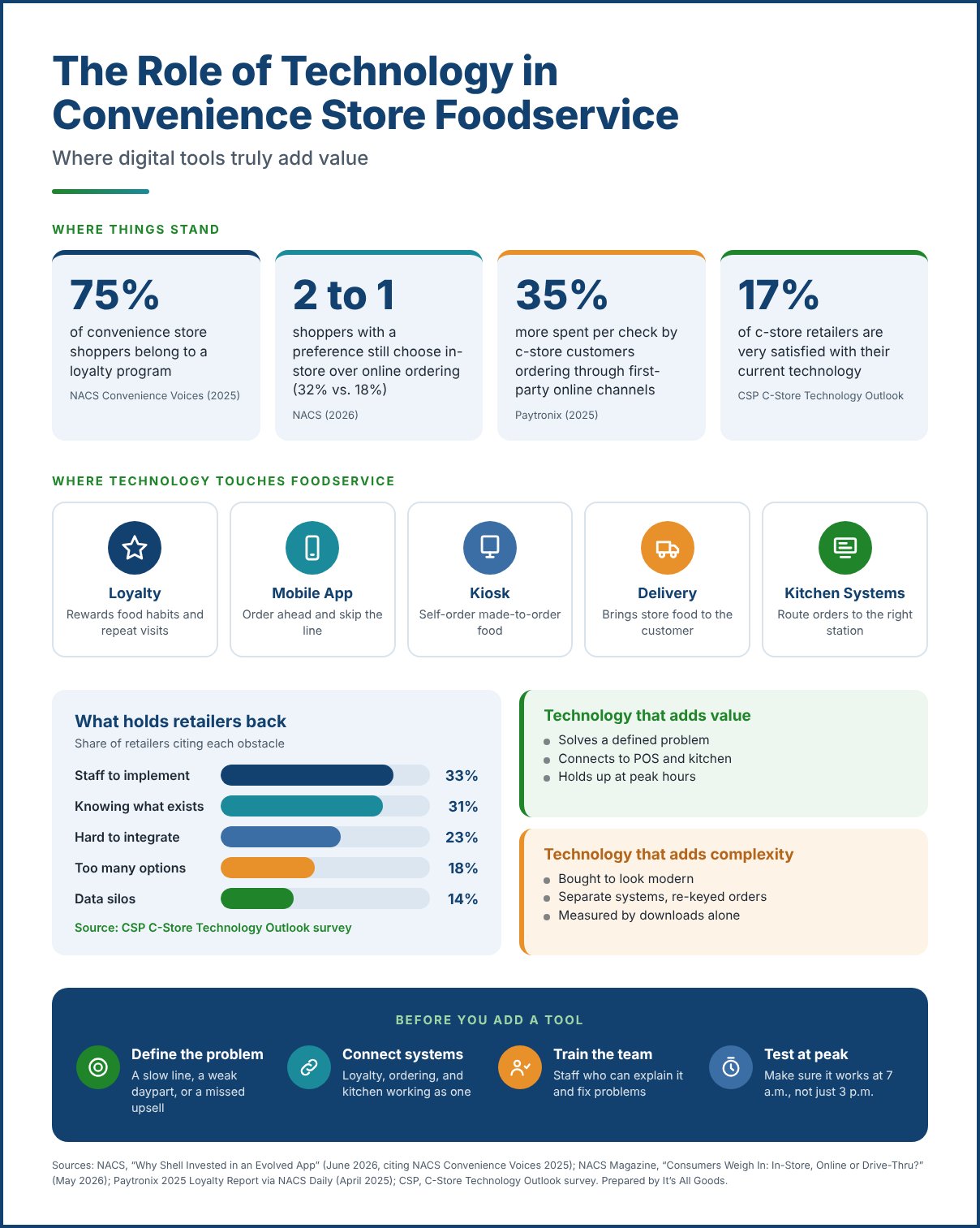
Digital tools have moved from the fuel island to the food counter. Loyalty programs that once rewarded gallons now reward coffee, breakfast, and meal bundles. Ordering kiosks, mobile apps, and delivery platforms let customers buy prepared food without waiting in line, and kitchen systems route those orders to the right station.
The reach is already wide. According to NACS Convenience Voices data cited in a 2026 NACS article on loyalty apps, 75% of convenience store shoppers belong to a loyalty program. Paytronix’s 2025 Loyalty Report found that 31% of c-store brands saw loyalty check sizes rise by more than 10% year over year, and that c-store customers ordering through a retailer’s own online channel spent 35% more per check.
Retailers, however, are not fully confident in the systems they have. In CSP’s C-Store Technology Outlook survey of more than 100 retailers, only 17% said they were very satisfied with their current technology. A third said they lacked the staff to implement new technology, and nearly a quarter said integration was too difficult.
Every new tool promises convenience to the customer. Whether it delivers depends on what happens inside the store after the order is placed. An app that promises a sandwich in five minutes creates a problem if the kitchen is already working through a line of walk-in customers.
Customer preferences also vary more than the hype suggests. A NACS consumer survey reported in NACS Magazine’s look at in-store, online, and drive-thru preferences found that among consumers with a preference, in-store shopping beat online ordering by almost two to one, 32% to 18%. Younger adults leaned the other way: shoppers aged 18 to 34 favored online ordering, 28% to 13%.
That split matters. Most c-store food customers still want to walk in, see the food, and buy it quickly, while a growing younger group expects to skip the line entirely. Technology has to serve both without making either one wait longer.
Loyalty is often the most valuable foodservice technology a c-store has, because it connects food purchases to an identifiable customer. A well-run program can reward a breakfast habit, encourage a second daypart, or introduce a new item to customers who already trust the store.
The weak point is usually execution rather than software. Intouch Insight research reported by CSP on c-store loyalty frustrations found that 39% of non-members said c-store rewards take too long to earn. In about 1,000 mystery-shop visits, cashiers did not mention the loyalty program 65% of the time. Yet 56% of consumers said a good loyalty program influences where they shop.
“Loyalty needs to be simple to track and benefit from.”
— Zoë Baldwin, Chief Marketing Officer, Mobility and Convenience, Shell North America
For foodservice, the lesson is straightforward. Rewards tied to food should be easy to understand, quick to earn, and mentioned at the counter. A program customers never hear about cannot influence what they eat.
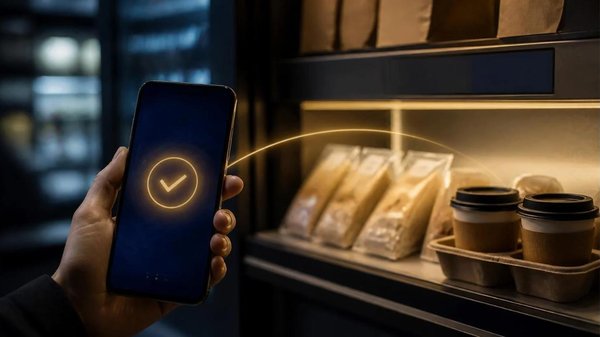
Digital ordering can raise check sizes and pull orders out of the line, but only when the order arrives on time and correct. Paytronix’s 2025 Online Ordering and Catering Report found that guests ordering in native apps finished orders four times faster than on the web, and that connecting ordering systems to kitchen systems was associated with a 22% reduction in mistakes. The same report put the average completion rate for first-party apps at about 40%, a reminder that many digital orders are started and never finished.
The kitchen side is just as important. Restaurant chains have learned that digital orders can overwhelm a store at peak times. In 2024, Starbucks reported that a mid-teens percentage of mobile orders were going uncompleted, with customers citing long waits and items being unavailable, according to Restaurant Dive’s coverage of Starbucks’ mobile ordering. A 2026 Intouch Insight study of quick-service order-ahead visits, released in May 2026, found that 21% of mobile orders were not ready on time, and satisfaction dropped from 97% to 76% when they were late.
Before adding digital ordering, operators should ask a few practical questions. Can the kitchen produce digital orders without delaying walk-in customers? Is there a clear pickup spot? Does the menu shown online match what the store can actually make at that hour? Will the order flow into the existing point-of-sale and kitchen systems, or create a second process for staff to manage?
The most common technology mistake is buying the tool before defining the problem. A kiosk installed to “modernize” the store, rather than to shorten a specific line or raise a specific check, often ends up underused or worked around.
Adding tools that don’t talk to each other. Separate systems for loyalty, ordering, and the kitchen force staff to re-enter information and leave gaps in the data.
Underestimating training. Store teams have to explain the app, handle digital orders, and fix problems in real time. Without training, the technology becomes a source of friction at the counter.
Ignoring peak periods. Tools that work in a quiet afternoon can break down at 7 a.m. Rollouts should be tested against the store’s busiest hours.
Measuring downloads instead of outcomes. App sign-ups matter less than repeat food purchases, order accuracy, and speed of service.
“If we take shortcuts and we implement things improperly, there’s going to be some type of functionality issue.”
— Justin Mitchell, Vice President and Head of IT, Refuel Operating Co.
The same thinking applies to loyalty. As It’s All Goods explained in Designing the Perfect Convenience Store Loyalty Program, a strong loyalty program starts with clear goals and a clear picture of the customers it is meant to reach, then chooses rewards that matter to them. The technology should serve that plan, not define it.
7-Eleven’s 7NOW delivery app shows how foodservice technology can grow when it is built on the store’s existing strengths. The service launched in Dallas in 2017 and, by early 2025, operated in more than 40 major cities around the clock, according to C-Store Dive’s report on 7-Eleven’s 7NOW goals. Average delivery time in the first three quarters of 2024 was about 28 minutes, and the average delivery order was nearly $16, roughly 1.7 times the size of an in-store basket.
Food is central to the model. On an earnings call, 7-Eleven president Stan Reynolds said that a quarter of 7NOW’s top-selling items were fresh food and proprietary beverages. The company paired delivery with its loyalty program and a monthly subscription that waives delivery fees.
The results have been steady rather than dramatic. C-Store Dive’s analysis of 7-Eleven’s fiscal fourth quarter reported that 7NOW sales reached $979 million in fiscal 2025, up nearly 30% from the year before, and that the company set a target of $1.25 billion by 2030. Few retailers have 7-Eleven’s scale, but the approach translates: start with food customers already buy, make the order reliable, and connect it to loyalty.
Technology is now part of how convenience store customers find, order, and return for food. Loyalty programs, apps, and digital ordering can raise check sizes and build habits, but only when they fit how the store actually operates.
The operators who benefit most treat technology as a way to execute better, not as a goal on its own. They define the problem first, connect systems, train their teams, and measure results in repeat food sales and reliable service. Chosen that way, digital tools strengthen the food program instead of competing with it for attention.
Technology helps customers find, order, and pay for food, and helps stores route orders, reward repeat visits, and understand what sells. Loyalty programs, mobile apps, kiosks, and kitchen systems are the most common tools.
Often, yes. Loyalty connects food purchases to individual customers and can encourage repeat visits and larger checks. The program has to be simple, rewards have to come quickly, and store teams need to mention it at the counter.
Not necessarily. Mobile ordering works best when the kitchen can fill orders on time without slowing walk-in customers. Stores should confirm their capacity, pickup area, and system integration before adding it.
Adopting a tool before defining the problem it should solve. Technology chosen to look modern, rather than to improve speed, accuracy, or repeat sales, often goes underused or adds work for store teams.
Focus on outcomes such as repeat food purchases, check size, order accuracy, on-time pickup, and speed of service, rather than app downloads or sign-ups alone.

Subscribe to receive latest news
12968 Vallejo Circle, Westminster CO. 80234
Phone: (303) 604-1064





