



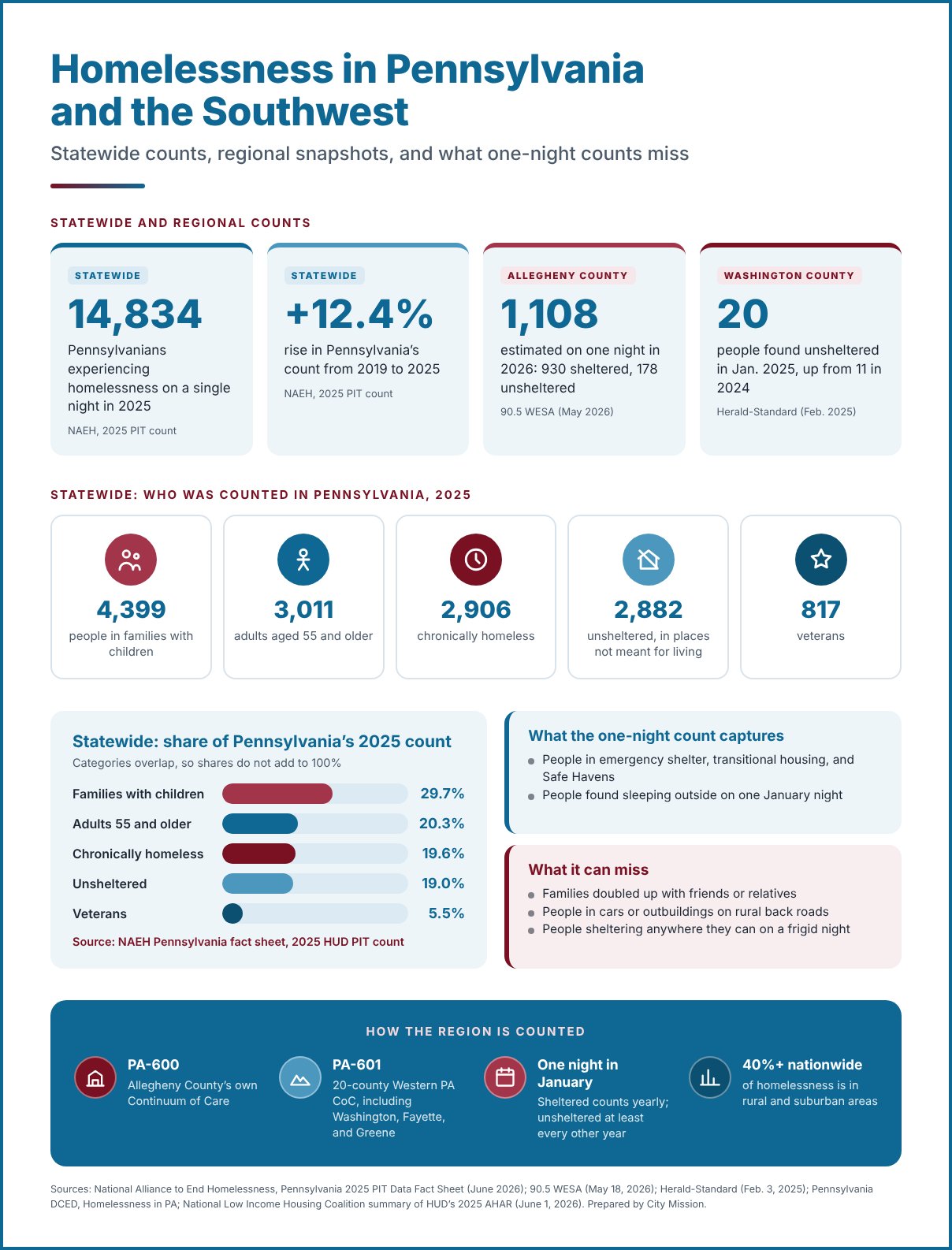
sk most people to picture homelessness and they describe a big-city street corner: tents under an overpass, someone sleeping in a doorway downtown. That picture is real, but it covers only part of what happens in Southwestern Pennsylvania. Here, homelessness can just as easily mean a mother and her children in a shelter suite, a veteran living out of a vehicle on a rural road, or a family moving between relatives’ couches without ever appearing in an official count. Pennsylvania counted 14,834 people experiencing homelessness on a single night in 2025, and the numbers for our four-county region tell a story that national headlines tend to miss.
This article looks at what the most recent data shows about homelessness in Washington, Fayette, Greene, and Allegheny Counties, how that data is collected, where the counts fall short, and who is most affected close to home. It is the first in a three-part series from City Mission’s Knowledge Center on the state of homelessness in our region.
The national figures are the ones most people hear. HUD’s 2025 Annual Homelessness Assessment Report, released on May 29, 2026, found 745,652 people experiencing homelessness on a single night in January 2025, including 266,320 who were living unsheltered. According to the National Low Income Housing Coalition’s summary of the report, that total was 3.4% lower than in 2024, the first year-over-year decline since 2016. The same report showed chronic homelessness, meaning long-term homelessness combined with a disability, rising to 155,750 people, the highest figure on record.
A modest national dip can hide very different local trends, and Pennsylvania illustrates the point. The National Alliance to End Homelessness’s 2025 Pennsylvania Point-in-Time fact sheet shows that the state’s count rose 12.4% between 2019 and 2025. National averages also blend major coastal cities with places like Greene County, which has no large urban center and very different housing pressures. For anyone trying to understand what is happening in Washington or Uniontown, the more useful questions are local ones: how many people are affected here, where they are, and what kinds of help they need.
Most homelessness data comes from the federally required Point-in-Time (PIT) count. Communities organize these counts through regional planning bodies called Continuums of Care, or CoCs. According to the Pennsylvania Department of Community and Economic Development, the state has 16 CoCs. Allegheny County runs its own (PA-600), while Washington, Fayette, and Greene Counties belong to the Western Pennsylvania CoC (PA-601), a 20-county Balance of State region that covers some of the most rural parts of the Commonwealth. Each January, CoCs count people in emergency shelters, transitional housing, and Safe Havens, and they are required to count people sleeping outside at least every other year. The results feed HUD’s national reports and help guide federal funding.
The method has real limits. Counts happen on one night in late January, often in bitter cold. In Washington County, volunteers who fanned out on the night of January 22, 2025, found 20 people living unsheltered, most of them in the city of Washington, up from 11 the year before, as the Herald-Standard reported. Overnight temperatures were in the single digits that night, and county homelessness and housing director Nicole Masur said she believed the cold pushed people into any shelter they could find:
“We truly believe that on a warmer night, that would change.”
— Nicole Masur, Homelessness and Housing Director, Washington County
The PIT count also leaves out entire groups by design. HUD’s definition of homelessness for the count does not include people who are doubled up, staying temporarily with friends or family because they have nowhere else to go. HUD itself notes that PIT counts do not include people living in housing assistance programs for the homeless. In a rural county, where there may be no shelter for miles and people are more likely to sleep in cars, outbuildings, or on a relative’s couch, these gaps can make the problem look smaller than it is.
Homelessness in Pittsburgh and homelessness in Waynesburg share root causes, but they look different on the ground. Allegheny County has a concentrated network of shelters, outreach teams, and service providers. Its latest count, released in May 2026, estimated 1,108 people experiencing homelessness on a given night: 930 in shelter and 178 unsheltered, according to 90.5 WESA.
In Washington, Fayette, and Greene Counties, people experiencing homelessness are spread across small cities, boroughs, and rural townships. Services are farther apart, public transportation is limited, and shelter beds are scarce outside a few towns. That distance changes what help looks like. When temperatures drop below 25 degrees between November and March, Greene County opens temporary overnight shelter through its Warm Nights Program, the Herald-Standard noted, a reminder that in rural areas a safe place to sleep often has to be arranged night by night.
This pattern holds well beyond our region. NLIHC’s summary of the national data notes that although most people experiencing homelessness live in urban areas, rural and suburban areas together now account for more than 40% of homelessness nationally, and rural CoCs represent 20% of the nation’s unsheltered homelessness. Southwestern Pennsylvania sits squarely in that pattern: a mid-sized urban county surrounded by small cities and rural communities where homelessness is less visible but no less present.
Statewide data offers the clearest picture of who is affected, because county-level breakdowns for our region are limited. Of the 14,834 Pennsylvanians counted in 2025, 81% were sheltered and 2,882, or 19%, were living in places not meant for human habitation. Some 4,399 people, or 29.7%, were members of families with children. Another 3,011 (20.3%) were adults aged 55 and older, 2,906 were chronically homeless, and 817 were veterans. These categories overlap, so they do not add up to the total, but together they show that homelessness in Pennsylvania reaches children, older adults, and people who have served in the military, not just single adults on the street.
City Mission sees that range every day in Washington. Its shelter and care programs at City Mission serve men, women, mothers with children, and veterans across five long-term shelters with room for 212 people at a time, plus 24 emergency beds year-round. The Women with Children Shelter offers 12 family suites, the Crabtree-Kovacicek Veterans House provides 22 beds for veterans, and Sally’s Sanctuary, a 54-bed shelter for women, opened in September 2025 in response to growing need. The dining hall also serves free meals 365 days a year to anyone in the region who needs one, which means many neighbors who never appear in a PIT count still walk through the Mission’s doors.
Washington County officials have described the same trend from a different angle. Masur told the Herald-Standard that the county’s sheltered and unsheltered population had been rising for three or four years, and Washington County Human Services Director John Tamiggi pointed to the gap in affordable housing as a major part of the challenge.
Allegheny County’s 2026 count shows how much the numbers depend on the method behind them. For its February 3 count, the county Department of Human Services changed its approach to estimating unsheltered homelessness, introducing a random sampling method and deploying close to 300 volunteers to cover more ground than in past years. Officials cautioned against comparing the result directly to earlier counts because the method was so different.
“Good policy starts with accurate measurement,” Alex Jutca, acting director of the Allegheny County Department of Human Services, told WESA. He described the new estimate as more transparent, more replicable, and more geographically comprehensive, and called the 2026 count a new baseline for future measurement. He also cautioned that fewer encampments do not mean unsheltered homelessness is solved, and he pointed to a new triage center at the Second Avenue Commons shelter, targeted street outreach, and the county’s 500 in 500 housing initiative as part of the response.
The lesson for the rest of the region is practical. A count is a measurement tool, and better tools produce numbers that communities can trust and compare over time. Rural counties face the opposite challenge from Allegheny: they have more ground to cover with fewer volunteers, which makes a single cold night even less likely to capture the full picture. Supplementing the PIT count with data from shelters, schools, outreach workers, and organizations like City Mission gives local leaders a far more complete view of who needs help.
Homelessness in Southwestern Pennsylvania is larger, more varied, and more spread out than the familiar big-city image suggests. National totals dipped in 2025, but Pennsylvania’s count is up 12.4% since 2019, and the people affected include families with children, older adults, and veterans. In rural and small-city communities, homelessness often stays out of sight, and the one-night PIT count is likely to miss people who are doubled up, sleeping in cars, or sheltering wherever they can on a frigid January night.
Understanding the data is the first step toward responding to it well. The next article in this series looks at how City Mission and its partners respond across the region, and the third examines what Southwestern Pennsylvania still needs to make homelessness rare, brief, and nonrecurring.
Pennsylvania counted 14,834 people experiencing homelessness on a single night in 2025, according to the National Alliance to End Homelessness. That figure is up 12.4% from 2019, and about 19% of those counted were unsheltered.
The Point-in-Time count is a HUD-required count of people experiencing sheltered and unsheltered homelessness on a single night in January. Local Continuums of Care plan and carry it out, and the results inform federal reports and funding.
Washington, Fayette, and Greene Counties are part of the Western Pennsylvania CoC (PA-601), which covers 20 mostly rural counties. Allegheny County has its own CoC, PA-600.
Counts take place on one cold January night, rural areas have more ground to cover, and people who are doubled up with friends or family are not included in HUD’s definition for the count.
City Mission serves men, women, mothers with children, and veterans through five long-term shelters for up to 212 people, 24 year-round emergency beds, free meals for the community, and medical care for residents.

Subscribe to receive latest news
12968 Vallejo Circle, Westminster CO. 80234
Phone: (303) 604-1064