





rtificial intelligence is moving quickly from industry headlines into convenience store kitchens. It is already forecasting how many sandwiches to make, suggesting offers to loyalty members, and taking orders at restaurant drive-thrus. Over the next few years, more of these tools will reach c-store foodservice, and most will be sold as the next thing operators cannot afford to miss.
Some of them will earn their place. Others will add cost, confuse customers, or create risks the store did not plan for. As It’s All Goods outlined in Implementing Foodservice Technology Without Disruption, the way a tool is introduced matters as much as the tool itself. This article looks ahead at what is coming, and at how operators can decide what to adopt and what to avoid.
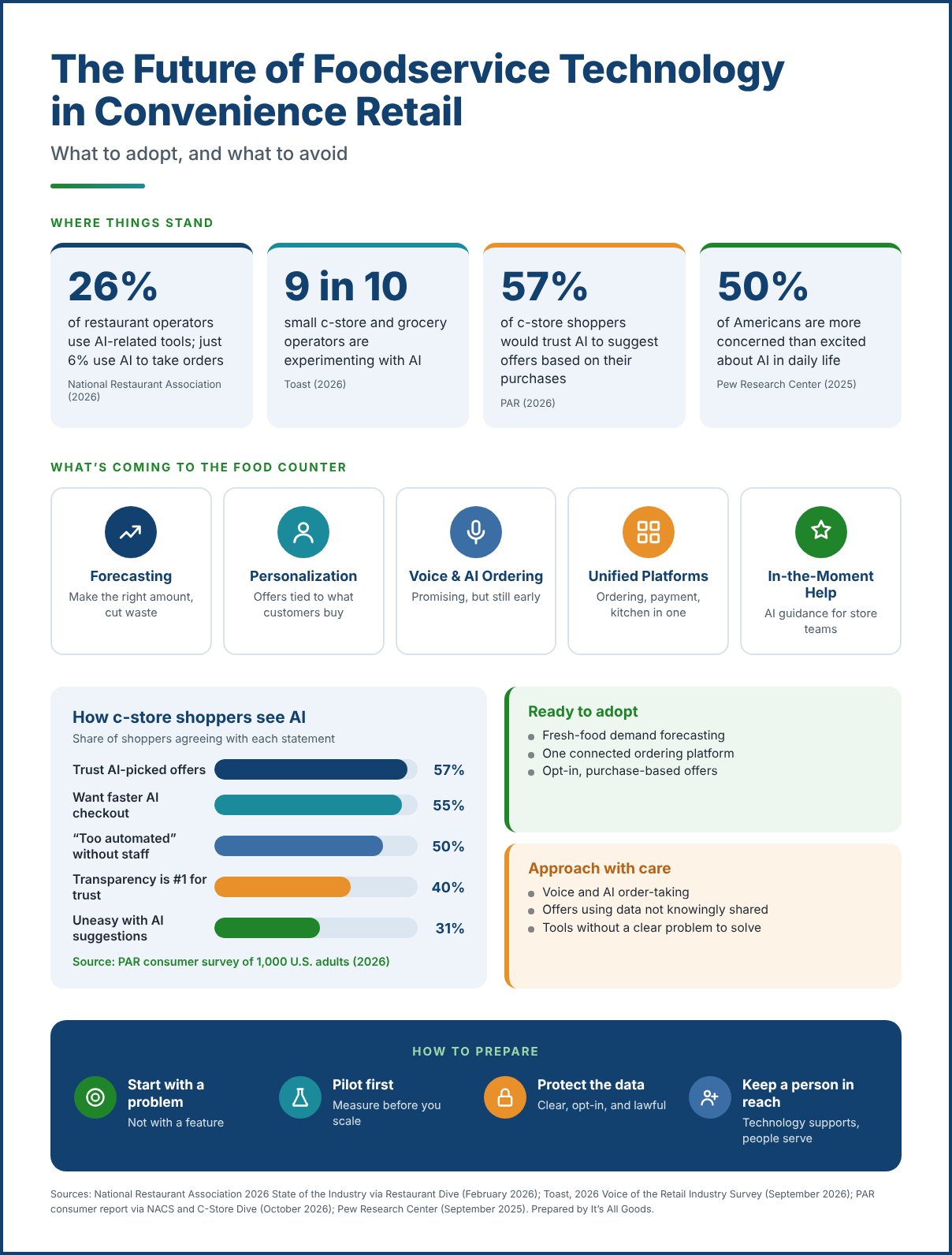
AI use is spreading, but it is still early. According to the National Restaurant Association’s 2026 State of the Industry report, as reported by Restaurant Dive, 26% of restaurant operators use AI-related tools, and only 6% use AI to take customer orders. Smaller retailers are testing too: in Toast’s 2026 Voice of the Retail Industry survey of 340 convenience, grocery, and bottle-shop operators with 16 or fewer locations, nine in ten said they are experimenting with AI.
The most practical uses so far sit behind the counter. Forecasting tools predict demand for fresh food by store and daypart, which helps reduce both waste and empty cases. Food waste is a large target: ReFED estimates that about 29% of U.S. food went uneaten or unsold in 2024, according to NACS’ report on how AI helps cut food waste. In one test across more than 1,300 grocery stores cited in that report, AI reduced produce waste by an average of 14.8% per store. Wawa, for its part, has used machine-learning forecasting to plan fresh food across its stores.
Customer-facing AI has been bumpier. McDonald’s ended its AI drive-thru ordering test with IBM after running it in about 100 restaurants, according to Nation’s Restaurant News, while saying voice ordering would still be part of its future. Taco Bell has also adjusted its voice AI plans after mixed results in its drive-thrus.
“I think at the end of the day, it’s really, really early. And we feel that. And I think other brands feel that, too.”
— Dane Mathews, Chief Digital and Technology Officer, Taco Bell
Personalization is where loyalty programs are headed. Instead of sending every member the same coupon, stores can use purchase history to offer the breakfast sandwich a customer buys on weekdays or a discount on the coffee they tried once. Kwik Trip, for example, has added AI-personalized challenges to its loyalty program, which serves 5.25 million members, according to NACS Daily.
Customers are open to this, within limits. In an August 2026 survey of 1,000 U.S. adults by restaurant and retail technology provider PAR, reported by NACS, 57% said they would trust AI to recommend personalized offers based on their purchase history. Comfort drops when offers seem to rely on information customers did not knowingly share. As PAR put it, in C-Store Dive’s coverage of the report, “A loyalty-app coupon uses information customers already gave the store on purpose, in exchange for a clear benefit.”
For foodservice, the safest path is personalization that feels obvious and useful: offers tied to items customers already buy, at times they usually visit, through a program they chose to join.
More technology is not the same as better service. In the Toast survey, 31% of small retailers listed simplifying their operations among their top three goals, up 12 points from the prior year. Consumers are divided, too: the National Restaurant Association found that 41% of consumers felt technology had improved hospitality, while 38% said it had taken away from it, according to QSR Magazine.
“AI delivers its greatest impact when it becomes part of everyday processes—not a standalone tool.”
— Raghu Bongula, Chief Technology Officer, PDI Technologies
The test for any new tool is simple to state and harder to apply: does it remove a step for the customer or the team, or add one? A screen, app feature, or alert that does not clearly make ordering faster, food fresher, or work easier is likely to become clutter.

Trust may become the deciding factor in how far foodservice technology can go. Pew Research Center found in 2025 that 50% of Americans are more concerned than excited about the growing use of AI in daily life, up from 37% in 2021. In the PAR survey, 40% of c-store customers ranked transparency as their top trust factor, and half said a store becomes “too automated” once they cannot easily reach a real employee.
Regulation is moving in the same direction. According to MultiState’s tracking of state privacy laws, 20 states now have comprehensive privacy laws on the books, with more taking effect in 2026. Retailers that collect loyalty and ordering data need to know what they collect, why, and how customers can control it.
Practical steps help build confidence: explain clearly what data a loyalty program uses and what customers get in return, make opting out easy, avoid offers that reveal more than the customer expects, and keep a person available when technology does not work.
Foodservice technology will keep changing faster than store formats. Retailers do not need to adopt every new capability, but they do need to be ready to evaluate them. A PDI Technologies survey of convenience professionals found that one-third were uncertain how to deploy AI effectively, according to the company’s 2026 outlook release.
A few habits make change easier to manage. Start each project with a clear business problem rather than a feature. Pilot in a small number of stores and measure results before expanding. Favor platforms that connect to existing point-of-sale and kitchen systems and can add capabilities over time. Keep clean, well-organized sales and loyalty data, because almost every future tool will depend on it. And review the technology plan regularly, so the store can adopt what works and drop what does not.
Spinx, which operates 96 convenience stores in the Carolinas, offers an example of planning for the future by simplifying first. In early 2026, the company chose AI-native retail platform Tote to update point-of-sale touchpoints across its stores, consolidating ordering, payment, and kitchen technology onto a single system that runs on Spinx’s existing hardware, according to C-Store Dive’s report on the Spinx update.
Spinx had originally selected a different provider before reopening its search. Foodservice tipped the decision. “The platform was compelling enough that we reopened our evaluation,” said Luis Ackerman, Spinx’s vice president of technology. “When we discovered it could also handle our food service technology needs, the decision became clear.”
The new systems are scheduled to begin going live in the second half of 2026, with all stores expected to be updated by spring 2027. The approach reflects the priorities this article describes: one connected system instead of several separate tools, reuse of hardware the stores already have, and AI built into everyday work rather than added on top of it.
AI, personalization, and connected systems will shape the next generation of convenience store foodservice. The retailers who benefit most will not be the ones who adopt everything first. They will be the ones who adopt deliberately, choosing tools that solve real problems, keep operations simple, and respect the customer’s trust.
For operators, the strategic choice is less about which technology is newest and more about which technology fits. Start with the problem, protect the data, keep a person within reach, and build on a foundation that can grow. Technology chosen that way will help food programs compete for years to come.
The most practical uses today are behind the counter, such as forecasting fresh-food demand to reduce waste and empty cases. Customer-facing uses, such as voice ordering and personalized offers, are growing but still early.
It is still developing. Large restaurant chains have reported mixed results, and McDonald’s ended one AI drive-thru test in 2024. C-stores should watch results closely and pilot carefully before committing.
Many do, especially when offers are based on what they already buy through a program they chose to join. Comfort drops when offers seem to use information customers did not knowingly share.
Be clear about what data is collected and why, give customers an easy way to opt out, avoid offers that feel intrusive, follow state privacy laws, and make sure customers can reach a real employee when needed.
Start with clear business problems, pilot before scaling, choose platforms that integrate with existing systems, keep data organized, and review technology decisions regularly.

Subscribe to receive latest news
12968 Vallejo Circle, Westminster CO. 80234
Phone: (303) 604-1064





