





nnovation keeps convenience store foodservice interesting. A new flavor, a seasonal drink, or a returning favorite gives regular customers a reason to look at the menu again and gives first-time visitors a reason to stop. Every new item also asks something of the store, though: another ingredient to order, another build to learn, and another product to hold, rotate, and track. In a channel where the same small team often runs the register, the coffee bar, and the kitchen, those demands add up quickly. The operators that gain the most from innovation are rarely the ones that launch the most items. They treat innovation as a managed process, with clear goals, realistic limits, and a planned end date for anything that does not earn a permanent place.
This article looks at why customers respond to novelty, what over-innovation costs, how innovation and execution pull against each other, how limited-time offers (LTOs) can serve as low-risk tests, and how operators can settle into a sustainable rhythm.
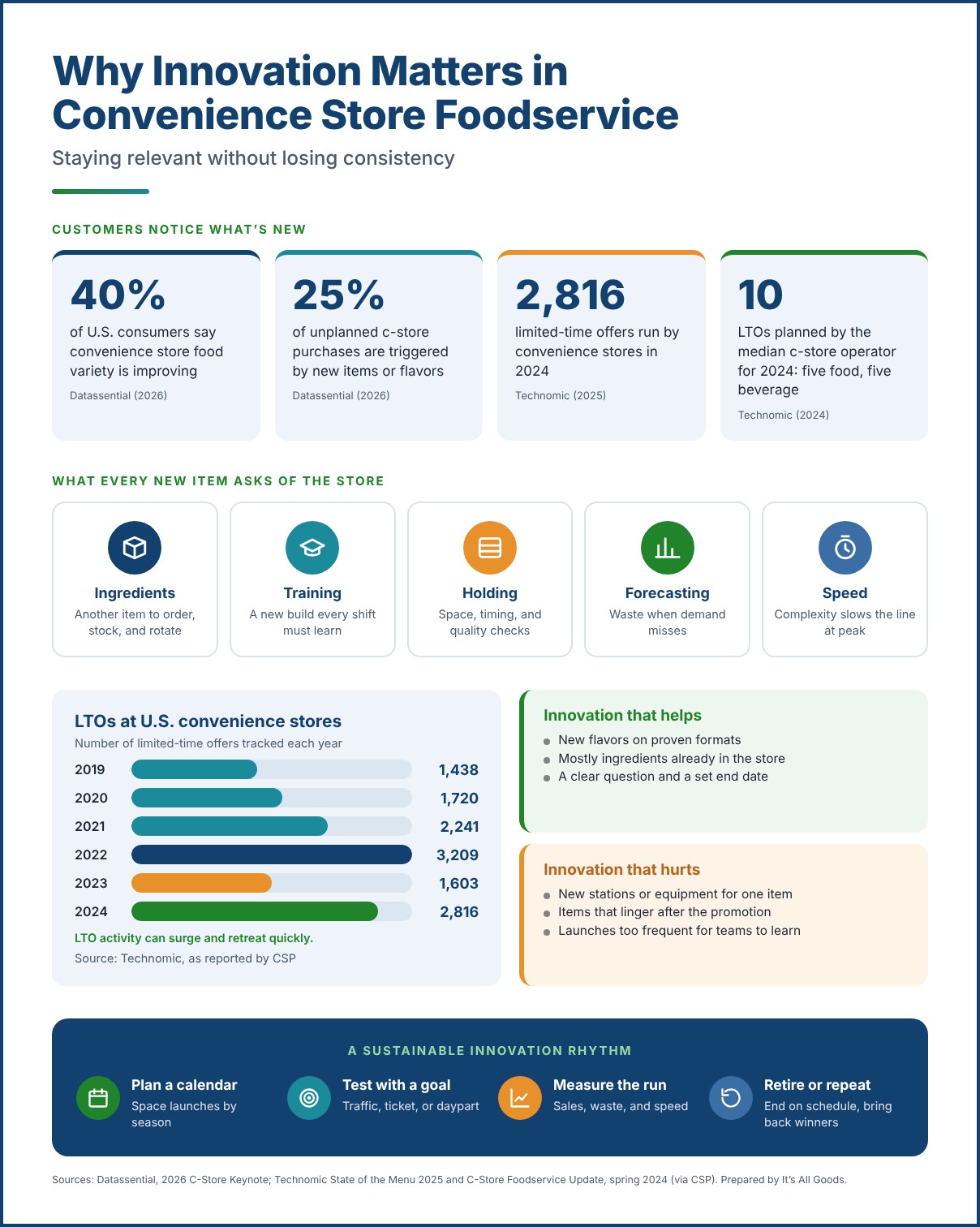
Customers are noticing when c-store menus change. In its 2026 C-Store Keynote, Datassential found that 40% of U.S. consumers say convenience store food variety is improving, up from 38% in 2023 and eight times the share who say it is getting worse. Variety has become part of how shoppers judge a food program, not just a nice extra.
Novelty also drives spending that customers did not plan. Datassential reported that more than one-third of consumers buy prepared food items at c-stores that they had not intended to purchase, and that new items or flavors were behind 25% of unplanned purchases. LTOs specifically accounted for 9%. For a business where many trips start at the pump, a new item on the counter can turn a fuel stop into a food sale.
That appetite is not uniform, however. Datassential found that younger shoppers express higher expectations for innovation and customization, while three-quarters of consumers overall are already satisfied with prepared food variety. The practical lesson is that innovation should freshen a dependable core menu rather than replace it.
Every new item carries costs that rarely show up on the promotional poster. It adds an ingredient to order, a recipe to train, a place in the holding cabinet, and a forecast that can miss in either direction. Technomic’s spring 2024 C-Store Foodservice Update found that more than seven in 10 c-store operators were worried about rising ingredient costs, rising packaging costs, supply chain availability, and staffing. A poorly planned LTO touches all four at once.
The restaurant industry offers a clear warning. By early 2025, Starbucks CEO Brian Niccol had described the coffee chain’s menu as “overly complex,” a problem tied to long lines, and on the company’s January 2025 earnings call he announced a roughly 30% reduction in beverages and food, according to CNN. U.S. sales at stores open at least a year had fallen 6% in the quarter. Niccol argued that a slimmer menu would make Starbucks more responsive to cultural moments. Starbucks is a coffeehouse rather than a convenience retailer, but the lesson carries over: cutting clutter made room for the right kind of new ideas.
The risk is often greater in a c-store, where foodservice labor is shared with fuel, tobacco, lottery, and cleaning duties. Items that linger after a promotion ends slowly turn into menu creep. As It’s All Goods explained in Menu Evolution Without Menu Creep, additions that require new equipment, new prep paths, or specialized training destabilize the system, and menu evolution is incomplete without subtraction.
Innovation and execution naturally pull in different directions. Marketing wants news to promote, while store teams perform best through repetition. Consistency is what builds trust in a food program: a customer who loves a particular breakfast sandwich expects it to taste the same on Tuesday morning as it did on Saturday night. Each new build interrupts that repetition, at least until employees learn it.
The most reliable way to reconcile the two is to innovate inside the existing system. New flavors, sauces, toppings, and limited builds on proven formats give customers something new while staff work with ingredients and equipment they already know. A seasonal sauce on a familiar chicken sandwich asks far less of the kitchen than a new category that needs its own station.
Before approving a new item, operators can run it through a few simple filters. Can it be made at peak volume with current equipment and staffing? Does it rely mostly on ingredients already in the store? What happens to leftover inventory when the promotion ends? Which existing item will it compete with, and is that trade worthwhile? An idea that fails these questions is usually better left in the test kitchen.
LTOs have become the channel’s main vehicle for menu innovation. According to Technomic’s State of the Menu 2025 report, convenience stores offered 1,438 LTOs in 2019, 3,209 in 2022, 1,603 in 2023, and 2,816 in 2024. Across c-stores and full- and limited-service restaurants combined, LTOs rose 36% from the fourth quarter of 2023 to the fourth quarter of 2024 and 128% over five years. Lizzy Freier, Technomic’s director of menu research and insights, said that in 2024 operators did “just about anything it took to drive traffic.”
The sharp swing between 2022 and 2023 shows how quickly LTO activity can surge and retreat. Used deliberately, though, an LTO is one of the safest ways to try something new. It limits the inventory commitment, comes with a natural end date, and produces real sales data instead of opinions. A strong performer can return next season or join the core menu, while a weak one simply expires without a public reversal.
To work as a test, an LTO needs a clear question. Is the goal to build traffic, raise the average ticket, strengthen a slow daypart, or try a flavor before a broader launch? Tracking unit sales, attachment rates, waste, and speed of service during the promotion turns a short-term offer into a lasting lesson.
Leading operators plan innovation in advance rather than reacting week to week. In Technomic’s spring 2024 update, nearly seven in 10 c-store operators said they develop an annual LTO calendar, and the median number of LTOs planned for 2024 was 10, split evenly between five food and five beverage items. Their most important reasons for running LTOs were drawing in new customers, increasing visits from current customers, and differentiating from competitors.
A calendar spaces launches so teams are not learning new builds every week. It aligns promotions with seasons and supplier lead times, and it lets operators pair a few genuinely new items with returning favorites customers already know. Beverage LTOs can lighten the load further, since many involve swapping a syrup, sauce, or topping rather than changing a kitchen process.
Rhythm also means knowing when to stop. Scheduling review points before each promotion begins makes it easier to retire an underperforming item on time and to recognize the rare winner that deserves a permanent spot.
Sheetz, the Altoona, Pennsylvania–based chain, shows how a large operator can keep its menu feeling new without rebuilding the kitchen. Its fall 2026 LTO menu launched September 2 at all 850-plus locations, according to NACS. The lineup included three new $5 milkshake flavors; a Pumpkin Chai served hot, iced, or frozen; a Pumpkin Cold Foam made with protein milk to top any Sheetz Bros. Coffee; and a canned pumpkin iced coffee for the cooler. In the bakery, Sheetz brought back its Shweetz Pumpkin Donut Holes and Apple Fritters alongside three new treats.
The structure of the lineup is the lesson. Most of the new items are new flavors on formats the stores already run, such as milkshakes, coffee, cold foam, and the bakery case, rather than new cooking processes. Returning favorites sit beside the new arrivals. Jacee Scoular, director of brand strategy and design at Sheetz, described the balance the chain was trying to strike:
“Our customers want the pumpkin, spice and comfort they love, but they also expect us to make it bigger, bolder and a little unexpected.”
— Jacee Scoular, Director of Brand Strategy and Design, Sheetz
Sheetz applied the same thinking to its made-to-order kitchen. Starting the same day, it offered three limited-time items created for “Fuel Stop Feast,” a mini-series with the YouTube channel First We Feast in which chefs built “menu hacks” from Sheetz’s made-to-order food and other items sold in its stores, according to a separate NACS report. The Lumberjack Breakfast Sandwich, Pizza Bagel Bunz Burger, and Tater Bomb Nachos gave customers something new while relying on components the kitchen already handles.
Behind the scenes, Sheetz also invests in the production capacity that supports this approach. In October 2026 it opened a $169 million food manufacturing and distribution center in Findlay, Ohio, its third such facility after Claysburg, Pennsylvania, and Burlington, North Carolina, as NACS reported. Smaller operators cannot match that scale, and Sheetz has not published sales results for the fall lineup. The underlying principle still transfers: build novelty from what the store already does well, and give every limited item a clear end date.
Innovation matters in convenience store foodservice because customers notice it and respond to it. More shoppers say c-store variety is improving, and new items and flavors are a meaningful source of unplanned purchases. Innovation also carries real costs in inventory, training, labor, and complexity, and those costs can erode the consistency that keeps customers coming back.
The operators that benefit most treat innovation as a disciplined process. They innovate within their existing systems, use LTOs to answer specific questions, plan launches on a calendar, and retire items on schedule. The next article in this series turns to execution, with practical guidance on rolling out LTOs without disrupting store operations.
New items give customers a reason to revisit the menu and can trigger unplanned purchases. Datassential found that new items or flavors were behind 25% of unplanned c-store purchases, and 40% of consumers say c-store food variety is improving.
According to Technomic, convenience stores offered 2,816 LTOs in 2024, up from 1,438 in 2019. In a 2024 survey, the median c-store operator planned 10 LTOs for the year, five food and five beverage.
Each new item adds ingredients, training, holding requirements, and forecasting risk. Too many additions can slow service, raise waste, and weaken consistency, especially when items stay on the menu after a promotion ends.
LTOs limit inventory commitment, end on a set date, and generate real sales data. Operators can use them to test a flavor, daypart, or price point before deciding whether an item deserves a permanent place.
Sheetz’s fall 2026 LTO menu paired new milkshake, coffee, and bakery flavors with returning favorites, mostly using formats its stores already run, and added limited items built from its made-to-order menu.

Subscribe to receive latest news
12968 Vallejo Circle, Westminster CO. 80234
Phone: (303) 604-1064





