





very breakfast sandwich that sits past its hold time, every tray of chicken that never sells, and every case of produce that spoils in the back cooler has already been paid for. The ingredients were bought, the labor was scheduled, and the equipment ran. When that food goes in the trash, the store loses all of it, along with the sale it was meant to produce.
In convenience store foodservice, that loss is easy to overlook. It happens in small amounts, spread across shifts and dayparts, and it rarely shows up as a single line on a report. But as foodservice becomes a larger share of the c-store business, waste becomes a larger threat to profit. This article looks at where foodservice waste comes from, what it costs, how it connects to sustainability, and why the most effective fixes start with treating waste as a process problem rather than a cost of doing business.
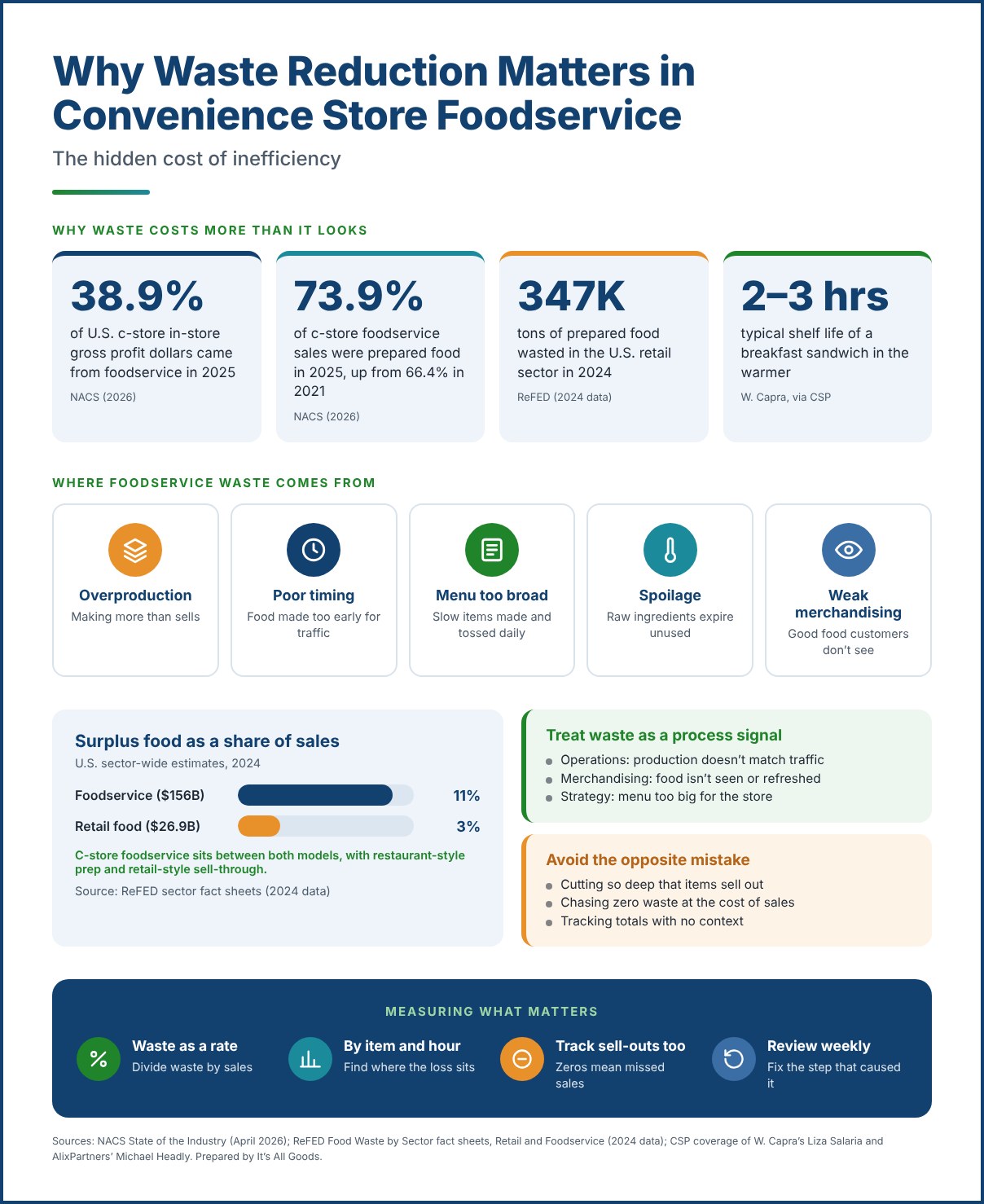
Not all food loss is the same. Liza Salaria, merchandising and foodservice practice lead at the consulting firm W. Capra, told attendees at CSP’s C-Store Foodservice Forum that convenience foodservice has two types of known loss: waste, which is finished food that goes unsold, and spoilage, which is raw ingredients that expire before they are used. “We have to report both,” she said, because each one points to a different breakdown.
Finished-goods waste usually traces back to production. A store makes more than it sells, makes it too early, or keeps the full menu running during hours when traffic cannot support it. Salaria noted that breakfast sandwiches typically have a two- to three-hour shelf life, which means a few hours of misjudged timing can turn a full warmer into a full trash can. Spoilage usually traces back to ordering and inventory: too many ingredients on hand, poor rotation in the walk-in, or menu items that use an ingredient no other item shares.
Prepared food is where most of that risk is concentrated. According to ReFED’s retail sector fact sheet, prepared foods were the third most wasted food type in the U.S. retail sector in 2024, at about 347,000 tons, behind produce and fresh meat and seafood. For c-stores, prepared food is also the heart of the foodservice business, which means the category with the most growth potential is also the one with the most waste potential.
The scale of foodservice in convenience retail makes waste a bottom-line issue. In 2025, foodservice accounted for 28.5% of U.S. convenience store in-store sales and 38.9% of in-store gross profit dollars, according to the NACS State of the Industry data. Prepared food made up 73.9% of those foodservice sales, up from 66.4% in 2021. Because foodservice earns a larger share of profit than of sales, every dollar lost there carries more weight than a dollar lost in most other parts of the store.
Across the wider food industry, the losses are large. ReFED estimates that surplus food in the U.S. foodservice sector, which includes restaurants and other food-away-from-home operators, was valued at $156 billion in 2024, equal to about 11% of foodservice sales, according to its foodservice sector fact sheet. In the U.S. retail sector, surplus food was valued at $26.9 billion, or about 3% of food and beverage retail sales. C-store foodservice sits between those two models, combining restaurant-style preparation with retail-style display and sell-through.
The math at store level is what makes waste so costly. Consider a simple example: if a store’s prepared food earns a 55% gross margin, every $100 of food thrown away at cost requires roughly $180 in additional sales just to recover the loss. The store has paid for the ingredients, the labor to prepare them, the energy to cook and hold them, and the packaging, and it receives nothing in return.
There is also a hidden cost in the opposite direction. Salaria warned against cutting production so far that items run out: “We’re not in the sales prevention department, which can happen very easily,” she said. An empty warmer at noon means lost sales and disappointed customers. The goal is not zero waste at any cost, but the right amount of food at the right time.
Waste reduction is one of the rare areas where financial and environmental goals point in the same direction. Food that is never wasted never has to be hauled away, and the resources used to grow, ship, and prepare it are not lost. The U.S. Environmental Protection Agency’s Wasted Food Scale ranks preventing wasted food as the most environmentally beneficial option, ahead of donation, composting, and every other pathway. Prevention is also the option that saves the most money, because it stops the loss before the store has paid for it.
Customers are paying attention, though they remain skeptical. In a March 2025 survey of 1,026 U.S. consumers conducted for supply chain software company RELEX Solutions, only 14% said they fully trust grocery stores’ sustainability claims, while 93% said they support discounting short-dated products and 58% said they actively seek them out. The survey focused on grocery stores rather than c-stores, but it suggests that shoppers respond to visible action, such as markdowns on food nearing its sell-by time, more than to broad promises.
Large chains are setting formal targets. Seven & i Holdings, the parent of 7-Eleven, has set a goal through its Green Challenge 2050 program to reduce food waste by 50% by 2030 and 75% by 2050. Casey’s has partnered with food banks to recover food from its stores. For most operators, however, the practical starting point is simpler: make less food that goes unsold. Every pound prevented helps both the profit and loss statement and the sustainability report.
It is tempting to treat waste as an unavoidable cost of running fresh food. In reality, waste is usually a symptom. It shows where forecasting, production planning, merchandising, or menu design is not working. Michael Headly, a partner in the restaurants, hospitality and leisure practice at AlixPartners, has observed that much of c-store foodservice growth has come through experimentation, and that experimentation has created a great deal of waste, according to CSP.
“Food waste can be an operations issue; it can be a merchandising issue and it can be a business strategy issue.”
— Michael Headly, Partner, AlixPartners
Each of those categories calls for a different fix. An operations problem may mean the production schedule does not match traffic by hour. A merchandising problem may mean good food is placed where customers do not see it, or that the warmer is not refreshed often enough to look appealing. A strategy problem may mean the menu is too large for the store’s traffic, so slow items are made, held, and thrown away every day. As It’s All Goods explained in Executing Fresh Food Programs Without Creating Waste, fresh food performs best when it runs as a repeatable system built on forecasting, smaller batches, and disciplined rotation.
Waste that is not measured is difficult to manage. Headly noted that if a retailer is not tracking waste at the store level, it may not even recognize waste as a problem. Many stores record what they throw away, but the raw number on its own says little. Salaria described an aggregate waste figure without context as meaningless, and recommended a different approach: “You have to divide waste by sales so you get a rate of waste.”
A waste rate makes stores, items, and dayparts comparable. A busy store may throw away more food in total than a small one but have a much lower waste rate. A breakfast sandwich may sell well overall but show a high waste rate after 10 a.m., which suggests a timing fix rather than a menu change. Tracking waste by item and by hour shows where the problem actually sits.
The measure should also capture the opposite problem. Salaria said that zeros, meaning items that sell out with nothing left to waste, are not a sign of success, because they mean the store missed sales it could have made. Pairing waste data with out-of-stock data gives a fuller picture. For operators who are not sure where to begin, her advice was practical: look at transactions by hour, then align production with when customers actually buy.
Useful metrics do not need to be complex. A short list is often enough: waste as a percentage of sales by item, waste by daypart, spoilage of raw ingredients, out-of-stocks during peak periods, and the trend of each over time. Reviewed weekly, these numbers turn waste from a vague concern into a set of specific, fixable issues.
SunStop, an 82-store chain operated by Southwest Georgia Oil Co., offers a practical example of waste control designed into a fresh food program. According to CSP’s coverage of the chain, its stores run a hot deli case and plate-to-order options, with the goal of keeping waste between 10% and 15%.
The chain’s approach starts with repurposing. Curtis Robinson, brand manager of food and beverage, explained that food cooled after breakfast is repurposed into other dishes, and leftover chicken from lunch is cooled and used in another recipe. “That’s how we attack our waste,” Robinson said. Portions are sized to limit leftovers as well: the daily special is a 6-ounce entrée with two 3-ounce sides, reflecting Robinson’s observation that customers want less food at one time.
Pricing helps move food before it becomes waste. SunStop’s $8.99 daily special drops to $5 after 5 p.m., giving customers a reason to buy late in the day instead of leaving food to be discarded at close. The chain is also tying waste to profit: its margin goal is 60% to 70%, compared with about 57% today. Repurposing, portion control, and late-day pricing all work toward the same result, which is more of the food the store makes ending up in a customer’s hands.
Waste is one of the clearest signals of how well a foodservice program is running. It reveals where production timing is off, where the menu is too broad for the store’s traffic, and where merchandising is not converting food into sales. Because foodservice now delivers so much of the c-store’s gross profit, those signals deserve close attention.
The operators who make the most progress will treat waste as a process to manage, not a cost to accept. They will measure it as a rate, review it by item and by hour, balance it against missed sales, and fix the step that caused it. The result is better margins, less food in the dumpster, and a more credible sustainability story, all from the same discipline.
Most waste comes from overproduction, poor timing, overly broad menus, and ingredient spoilage. Finished food that goes unsold is waste, while raw ingredients that expire before use are spoilage, and each points to a different fix.
Foodservice produced 38.9% of U.S. c-store in-store gross profit dollars in 2025, according to NACS. Wasted food loses the cost of ingredients, labor, energy, and packaging, and recovering that loss takes significantly more in new sales.
Measure waste as a rate by dividing waste by sales, and track it by item and by daypart. Pair waste data with out-of-stock data so cuts in production do not lead to missed sales.
Not usually. Items that sell out regularly may signal lost sales. The better goal is producing the right amount at the right time, with a waste target the store can review and improve.
Preventing waste is the most environmentally beneficial option on the EPA’s Wasted Food Scale. It also saves the most money, because it stops the loss before the store pays for food that will not sell.

Subscribe to receive latest news
12968 Vallejo Circle, Westminster CO. 80234
Phone: (303) 604-1064





