






ost convenience store foodservice teams know what they are supposed to do. The build cards are posted, the hold times are on the chart, and the cleaning schedule is taped inside the cabinet door. The gap is rarely knowledge. It is follow-through: whether the standard is met at 6 a.m. and at 9 p.m., on a busy Friday and a slow Tuesday, by a veteran employee and by someone in their second week. Accountability is the system that closes that gap. It connects each expectation to a person, a measure, and a regular conversation, so that good execution is noticed and slippage is corrected before customers notice it first.
This article covers how to define roles and metrics, build a simple store-level scorecard, coach instead of police, reinforce standards so they stick, and manage the variability that comes with multiple shifts and stores. A case study shows how one Louisiana operator turned store rankings into a coaching tool.
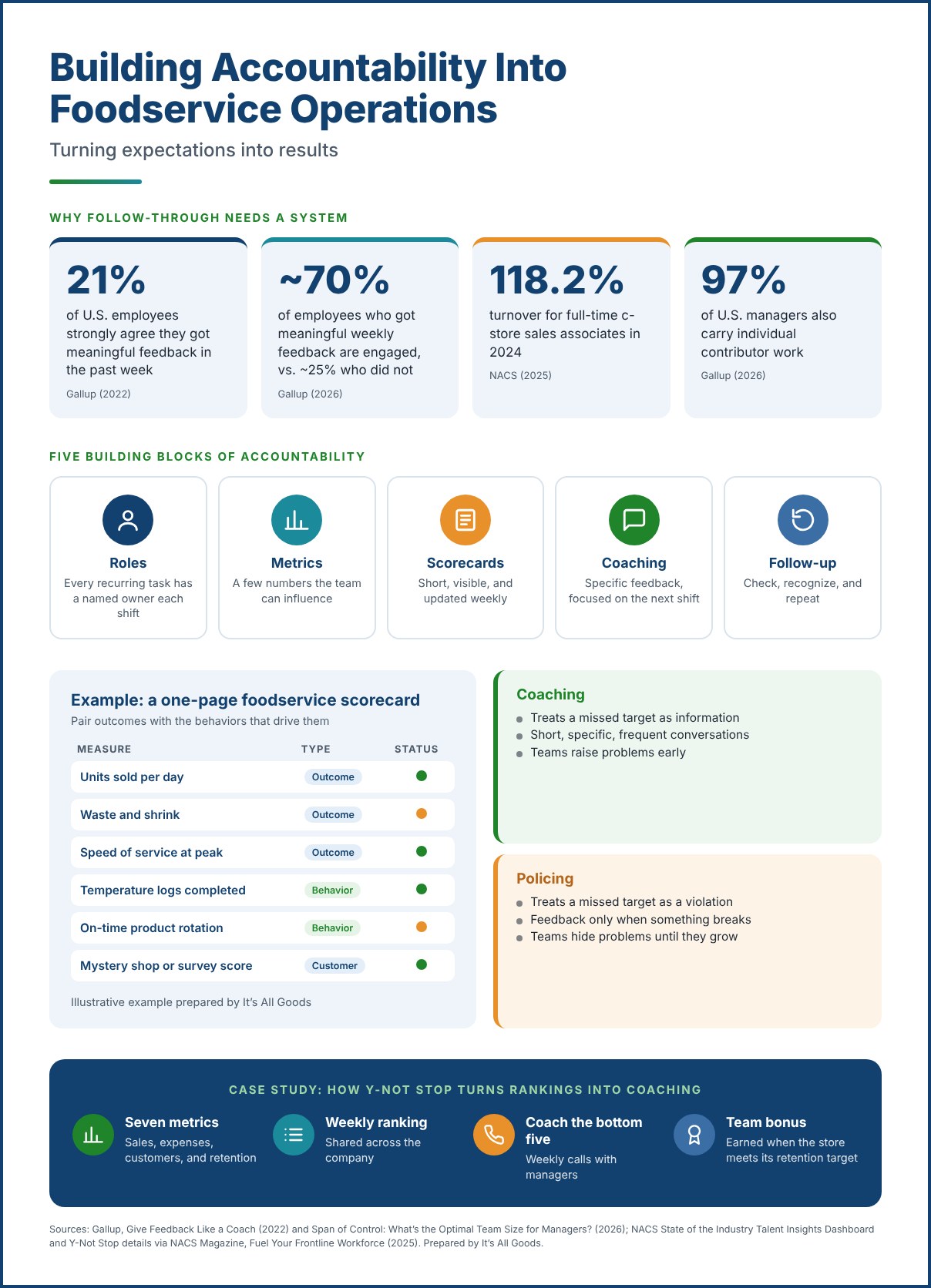
Accountability starts with ownership. Every recurring foodservice task, from opening the hot case to logging temperatures to discarding expired product, should have a named role responsible for it on every shift. When a task belongs to “whoever is free,” it often belongs to no one. A simple responsibility chart by daypart, kept at the station, removes the guesswork and makes handoffs between shifts cleaner.
Metrics come next, and fewer is better. A store team can act on a handful of numbers it understands; it will ignore a dashboard of 30. For most programs, a useful core set covers sales (units sold per day and attachment to beverages or fuel), waste or shrink, speed of service at peak, food safety compliance, and a customer measure such as mystery shop or survey scores. Each metric should be something the team can actually influence during a shift.
Food safety deserves a permanent place on that list. The FDA’s study of foodborne illness risk factors in fast food and full-service restaurants, released in June 2023, found that a well-developed and documented food safety management system was the strongest predictor that risk factors would be minimized. The most common problems were improper holding time and temperature and poor personal hygiene. Those are exactly the behaviors a daily accountability routine is designed to catch.
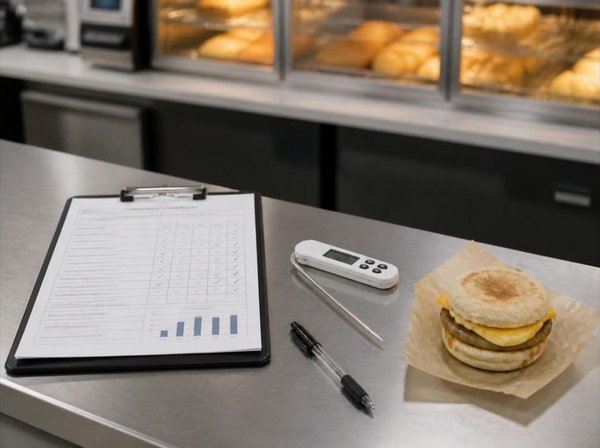
A scorecard turns metrics into a shared view of performance. The best ones are short, visible, and updated often enough to change behavior. A weekly one-page summary posted in the back room, or shown on the manager’s tablet at the start of each shift, works better than a monthly report that arrives after the moment has passed.
Good scorecards compare a store with its own targets and recent trend, not only with other stores. They pair outcome measures, such as food sales and waste, with behavior measures, such as completed temperature logs and on-time product rotation. That pairing helps managers see why a number moved, rather than just that it moved.
Scorecards also work best when employees understand how their actions show up in the results. In a sponsored 2026 NACS article, a key account manager for Krispy Krunchy Chicken compared foodservice metrics to a scoreboard and noted that many operators do not know exactly where their food sales or margins stand. He also pointed out that giving away an unpriced extra sauce can cost 38 cents a serving. Small leaks like that are easy to fix once a team can see them.
How leaders use a scorecard matters as much as what is on it. Policing treats a missed target as a violation to be documented. Coaching treats it as information to be understood. Policing tends to produce defensive teams that hide problems; coaching produces teams that raise them early.
Feedback is the core of coaching, and most employees are not getting enough of it. In a February 2022 survey, Gallup found that only 21% of U.S. employees strongly agreed that they had received meaningful feedback in the past week, according to its guide on how to give feedback like a coach. Gallup’s 2026 analysis of manager span of control found that about 70% of employees who strongly agreed they had received meaningful feedback in the past week were engaged, compared with roughly 25% of those who had not.
The same Gallup analysis points to a reality every c-store manager will recognize: 97% of U.S. managers have some individual contributor responsibilities, with a median of 40% of their time spent on that work. A store manager who is also running a register, receiving deliveries, and covering call-offs needs coaching routines that fit into the shift. Short, specific conversations work best: what went well, one thing to adjust, and why it matters to the customer.
Standards fade without reinforcement. A new build or procedure may be followed carefully for the first week and then drift as habits return. Reinforcement keeps the standard visible long after the launch.
Practical tools include a two-minute pre-shift huddle on the day’s priority, quick station checks during the first hour of a daypart, and photo standards that show exactly what a correct item looks like. Recognition belongs on this list too. When a team member catches an out-of-temperature item or keeps the hot case full through a rush, saying so in front of the team reinforces the behavior more than a memo ever will.
Consequences still matter. When the same standard is missed repeatedly after clear coaching, managers need a consistent, fair next step. The difference from policing is the order of operations: clarity and support come first, and consequences follow only when those have been given a real chance.
Variability is the natural enemy of foodservice consistency. Results swing between shifts, between stores, and between the weeks when the store is fully staffed and the weeks when it is not. Turnover makes this harder. According to NACS data cited in NACS Magazine, industrywide turnover for full-time c-store sales associates was 118.2% in 2024. With that much change, a standard that lives only in one experienced employee’s head will not survive the next schedule.
Operators can reduce variability by comparing like with like. Reviewing results by daypart and shift, not only by store, shows where a standard is breaking down. District leaders can spend more time in the stores and shifts with the widest gaps, and less in the ones that are steady. When one store consistently outperforms, its routines are worth documenting and sharing.
Variability also calls for realistic expectations. A store that loses two experienced team members in a month will dip; the goal is to shorten the dip with fast training and close support, not to pretend it will not happen.
St. Romain Oil Company, which operates 15 Y-Not Stop convenience stores in Louisiana, offers a useful example of accountability built around coaching rather than blame. According to the same NACS Magazine article, CFO and co-CEO Annie Gauthier reviewed the company’s store employment data and concluded that the store manager was the deciding factor in retention.
The company tied store bonuses to seven metrics: three for sales, two for expense control, one for customer satisfaction, and one for retention. Team members earn the bonus when their store meets its quarterly retention target. Stores are ranked weekly by retention, and the rankings are shared across the company. Gauthier then holds weekly calls with the five managers at the bottom of the ranking. She explained the purpose of the ranking this way:
“The ranking wasn’t to blame or shame anyone, but to encourage them to get their numbers up.”
— Annie Gauthier, CFO and Co-CEO, St. Romain Oil Company
According to the article, managers who accepted the coaching and were willing to try new tactics began to see results with their frontline teams. The company also uses a prehire assessment that screens for traits such as integrity and dependability, which Gauthier said can help match candidates to kitchen work or front-of-store roles. Gallup Q12 surveys at the company showed that stores scoring lower on manager engagement and on employees feeling heard had higher turnover.
The program focuses on retention rather than foodservice execution alone, and the article does not report specific turnover results. Its structure still translates directly to the kitchen: a small set of clear metrics, a visible ranking, frequent conversations focused on the stores that need help most, and rewards that the whole team can earn.
Accountability in foodservice is not about watching employees more closely. It is about making expectations clear, measuring a few things that matter, and talking about results often enough that small problems never become big ones. Assign every recurring task to a role, keep the scorecard short and visible, and pair outcomes with the behaviors that drive them.
Coach first, follow up consistently, and recognize good execution as readily as you correct mistakes. Manage variability by looking at results by shift and daypart, and focus support where the gaps are widest. As the previous article in this series, Why Leadership Matters in Convenience Store Foodservice, explained, these systems only work when leaders are visible and treat mistakes as signals to fix. The final article in this series looks ahead to how foodservice leadership models may evolve.
Accountability connects each foodservice expectation to a responsible role, a clear measure, and regular follow-up, so that standards are met consistently across shifts and stores.
A short list works best: units sold, waste or shrink, speed of service at peak, food safety compliance, and a customer measure such as mystery shop or survey scores.
Policing treats a missed target as a violation to document. Coaching treats it as information to understand and fix, which encourages teams to raise problems early.
Weekly or more. Gallup found that about 70% of employees who received meaningful feedback in the past week were engaged, yet only 21% of U.S. employees strongly agreed they had received it.
St. Romain Oil ties Y-Not Stop store bonuses to seven metrics, ranks stores weekly on retention, and holds weekly coaching calls with the managers of the five lowest-ranked stores.

Subscribe to receive latest news
12968 Vallejo Circle, Westminster CO. 80234
Phone: (303) 604-1064





