





oodservice programs rarely fail because of a bad recipe. They falter when the recipe is followed carefully on Monday morning and loosely on Saturday night, when the holding chart is ignored during a rush, or when a new hire is shown the sandwich station once and left to figure out the rest. Equipment, menus, and procedures set the standard, but people decide every day whether that standard is met. That decision is shaped less by policy manuals than by what leaders pay attention to, reward, and tolerate. In convenience retail, where small teams juggle fuel, register, cleaning, and food in the same shift, leadership and culture are not soft topics. They are part of the operating system.
This article looks at why visible leadership matters, how culture produces (or undermines) consistency, the difference between accountability and blame, how store-level ownership develops, and why clear expectations remain the foundation of all of it. A case study shows how Parker’s Kitchen ties its culture directly to foodservice execution.
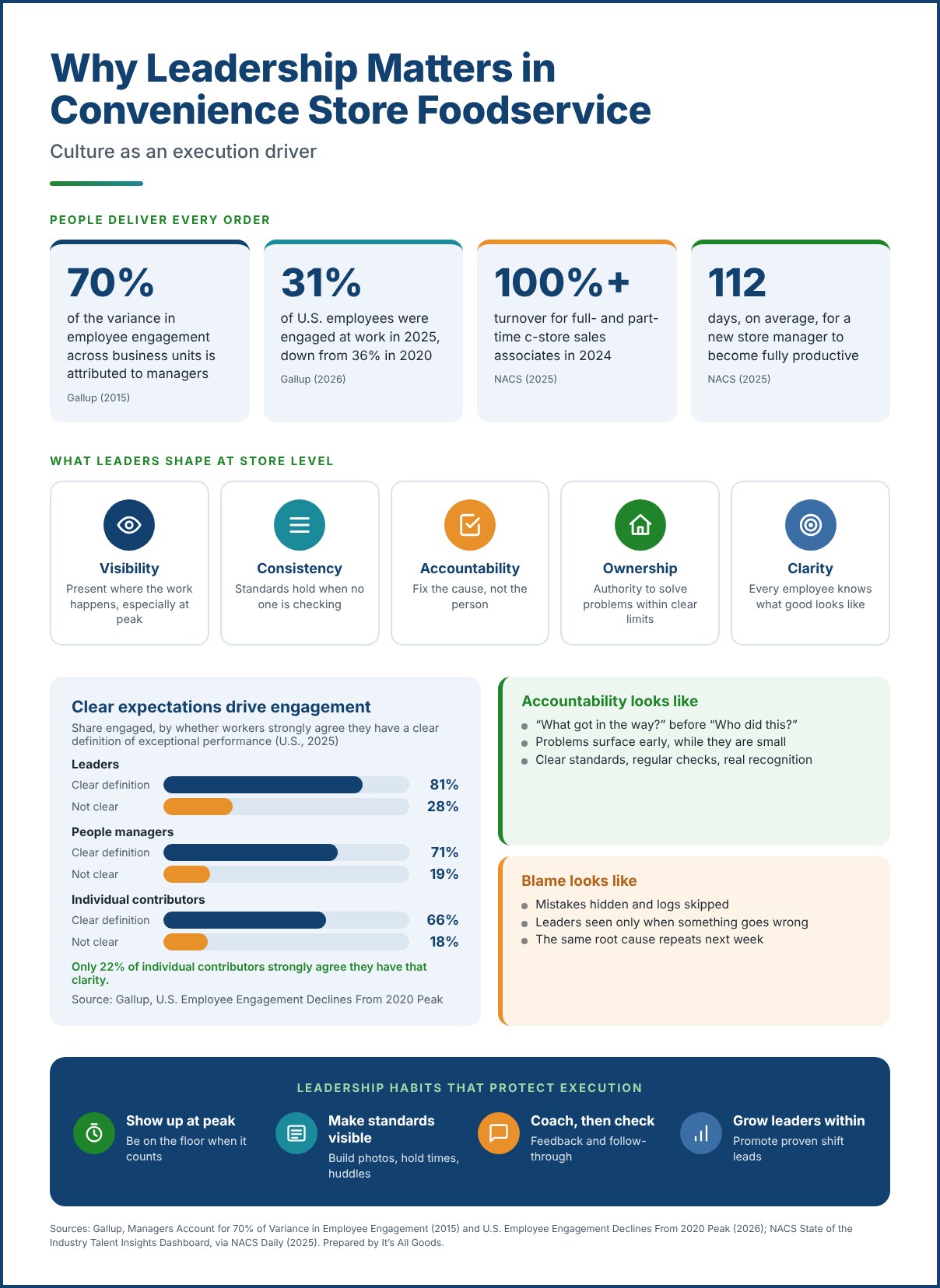
Store teams take their cues from the people closest to them. Gallup research has found that managers account for at least 70% of the variance in employee engagement scores across business units, an estimate drawn from its State of the American Manager research. The same Gallup analysis reported that companies miss the mark on high managerial talent in 82% of their hiring decisions. For c-store foodservice, the implication is direct: the store or kitchen manager has more influence over daily execution than any corporate program.
Visibility means being present where the work happens, particularly during peak periods. A manager who checks the hot case at 11:30 a.m., tastes the coffee, and helps restock the sandwich station during a rush communicates priorities more clearly than any memo. District and regional leaders send a similar signal when store visits focus on food quality and customer experience, not only on audits and paperwork. When leaders consistently show up for foodservice, teams conclude that food matters.
The reverse is also true. If leaders only appear when something goes wrong, employees learn to treat their visits as inspections rather than support, and the standards slip between visits.
Culture is what happens when no one is checking. It shows up in whether an employee discards product at the end of its hold time when the case still looks full, whether a cleaning task gets done on a slow overnight shift, and whether a team member who sees a problem fixes it or walks past it. Consistency at scale depends on those small, unobserved choices.
Engagement is a useful indicator of that culture, and it is under pressure. Gallup’s 2025 U.S. engagement data found that only 31% of U.S. employees were engaged, unchanged from 2024 and down from a 2020 peak of 36%. Clarity of expectations showed one of the largest declines since 2020, falling nine points. A disengaged team can still follow a checklist when supervised, but it is unlikely to protect quality on its own.
Turnover makes the challenge harder. According to the NACS State of the Industry Talent Insights Dashboard, as reported in How to Combat Manager Turnover, turnover for both full- and part-time c-store sales associates exceeded 100% in 2024. When a large share of the team is new at any given time, culture becomes the main way standards are passed from one employee to the next.
Accountability and blame can look similar from the outside, but they produce very different results. Blame focuses on who made the mistake. Accountability focuses on what the standard is, why it was missed, and what will change. In a blame culture, employees hide problems, skip temperature logs they fear will be questioned, and avoid owning tasks. In an accountability culture, problems surface early, while they are still small and cheap to fix.
Leaders set that tone in the first conversation after something goes wrong. Asking “What got in the way?” before “Who did this?” often reveals a root cause that has little to do with individual effort: a station layout that slows prep, a schedule that leaves one person covering food and the register at lunch, or training that never covered the task in the first place. Fixing those conditions reduces the chance of a repeat far more than a reprimand does.
Accountability still requires follow-through. Standards that are explained but never checked quickly become suggestions. The goal is a predictable loop of clear expectations, regular observation, honest feedback, and recognition when the standard is met, not a hunt for someone to fault.
The strongest foodservice stores tend to have teams that think of the program as theirs. Ownership grows when employees understand why standards exist, have some authority to solve problems within defined limits, and see a path to grow. As It’s All Goods discussed in Building a Foodservice-First Culture, empowerment works best inside clear boundaries, paired with recognition and career development.
Investing in people also shows up in the numbers. NACS reported in its key retention metrics that top-decile c-store companies, the top 10% ranked by store operating profit, had store employee turnover of 60.8% and manager turnover of 17.1% in the first half of 2025. Those companies spent $23.10 per labor hour on wages and benefits, almost $5 more than the bottom decile, and generated $8 more in gross profit per labor hour. Higher pay alone does not create ownership, but stable, well-supported teams have more time to master the standards that make foodservice consistent.
Developing leaders from within reinforces that ownership. NACS data shows that hiring a store manager costs about $1,800, with roughly $5,000 more for training, and that a new store manager takes an average of 112 days to become fully productive. Promoting a proven shift leader or kitchen lead shortens that ramp and tells the rest of the team that strong execution leads somewhere.
Every element of foodservice culture rests on a simple question: does each employee know exactly what good looks like? Gallup’s research suggests many do not. In a third-quarter 2025 survey, only 22% of U.S. individual contributors strongly agreed that they had a clear definition of exceptional performance, compared with 32% of leaders. Among individual contributors who did strongly agree, 66% were engaged, compared with 18% of those who did not.
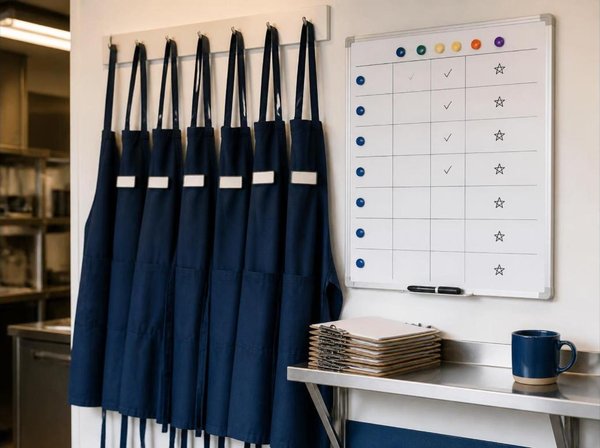
In a c-store kitchen, clear expectations are concrete. Photos of correctly built items at each station, posted hold times, a short pre-shift huddle on the day’s priorities, and a consistent way to report out-of-stocks or equipment issues all reduce guesswork. Communication also needs to flow upward. Employees who see recurring problems, such as a recipe that is hard to execute at peak or an ingredient that arrives inconsistently, should have a simple way to raise them and see a response.
Parker’s Kitchen, the Savannah, Georgia–based chain founded in 1976, is known for a made-from-scratch, Southern-inspired menu that includes hand-breaded chicken tenders and a breakfast bar. It operated 108 stores as of January 1, 2026, ranking No. 64 on CSP’s 2026 Top 202 list of convenience chains. The company employs more than 1,800 team members across Georgia and South Carolina and serves about 1.1 million transactions each week, according to The Shelby Report.
Leadership at Parker’s connects people and performance explicitly. After becoming CEO in 2025, Brandon Hofmann told CSP that the company’s goals run through its “core four”: best place to work, growing store profits, new store growth, and charitable giving. Placing “best place to work” alongside profit and growth makes culture a measured business priority rather than a side initiative. Hofmann also described proprietary kitchen technology that forecasts chicken tender sales in 15-minute increments with 95% accuracy, which gives store teams clear production targets instead of guesswork.
The company’s leadership path is itself a culture signal. Hofmann began at Parker’s as a third-shift cashier at 19 and later served as district manager, chief marketing officer, chief operating officer, and president before becoming CEO, according to the company’s leadership announcement. In that announcement, founder Greg Parker described succession as a core responsibility of leadership:
“Truly effective leaders always try to replace themselves with leaders who are better than they were.”
— Greg Parker, Founder and Executive Chairman, Parker’s Kitchen
That philosophy has continued. In October 2025, Parker’s promoted John Rudolfs to co-CEO alongside Hofmann, and the company has been recognized as a USA Today Top Workplace. Parker’s has not published store-level execution data tied to these efforts, and few operators can match its growth. The transferable lesson is that culture works best when leaders name it as a priority, measure it, and visibly reward the people who carry it out.
Leadership matters in convenience store foodservice because people, not policies, deliver every order. Managers have an outsized influence on engagement, engagement is under pressure, and high turnover means standards must be taught and reinforced continuously. Culture determines whether quality holds up when no one is watching.
The leaders who get the most from their foodservice programs are visible during peak periods, treat mistakes as signals to fix rather than people to blame, give teams real ownership within clear limits, and make expectations concrete. The next article in this series turns those principles into practice, with guidance on building accountability into daily foodservice operations.
Leaders shape what store teams prioritize. Gallup estimates that managers account for at least 70% of the variance in employee engagement across business units, and engagement affects whether food standards are followed consistently.
Culture drives the small, unobserved choices that determine quality, such as discarding product on time or completing cleaning tasks during slow shifts. Strong cultures help standards pass from experienced employees to new ones.
Blame focuses on who made a mistake. Accountability focuses on the standard, why it was missed, and what will change, which helps problems surface early and leads to lasting fixes.
According to NACS, turnover for full- and part-time c-store sales associates exceeded 100% in 2024. Top-decile companies reported store employee turnover of 60.8% in the first half of 2025.
Parker’s Kitchen lists “best place to work” alongside store profits, new store growth, and charitable giving as its core goals, promotes leaders from within, and gives store teams forecasting tools for food production.

Subscribe to receive latest news
12968 Vallejo Circle, Westminster CO. 80234
Phone: (303) 604-1064





