



food-safety policy may be technically correct and still fail inside a store. The difference between a policy that exists and a system that works is execution: employees must understand the requirement, have the resources to follow it, recognize when something is wrong, and know what corrective action to take. Managers must then verify that the process was completed rather than assuming that written instructions produced the intended result.
This challenge is especially important in convenience retail. Stores operate across multiple dayparts, often with changing staffing levels, frequent interruptions, compact preparation areas, and employees responsible for both foodservice and broader retail duties. A workable food-safety system must therefore fit the realities of the store. It should make safe practices clear and repeatable without depending on ideal conditions, perfect memory, or constant supervision.
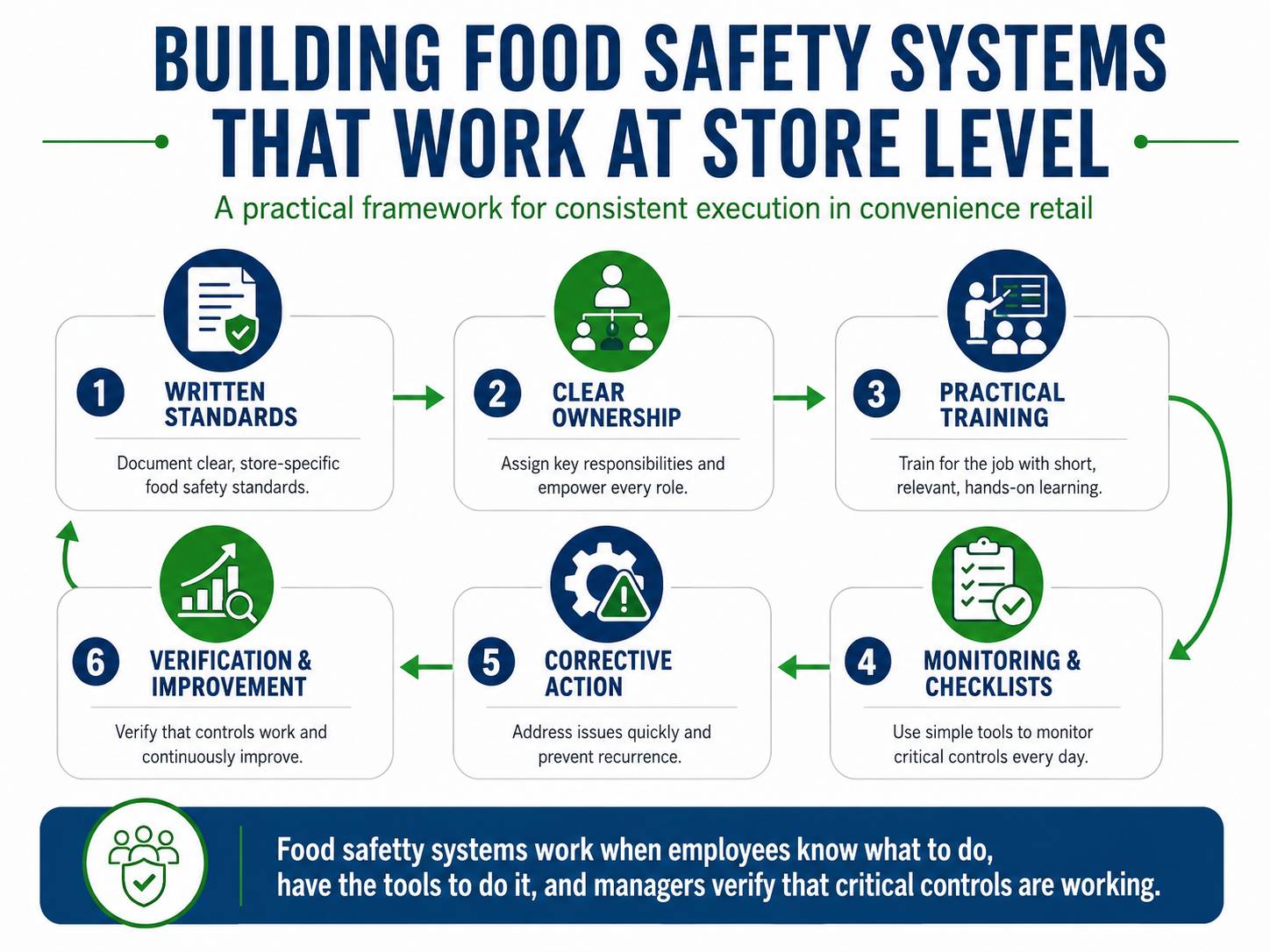
Corporate policies provide consistency across locations, but they cannot remain broad statements such as “maintain proper temperatures” or “clean equipment regularly.” Employees need instructions that define the action precisely.
For temperature control, that means identifying which products and equipment must be checked, the acceptable range, the frequency of the check, the approved thermometer, the person responsible, and the corrective action required when a reading is outside the limit. For cleaning, it means defining how equipment is disassembled, which chemical is used, the correct concentration, how long surfaces must remain wet, and who verifies completion.
The U.S. Food and Drug Administration describes active managerial control as a preventive approach in which management deliberately incorporates procedures into daily operations to control foodborne-illness risk factors through continuous monitoring and verification. The FDA’s Retail and Food Service HACCP guidance provides a framework for adapting these principles to operations ranging from limited foodservice to highly complex preparation environments.
The practical lesson is that policies should be written from the employee’s point of view. What must be done? When must it happen? What equipment or supplies are needed? What result is acceptable? What happens when the result is not acceptable? A policy becomes operational only when those questions have clear answers.
Food-safety tasks are vulnerable when they are assigned to everyone in general but no one in particular. A statement that “staff should check refrigeration temperatures” may produce inconsistent results because responsibility shifts from one employee to another throughout the day.
Each recurring control should have a defined owner. The opening employee may verify refrigeration and sanitizer concentrations. The foodservice lead may check cooking and holding temperatures during peak periods. The closing employee may complete equipment disassembly and sanitation. The manager on duty may review records and corrective actions before the shift ends.
Ownership should also extend above the store level. District and regional leaders need visibility into recurring failures, overdue maintenance, training gaps, and patterns that affect multiple locations. A refrigerator that repeatedly drifts above its approved range is not merely a documentation issue. It may indicate a maintenance, equipment, loading, or workflow problem that requires intervention beyond the store.
Certification can strengthen managerial oversight. CDC research has found that restaurants with certified kitchen managers were less likely to experience foodborne-illness outbreaks, and states adopting Food Code provisions requiring certified managers had fewer norovirus outbreaks. CDC guidance on certified kitchen managers also emphasizes that certification demonstrates tested food-safety knowledge, though effective execution still requires management presence and follow-through.
Certification is not a substitute for accountability. Its greatest value comes when knowledgeable managers actively coach employees, investigate deviations, and reinforce expectations during ordinary shifts.
Food-safety training often occurs away from the conditions in which employees will use it. A worker may complete a video or online module successfully but still struggle to perform the procedure during a breakfast rush, while assisting customers, restocking products, and responding to equipment alerts.
Training should therefore include demonstration, supervised practice, and observation in the actual work environment. Employees need to rehearse checking food temperatures, calibrating thermometers, testing sanitizer concentrations, changing gloves correctly, separating raw and ready-to-eat ingredients, cleaning equipment, and responding to a refrigeration failure.
Training should also address judgment. Employees must know when food should be discarded, when equipment should be removed from service, when a manager must be contacted, and when an illness prevents them from handling food. The goal is not merely to memorize a rule but to recognize the condition the rule is designed to prevent.
The approach connects directly with Training Foodservice Employees for Consistent Execution, which examines how demonstration, reinforcement, coaching, and practical routines help employees execute foodservice standards consistently.
Refresher training should respond to observed conditions rather than follow the calendar alone. If managers repeatedly see incomplete date marking, poor glove practices, or incorrect sanitizer readings, those behaviors should trigger immediate retraining and follow-up verification.
Checklists are useful because they make recurring tasks visible and reduce reliance on memory. They can support opening inspections, temperature checks, cleaning schedules, employee-health confirmation, equipment shutdown, and closing verification.
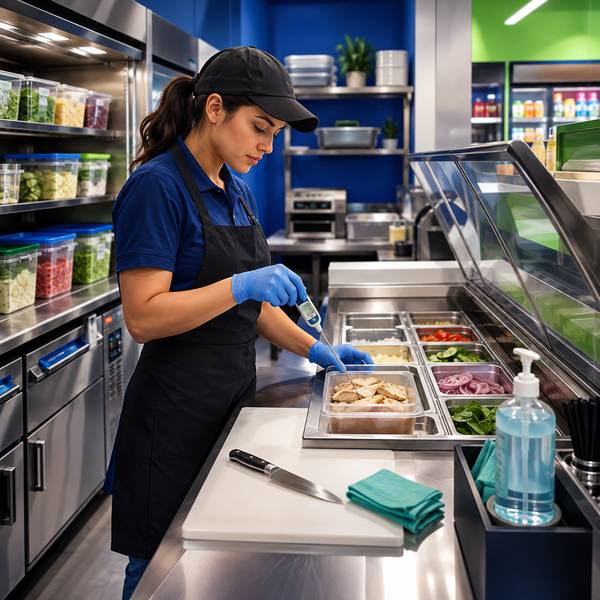
However, a completed checklist does not prove that the underlying work was done correctly. Employees may enter expected numbers, mark tasks complete without inspecting them, or repeat yesterday’s information. A food-safety system becomes vulnerable when documentation is treated as the objective instead of evidence that the control occurred.
Effective checklists are concise, relevant to the shift, and tied to corrective action. If a cooler is too warm, the form should not simply provide a place to record the reading. It should guide the employee through immediate steps: recheck the temperature, assess the food, move product when appropriate, notify the manager, initiate maintenance, and document the final disposition.
Managers should periodically observe the task while it is being performed. Comparing the actual procedure with the completed record helps reveal whether employees understand the process or are merely completing paperwork.
Checklists should also evolve. Menu changes, new equipment, recurring inspection findings, product recalls, and store-layout revisions may create controls that were not present when the original form was designed. A checklist that never changes can quietly become disconnected from the operation it is supposed to protect.
Digital systems can improve food-safety execution by making information faster to collect, easier to review, and more difficult to overlook. Connected refrigeration sensors can detect temperature changes. Digital thermometers can transmit readings directly to a record. Task-management systems can assign responsibilities and escalate missed checks. Mobile forms can require photographs, timestamps, corrective actions, or manager approval.
The strongest applications reduce friction while increasing reliability. An employee should not have to navigate several screens to record a routine temperature. A manager should not receive so many alerts that meaningful warnings become background noise. Technology must fit the workflow and direct attention toward genuine risk.
Digital records can also reveal patterns that paper logs conceal. Leaders may discover that one unit repeatedly warms during deliveries, that a store misses checks during a particular daypart, or that sanitizer failures increase when supplies run low. Those patterns support better equipment, staffing, purchasing, and training decisions.
Technology does not transfer responsibility away from employees. A sensor may report that a cooler is warm, but a person must still determine what happened, protect the food, and confirm that the condition was corrected. Automation is most useful when it strengthens human action rather than creating the impression that the system is managing itself.
Internal audits are often treated as rehearsals for regulatory inspections. That is useful, but the larger purpose should be identifying why the system is not producing consistent results.
An audit should examine more than whether records exist. It should observe employee practices, inspect the physical environment, review corrective actions, verify equipment performance, and evaluate whether managers understand the risks associated with the menu. Repeated failures should lead to root-cause analysis rather than repeated reminders.
For example, employees may continually miss a cleaning task because the required tools are stored in another part of the building. Temperature checks may be late because responsibility changes during a shift transition. Handwashing may decline during peak periods because the sink is inconveniently positioned or supplies are frequently depleted. These are system problems as much as employee-performance problems.
Audit results should be prioritized according to risk. A missing signature and an unsafe food temperature are not equivalent findings. Treating every deviation as equally important can bury serious hazards inside administrative details.
Store managers should receive feedback quickly, along with clear expectations for correction. District leaders should review recurring patterns across locations and determine whether the problem requires revised training, additional labor, maintenance, equipment replacement, or a change in the operating procedure.
Food-safety systems are tested most severely when stores are busy, short-staffed, or dealing with equipment problems. Employees watch what managers prioritize during those moments. If unsafe shortcuts are tolerated to preserve speed, the practical standard becomes different from the written standard.
Former FDA Deputy Commissioner for Food Policy and Response Frank Yiannas summarized the connection plainly:
“Food safety equals behavior.”
Yiannas argued that rules and compliance activities are necessary but insufficient without a culture that changes human behavior and makes food safety part of daily organizational thinking.
CDC research identifies leadership, manager commitment, employee commitment, and adequate resources as central components of a strong food-safety culture. Managers help establish that culture through visible personal commitment, useful policies, effective training, two-way communication, and the supplies employees need to work safely. CDC’s food-safety culture research also notes that short staffing and insufficient space or resources can undermine safe practices.
A strong culture does not mean mistakes never occur. It means employees are expected to report problems, managers respond constructively, and the organization learns from failures. Workers should be able to discard questionable food, stop using malfunctioning equipment, or report illness without believing they will be punished for slowing service or increasing waste.
Store-level food safety should function as a cycle. Standards define the expected practice. Training prepares employees to perform it. Monitoring shows whether it occurred. Corrective action addresses deviations. Verification confirms that the correction worked. Leadership then uses the results to improve the system.
This cycle prevents food safety from becoming a collection of isolated tasks. A missed temperature check becomes information about staffing or workflow. An improperly cleaned component becomes information about equipment design or training. A repeated refrigeration alarm becomes information about maintenance or capacity.
The best systems are rigorous without being unnecessarily complicated. They focus attention on the highest-risk activities, give employees practical instructions, and provide managers with meaningful evidence of performance. They also distinguish between an occasional mistake and a recurring operational weakness.
As convenience-store foodservice grows, retailers should expect their food-safety systems to mature with it. A program designed for limited grab-and-go products may no longer be sufficient after the addition of raw ingredients, expanded dayparts, commissary items, or made-to-order service. Growth requires deliberate reassessment of policies, staffing, equipment, training, and verification.
Food-safety policies create expectations, but store-level systems turn those expectations into customer protection. Reliable execution depends on clearly assigned responsibility, practical training, useful checklists, appropriate technology, risk-focused auditing, and managers who reinforce safe behavior during every shift.
Convenience retailers do not need systems that create paperwork for its own sake. They need systems that help employees recognize risk, take the correct action, and demonstrate that critical controls are working. When those systems reflect real store conditions, food safety becomes more consistent, manageable, and scalable across the organization.

Subscribe to receive latest news
12968 Vallejo Circle, Westminster CO. 80234
Phone: (303) 604-1064
Contact Us