





ustainability in convenience store foodservice is moving from a nice-to-have to a business requirement. New packaging laws are taking effect in several states, waste-tracking technology is becoming easier to use, and shoppers are paying closer attention to what happens to the food and packaging they leave behind. At the same time, margins remain tight, and few operators can afford programs that look good on paper but add cost without results.
As It’s All Goods explained in Practical Strategies to Reduce Foodservice Waste, the most reliable sustainability gains start with better forecasting, portioning, and data. This article looks ahead at the forces that may shape sustainable foodservice over the next several years, and at how retailers can respond in ways that protect both their responsibilities and their profitability.
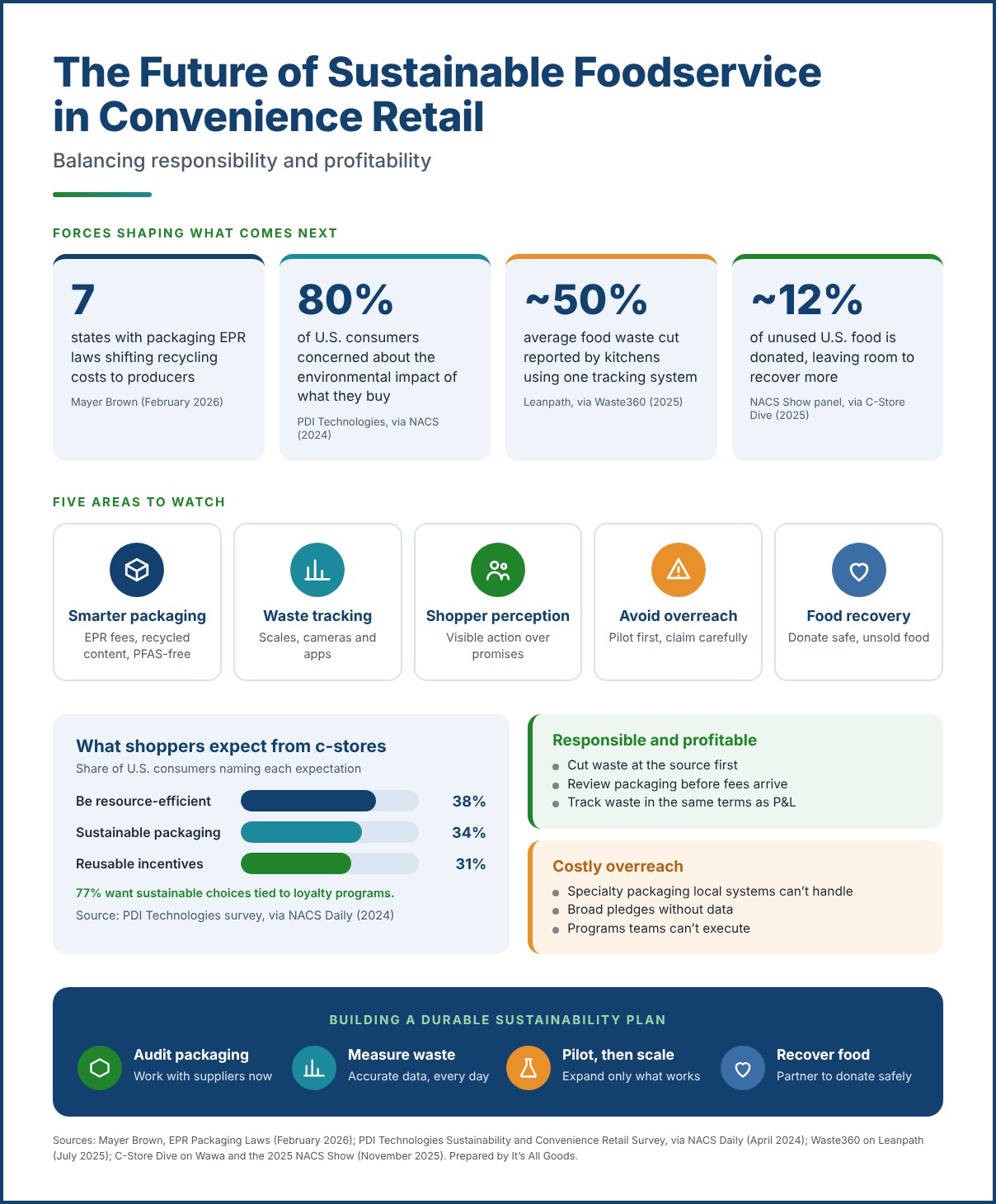
Packaging is likely to be the most visible area of change, largely because regulation is forcing the issue. Extended producer responsibility, or EPR, laws shift the cost of recycling and disposing of packaging from local governments to the companies that sell packaged products. According to a February 2026 review by law firm Mayer Brown, seven states now have packaging EPR statutes: California, Colorado, Maine, Maryland, Minnesota, Oregon, and Washington. Oregon’s program began in July 2025, Colorado producers had to join a producer responsibility organization by the same date, and California producers must join by January 2027.
The details vary by state, but the direction is clear. Depending on the jurisdiction, the “producer” responsible for fees can include a brand owner, a manufacturer, an importer, or a distributor or retailer. Some laws specifically cover food serviceware and food packaging. For c-stores with private-label food or proprietary foodservice packaging, that means packaging choices may soon carry a direct, recurring cost.
Packaging suppliers are responding with lighter materials, more recycled content, and designs that avoid hard-to-recycle components. Paul McCann, CEO of packaging maker Sabert, wrote in Packaging Digest in January 2026 that more sustainable packaging is associated with lower EPR fees, and that post-consumer recycled content can help customers lower those fees while still meeting performance needs. He also noted growing operator interest in packaging made without PFAS, the so-called “forever chemicals.” For retailers, the smart move is to review packaging with suppliers now, before fees and deadlines arrive, and to favor changes that also hold up on cost, food safety, and performance.
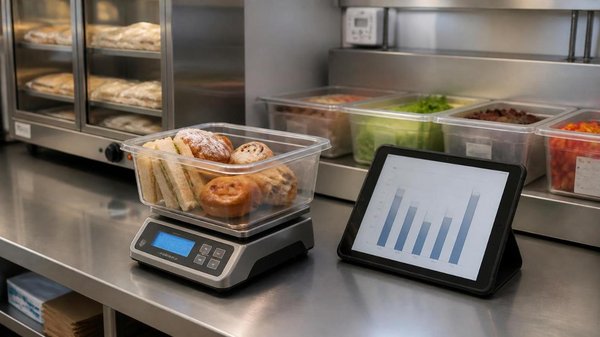
The second major shift is in how waste is measured. For years, many stores recorded waste on paper logs, if at all. Newer tools make it easier to capture what is thrown away, why, and when, and to turn that information into better production decisions.
Commercial kitchens offer a preview of what is possible. Leanpath, which provides food waste tracking systems with scales, cameras, and mobile apps, says most of its clients report an average food waste reduction of 50%, along with a 2% to 6% reduction in purchase costs, according to Waste360. One hospital customer, Carle Health, cut wasted food by just over 40% in its first year and saved almost $60,000. Most of the remaining waste it tracked came from overproduction, which shows how tracking tools point directly at the process to fix.
These are vendor-reported results in institutional kitchens, not c-stores, but the lesson carries over. As tracking becomes simpler, faster, and more connected to point-of-sale and forecasting systems, waste data will move from an end-of-day afterthought to a real-time management tool. Retailers that build the habit of recording waste accurately today will be ready to use those tools well.
Technology is not a substitute for discipline, however. A camera or scale only helps if store teams use it consistently and managers act on what it shows. The most effective programs combine simple tools with clear ownership and regular reviews.
Shoppers say sustainability matters to them, and that interest has been growing. In the fourth annual sustainability and convenience retail survey from PDI Technologies, reported by NACS Daily in April 2024, 80% of U.S. consumers said they were very or somewhat concerned about the environmental impact of the products they buy, up from 68% in 2023 and 66% in 2022. When comparing two similar products priced at $10 or less, 71% said they would choose the one that follows sustainable practices.
The same survey shows what consumers expect from convenience stores specifically. Their top expectation was that c-stores be resource-efficient, cited by 38% of respondents, followed by sustainable packaging and recycling at 34% and incentives to use reusable bags or containers at 31%. Notably, 77% of consumers said they were interested in pairing sustainable products and services with loyalty programs.
Those findings point to a practical reality. Shoppers are less interested in big promises than in visible, everyday actions: less waste, better packaging, easy recycling, and rewards for making sustainable choices. Their concern also does not always translate into paying more at the counter, especially for foodservice items where price and speed still drive most decisions. For c-stores, sustainability works best when it supports value and convenience rather than competing with them.
Not every sustainability initiative pays off. Some programs add cost, complexity, or labor without meaningfully reducing waste or improving the customer experience. Others make claims that customers find hard to believe, which can damage trust rather than build it.
Common forms of overreach include switching to specialty packaging that costs more but cannot be composted or recycled locally, launching broad pledges without the data to track progress, and adding programs that store teams cannot execute consistently during busy shifts. Even well-intended steps, such as adding several new waste streams at once, can confuse employees and customers if the store does not have the space, training, or local infrastructure to support them.
A better approach is to test before scaling. Pilot a packaging change or a food recovery program in a few stores, measure the cost and results, and expand only what works. Favor actions that reduce waste at the source, because those tend to save money as well as resources. And make claims carefully, sticking to specific, verifiable results rather than broad statements about being “green.”
The most durable sustainability strategies in convenience retail will be the ones that fit how stores actually operate. That means building on the basics: accurate forecasting, smaller batches, consistent portions, honest waste tracking, and packaging that works for both the product and the local recycling system.
Food recovery is one area where responsibility and practicality align well. Only about 12% of unused food in the United States is donated, according to panelists at the 2025 NACS Show. Federal law offers support: the Bill Emerson Good Samaritan Food Donation Act protects donors who give apparently wholesome food in good faith through qualifying channels, and some businesses may also qualify for tax benefits. Retailers can start small, with one or two stores and shelf-stable items, and work with established partners that handle logistics and reporting.
Sustainability goals should also be connected to the metrics operators already track. A lower waste rate, reduced packaging fees, and fewer trash pickups all show up in the profit and loss statement. When sustainability is measured in the same terms as the rest of the business, it becomes easier to justify, easier to sustain, and easier to communicate credibly to customers.
Wawa offers an example of a sustainability program designed to run as part of everyday store operations. According to C-Store Dive, the chain began its food donation program in 2013 with the nonprofit Food Donation Connection. Wawa’s quality assurance team decides which items can be donated, and stores set aside refrigerator and freezer space for perishable donations. Food Donation Connection collects the food in green thermal bags and delivers it to local organizations that distribute it to community members.
The program now spans hundreds of stores and has donated 150 million pieces of food since it began. Donated items include cooked and prepared foods and individually wrapped bakery items, the same categories that make up much of a c-store’s foodservice waste risk. Speaking at the 2025 NACS Show, Jason Read, Wawa’s director of store operations, said the program works whether a retailer has one store or more than 100.
“I can’t begin to impress upon you how easy it is to execute this on a daily basis.”
— Jason Read, Director of Store Operations, Wawa
Wawa’s approach reflects the balance this article describes. The program does not replace efforts to make the right amount of food in the first place. Instead, it gives safe, unsold food a better destination than the trash, using clear rules, a reliable partner, and a routine that store teams can follow every day.
Sustainable foodservice in convenience retail is likely to be shaped by regulation, technology, and steadily rising customer expectations. Packaging laws will put a price on packaging choices. Waste-tracking tools will make waste easier to see and manage. And shoppers will continue to reward visible, practical action more than broad promises.
Retailers that succeed will treat sustainability as an extension of operational discipline rather than a separate initiative. They will review packaging before fees arrive, build accurate waste data now, pilot new programs before scaling them, and use food recovery to give unsold food a better outcome. In the years ahead, the operators that balance responsibility with profitability will be the ones best positioned to grow.
Extended producer responsibility laws shift packaging recycling and disposal costs to the companies that sell packaged products. Seven states have enacted them, and depending on the state, producers can include brand owners, distributors, or retailers.
Waste-tracking tools using scales, cameras, and apps record what is thrown away and why. In commercial kitchens, users of one such system report an average 50% reduction in food waste.
Yes. In a PDI Technologies survey, 80% of U.S. consumers were concerned about the environmental impact of what they buy, and their top expectation for c-stores was resource efficiency.
It can be. Wawa’s program, run with a nonprofit partner, has donated 150 million pieces of food. Federal law protects good-faith donors, and retailers can start with a small pilot.
Pilot changes before scaling them, focus first on reducing waste at the source, choose packaging that works with local recycling, and make only specific, verifiable claims.

Subscribe to receive latest news
12968 Vallejo Circle, Westminster CO. 80234
Phone: (303) 604-1064





