





nowing that waste hurts margins is the easy part. Reducing it, shift after shift and store after store, is harder. Waste in convenience store foodservice rarely comes from a single bad decision. It builds up from small, repeated gaps: a warmer filled too early, a portion that runs a little heavy, a pan left past its hold time, or a sales pattern no one has looked at in months.
As It’s All Goods explained in Why Waste Reduction Matters in Convenience Store Foodservice, waste is best treated as a signal that a process needs attention. This article turns that idea into practice. It covers five areas where operators can take control, from forecasting and production to rotation, portioning, training, and data, so that waste reduction becomes part of how the store runs every day rather than a one-time project.
Most foodservice waste is decided before a single item goes in the warmer. When production is based on habit or a rough sense of what sold yesterday, stores tend to overproduce during slow hours and run short during busy ones. A forecast built on actual sales by hour gives teams a far better starting point.
That forecast does not need to be complicated. At InConvenience Inc., which operates The Gas Spot and The Goods Spot stores in Arkansas, Iowa and Missouri, category manager Erin Slater told CSP that the team pulls item-level sales by store by hour from its back-office system and uses them to build store-specific warmer schedules. Because the stores were new, the team compared results week over week and month over month rather than waiting for a full year of history.
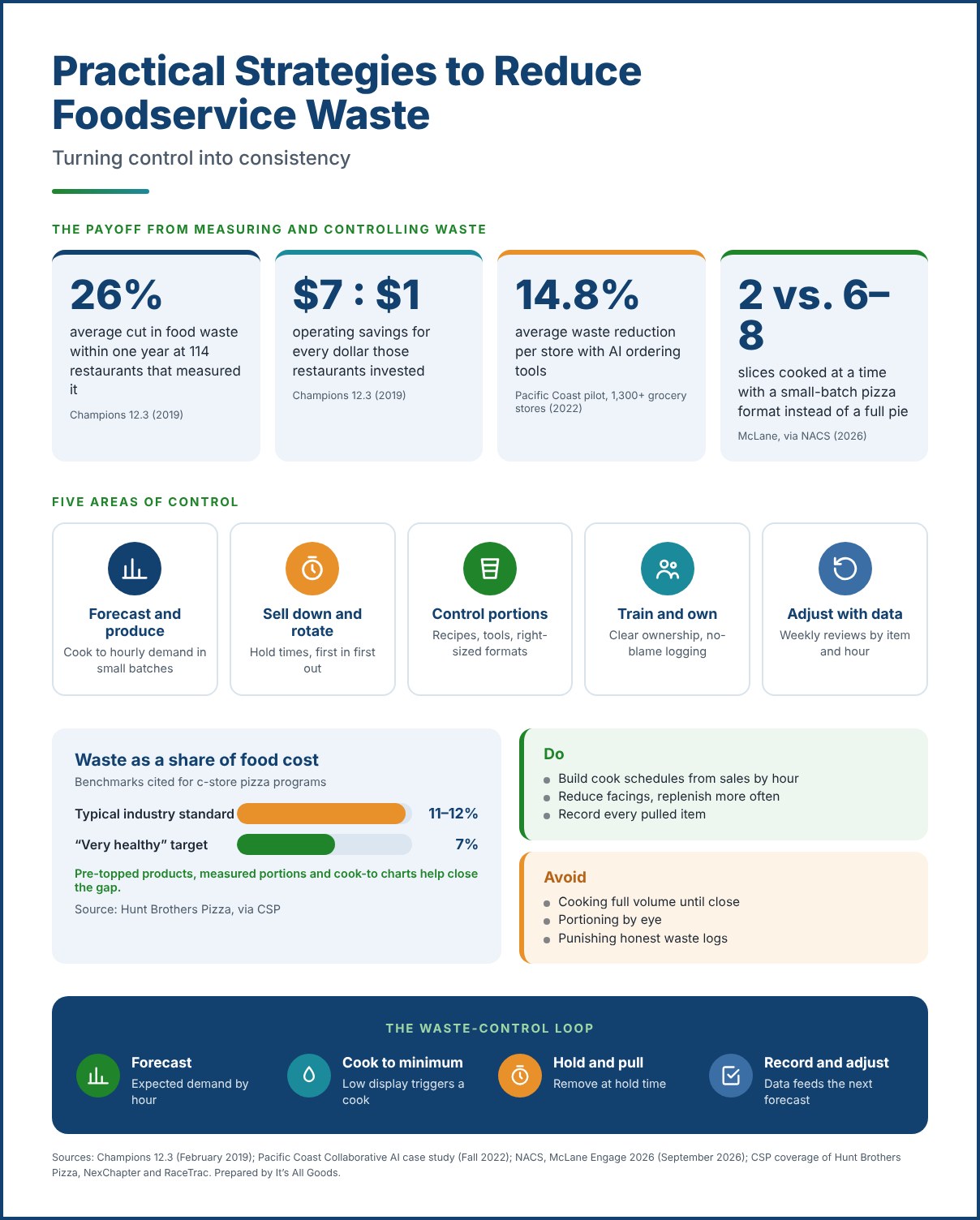
Production should follow the forecast in small, frequent batches. Cooking smaller quantities more often keeps food fresher and limits how much is at risk if traffic slows. Some suppliers are designing products around this idea. Farley Kaiser, vice president of retail foodservice at McLane Company, told NACS that many retailers throw away several slices of every pizza, and described a two-slice format that lets stores cook to demand: “Instead of cooking six or eight slices, you’re cooking two slices.”
Technology can sharpen the forecast further. In April 2026, NACS reported that AI tools are helping retailers take the guesswork out of ordering and production. Wawa, for example, selected machine learning-based forecasting and replenishment software for its stores with the stated goal of reducing spoilage. Whether a store uses advanced software or a simple spreadsheet, the principle is the same: produce to expected demand, by hour, and adjust as real sales come in.
Once food is made, the goal is to sell it while it is at its best. That requires clear rules for how long each item can be held, how cases are refilled, and what happens as the day winds down.
Hold times are the foundation. Every hot and fresh item should have a defined hold time, a visible way to track it, and a clear expectation that expired product is removed and recorded. Without hold times, quality slips and customers notice. With them, teams know exactly when food must be pulled and can plan production to avoid reaching that point.
Rotation keeps older product moving first. In grab-and-go coolers, that means placing newer items behind older ones and checking dates at set times. In hot cases, it means refilling with fresh product in a way that keeps the oldest item at the front of the customer’s reach.
How a case is stocked matters as much as how much is in it. Mendy Meriwether, vice president of foodservice practice at consulting firm NexChapter, recommends reducing product facings and replenishing more often, noting that stores can keep cases looking full without overstocking. During slower periods, complementary packaged items such as beverages can help fill space without adding fresh food at risk.
Late-day sell-down also deserves a plan. Rather than cooking at full volume until close, stores can shift to smaller batches in the evening, bundle items nearing the end of their hold time into meal deals, or reduce the assortment in the last hours of the day. Meriwether suggests repurposing near-expired products into limited-time bundles to move them before they become waste.
Portioning is one of the least visible sources of waste and lost margin. A sandwich built with a little extra meat, a bowl filled slightly past the line, or a pizza topped by eye rather than by measure may not look like waste, but over hundreds of items each day it adds up to higher food cost and inconsistent quality.
The fix is to make the right portion the easy portion. Standard recipes, portioning tools, and visual guides remove guesswork. Hunt Brothers Pizza, which supplies pizza programs to convenience stores, gives operators color-coded measuring cups and recipe cards so team members know exactly how much of each topping to use. Dee Cleveland, the company’s director of marketing, summed up the approach simply: “It’s basically reading what needs to be done and following it.” The company puts typical industry waste at about 11% to 12% of overall food cost, and considers 7% a very healthy number for its pre-topped pizzas, showing how much room consistent build standards can create.
Portion sizes should also match how customers eat. Smaller formats, such as single slices, half sandwiches, and snack-size sides, can reduce plate waste and help stores sell more of what they make. When portions fit customer demand, fewer items go unsold and fewer are thrown away after purchase.
Even the best forecast and recipe cards fail without people who understand them. Training should cover not just how to make each item, but why hold times, portions, and production schedules matter. When team members understand the cost of waste, they are more likely to follow the process during a busy shift.
Accountability works best when it encourages honesty. If employees fear blame for every item they throw away, they may stop recording waste accurately, and the data becomes useless. Leading operators take the opposite approach. They want every pulled item recorded so they can understand what happened and fix the cause. Meriwether frames the question directly: “Who owns waste?” Clear ownership, whether it sits with a store manager, a foodservice lead, or a shift supervisor, gives the effort a home.
Recognition helps, too. Meriwether suggests rewarding stores that meet their waste targets. Sharing results across stores, celebrating improvement, and treating waste data as a coaching tool rather than a disciplinary one all build the habits that keep waste low over time.
Waste data is only useful if someone acts on it. Meriwether’s advice is to move beyond tracking what is thrown away, which is reactive, toward reviewing waste by category each week and working with operations teams to adjust production, assortment, and staffing. “You can’t manage what you can’t measure,” she said.
The evidence suggests that measurement pays off. In a study of 114 restaurants in 12 countries, Champions 12.3 found that sites cut food waste by an average of 26% within one year and saved $7 in operating costs for every $1 invested. The most common investments were measuring and monitoring waste, training staff, and redesigning menus. In retail, a Pacific Coast Food Waste Commitment pilot across more than 1,300 grocery stores found that AI-based ordering tools reduced food waste by an average of 14.8% per store.
For c-stores, the practical rhythm is simple. Review waste and sales by item and by hour each week. Look for items with consistently high waste, hours where production runs ahead of demand, and items that regularly sell out. Then make one or two specific changes, such as adjusting a cook-to chart, trimming a slow item, or shifting a batch later, and measure the result the following week.
Atlanta-based RaceTrac offers a clear example of how forecasting, hold times, and honest data work together. According to the same CSP report, the chain sets presentation minimums for its hot food cases based on each store’s volume. When a store’s display drops to that minimum, it triggers a new cook, so production follows real demand instead of a fixed schedule. During peak hours, high-volume stores carry a larger set.
Each item has a defined hold time based on sensory and quality audits. Once a pizza reaches its hold time, it is removed and recorded electronically as waste. Tony DeSerto, RaceTrac’s director of hot foods and dispensed, said the company wants team members to record all waste, even accidents, because it is better to know what happened than not to know.
“We never sacrifice guest experience and ensure we base all our hold times on sensory/quality thresholds.”
— Tony DeSerto, Director of Hot Foods and Dispensed, RaceTrac
That data then feeds back into forecasting, purchasing, and item-level planning. The result is a loop that connects every step covered in this article: forecast demand, produce in response to it, hold food to a clear standard, record what is pulled, and use the data to improve the next forecast. As DeSerto put it, “Nobody wants to grab that last slice.”
Reducing foodservice waste is not about a single program or tool. It comes from consistent control at each step of the process. Operators who want to make progress can start with a few practical moves: build production schedules from sales by hour, cook in smaller and more frequent batches, set and enforce hold times, standardize portions with simple tools, train teams on why the process matters, and record waste honestly.
Most important, treat waste data as a weekly management tool. Review it by item and by hour, make small changes, and measure the result. Over time, that discipline turns waste control from a constant struggle into a consistent routine, protecting margins while keeping food fresh for customers.
Start with production. Build cook schedules from item-level sales by hour, cook in smaller and more frequent batches, and adjust as real sales come in. Most waste is decided before food reaches the warmer.
Hold times protect quality and give teams a clear rule for when food must be pulled. Recording each pulled item also creates data that helps stores improve future production plans.
Standard recipes, measuring tools, and visual guides keep portions consistent, which controls food cost and quality. Portion sizes that match customer demand also reduce unsold food and plate waste.
No. Operators get better data when employees feel safe recording all waste, including accidents. Clear ownership, coaching, and recognition for meeting targets work better than blame.
Evidence suggests it does. In a Champions 12.3 study of 114 restaurants, sites cut food waste by 26% on average within a year and saved $7 for every $1 invested in measurement, training, and menu changes.

Subscribe to receive latest news
12968 Vallejo Circle, Westminster CO. 80234
Phone: (303) 604-1064





