

quipment choices can determine whether a convenience-store foodservice program performs consistently or becomes a daily source of friction. The right tools help employees prepare food quickly, protect product quality, manage demand, and maintain predictable operating standards. The wrong tools can create bottlenecks, increase cleaning and training requirements, consume valuable space, and leave the store unable to serve customers when equipment fails. Successful selection therefore begins not with the newest machine or the longest feature list, but with a realistic understanding of the menu, labor model, customer demand, and operating environment.
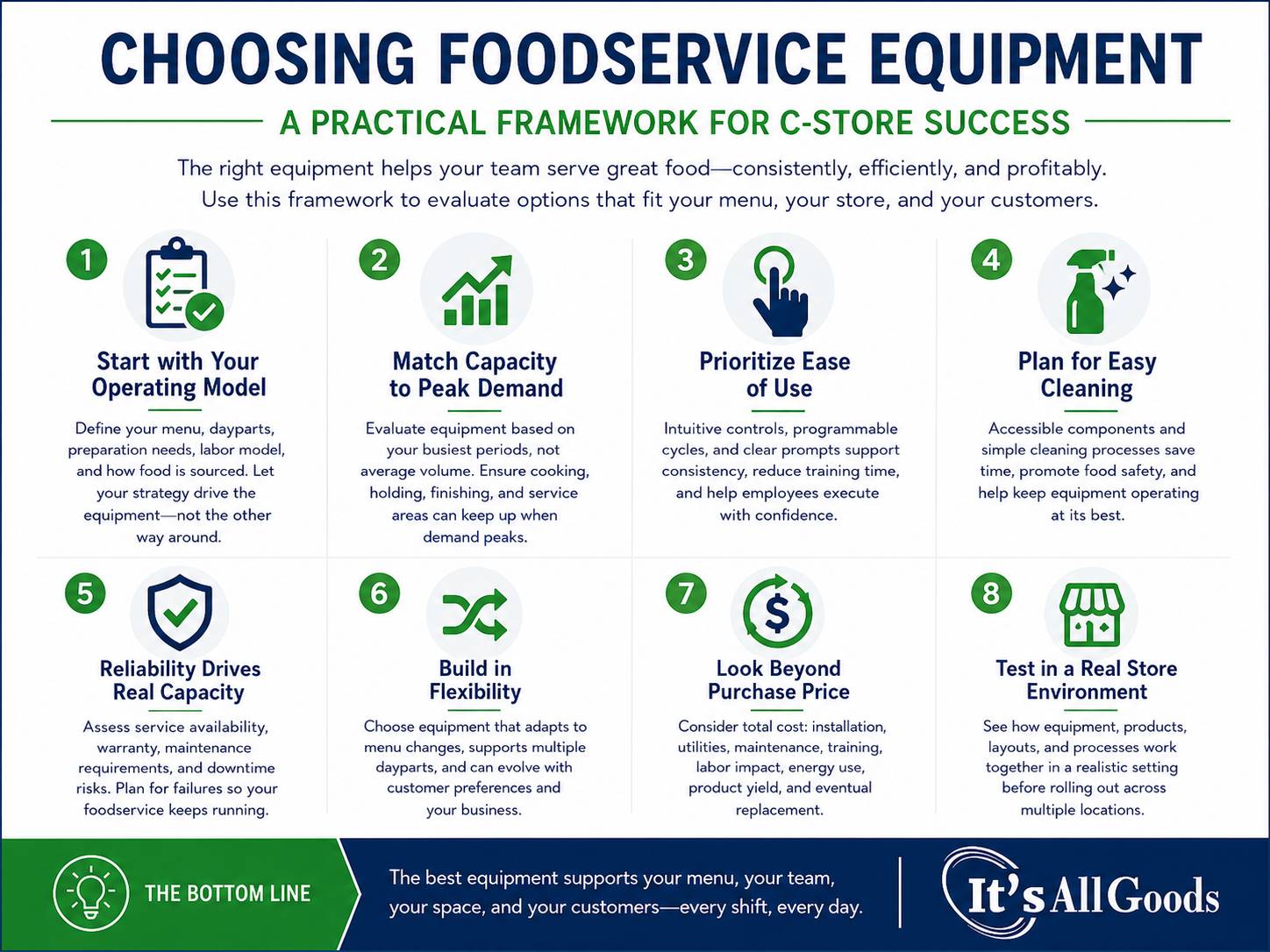
Before comparing individual ovens, fryers, refrigeration systems, holding units, or preparation equipment, retailers should define how the foodservice program is expected to operate.
A made-to-order kitchen has different requirements from a primarily grab-and-go program. A store serving breakfast, lunch, dinner, and late-night customers may need equipment that can transition rapidly between products and dayparts. A smaller location with limited staffing may benefit from simplified platforms that reduce preparation steps, while a high-volume store may require greater capacity and more specialized stations.
The operating model should answer several fundamental questions. What will be prepared on site? Which products arrive fresh, frozen, refrigerated, or fully cooked? How much preparation occurs before peak periods? How long can finished food be held without compromising quality? Which menu items share ingredients, cooking methods, or assembly steps? How many employees will operate the kitchen at one time?
These decisions establish what the equipment must accomplish. They also help prevent a common mistake: purchasing an impressive piece of equipment and then building the menu around its capabilities. Equipment should support the food strategy—not dictate it.
This principle reinforces the systems approach described in Operational Changes That Powered the Rise of C-Store Foodservice. Kitchen design, staffing, equipment, menus, and procedures must work together if foodservice is expected to scale reliably.
Manufacturer specifications often describe how much food a machine can produce under controlled conditions. Store operators need to understand how that capacity translates into actual customer demand.
Average volume alone is not enough. Equipment should be evaluated against the busiest breakfast period, the lunch rush, promotional demand, weekends, seasonal traffic, and sudden surges. A unit that performs adequately most of the day may still become the limiting factor when the store has its greatest opportunity to make sales.
Useful capacity questions include how many portions can be produced per cycle, how long the cycle takes, how quickly the unit recovers, and whether products can be added continuously or only in batches. Retailers should also consider what happens immediately after cooking. Adequate production capacity provides little benefit when the finishing station, holding equipment, packaging area, or pickup counter cannot keep pace.
Oversizing every piece of equipment is not the answer. Larger equipment may require more energy, ventilation, cleaning time, and floor space. The goal is balanced capacity across the full production line. Cooking, preparation, holding, and service should support one another without creating an expensive surplus in one area and a bottleneck in another.
Convenience-store employees frequently balance food preparation with stocking, customer service, cleaning, receiving, and other store responsibilities. Equipment must therefore be evaluated in the context of a workforce that may not include dedicated culinary specialists on every shift.
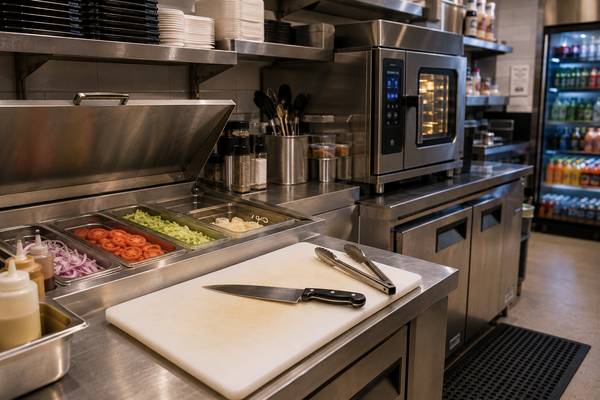
Simple, intuitive controls can improve execution. Programmable cooking cycles, clear visual prompts, automatic shutoffs, and repeatable settings reduce the number of decisions employees must make under pressure. Equipment that is easy to operate can shorten training time and make performance more consistent across locations and shifts.
Ease of use should not be confused with lack of capability. Advanced equipment can simplify work when its technology automates genuinely useful steps. Problems arise when additional functions create menus, screens, settings, and maintenance requirements that employees rarely use.
Cleaning is equally important. Components should be accessible, removable where appropriate, and compatible with the store’s sanitation procedures. A machine that is difficult to clean is more likely to be cleaned inconsistently, take longer to return to service, or create resistance among employees.
The most useful equipment makes correct execution easier. It reduces unnecessary decisions, supports repeatable processes, and allows employees to focus on product quality and customer service.
McLane opened its Innovation Kitchen at its Temple, Texas, headquarters in May 2024. The facility was designed as a full-scale replica of a convenience-store environment where customers can examine how foodservice equipment, products, layouts, counter spaces, planograms, and marketing materials work together before implementing them in operating stores.
The environment allows retailers to visualize equipment within realistic footprints rather than evaluating individual machines in isolation. Customers can test equipment, sample products, review merchandising, and consider how different solutions fit their store layouts and foodservice strategies. McLane also uses the facility to develop and test menu concepts through its McLane Fresh program.
“Through this platform for product testing, creation and display, we have the opportunity to engage with customers at every stage of their retail foodservice journey.”
Vito Maurici, McLane Chief Customer Experience Officer
McLane’s Innovation Kitchen illustrates an important equipment-selection principle: realistic testing should occur before broad implementation whenever possible. A demonstration environment cannot reproduce every condition inside an operating store, but it can reveal workflow conflicts, space limitations, training concerns, product-quality issues, and merchandising opportunities that may be missed when equipment is evaluated only through specifications or sales presentations.
Retailers considering substantial equipment investments can apply the same logic on a smaller scale. A pilot store, temporary test station, supplier demonstration, or limited-market trial can provide valuable evidence before a system is deployed across multiple locations.
A machine’s theoretical capacity matters only while the machine is operating.
Reliability should be evaluated through warranty coverage, expected service life, maintenance requirements, local technician availability, replacement-part access, and typical repair time. Equipment from a capable manufacturer may still be a poor fit when trained service providers are located far from the retailer’s operating market.
Preventive maintenance requirements should be understood before purchase. Filters, seals, belts, sensors, heating elements, refrigeration components, software updates, calibration procedures, and ventilation systems may all require attention. The retailer needs to know who performs that work, how often it occurs, what it costs, and whether the equipment must be taken out of service.
Stores should also plan for failure. Which menu items become unavailable if a key unit stops working? Can another piece of equipment provide limited backup? Can the menu be adjusted temporarily? Are essential replacement parts stored locally? Does the service agreement provide emergency support?
Redundancy does not always require duplicate machines. It can come from menu flexibility, shared cooking platforms, alternative preparation methods, or equipment capable of supporting several products. The objective is to prevent one failure from shutting down an entire foodservice program.
Equipment is generally expected to remain in service longer than many individual menu items. Retailers should therefore consider whether a proposed system can accommodate reasonable changes in consumer demand, product formats, ordering channels, and operating strategy.
Flexible equipment may support multiple menu categories, programmable cooking profiles, adjustable temperature zones, or modular accessories. It may allow a retailer to introduce a limited-time offer without adding another single-purpose machine. It can also make it easier to change the balance between made-to-order and grab-and-go production.
However, flexibility has limits. Equipment marketed as capable of doing everything may perform several functions adequately without performing the store’s most important function especially well. Retailers should prioritize the products that drive the program and treat secondary capabilities as additional value rather than the primary purchasing rationale.
Flexibility should also extend to physical installation. Utility connections, clearances, counter systems, ventilation, and data infrastructure should allow equipment to be replaced or reconfigured without major reconstruction. That connection between equipment and infrastructure becomes increasingly important as kitchens evolve.
The most valuable flexibility is practical. It helps the store respond to menu changes without adding complexity that undermines everyday execution.
Initial price is only one component of an equipment investment.
A complete evaluation should consider installation, electrical or plumbing upgrades, ventilation, freight, employee training, cleaning supplies, energy and water use, scheduled maintenance, service agreements, replacement parts, downtime, financing, and eventual replacement.
Labor can be especially significant. Equipment that reduces preparation steps, supports batch consistency, or simplifies cleaning may cost more initially while lowering operating demands over its useful life. Conversely, a lower-priced machine may become expensive when it requires frequent attention, specialized training, or repeated repairs.
Product yield also influences value. Accurate temperature control, portion consistency, and predictable cooking cycles can reduce waste and improve finished-food quality. Those gains may be difficult to see on a purchase order but meaningful across thousands of transactions.
The right comparison is therefore not simply one machine against another. It is the total cost and operational contribution of each system over time. Retailers should ask which option best supports throughput, quality, labor, reliability, and menu strategy—not merely which one has the lowest acquisition price.
Effective foodservice equipment selection begins with operational reality. The menu defines the required processes, peak demand determines capacity, employees determine whether controls and cleaning procedures are practical, and maintenance determines whether stated performance remains available. Retailers that test equipment, evaluate total cost, plan for failure, and preserve reasonable flexibility are better positioned to build foodservice programs that perform consistently. The best equipment is not necessarily the newest or most sophisticated. It is the equipment that helps the store execute its food strategy successfully, shift after shift.

Subscribe to receive latest news
12968 Vallejo Circle, Westminster CO. 80234
Phone: (303) 604-1064
Contact Us