





imited-time offers succeed or fail at the counter. A promotion can test well, look great on a poster, and still fall apart if the night shift has never made the item, the supplier ships short, or the oven cannot keep up with the lunch rush. In convenience stores, where the same employees often handle fuel, the register, and the kitchen, a poorly prepared launch does more than disappoint customers. It slows service on the core menu, raises waste, and frustrates the team. As It’s All Goods explained in Why Innovation Matters in Convenience Store Foodservice, LTOs are most valuable when they work as controlled tests, and that depends on execution as much as on the idea itself.
This article walks through the practical side of running LTOs: choosing concepts stores can actually execute, training and communicating with teams, preparing ingredients and equipment, monitoring performance, and deciding when an offer should end.
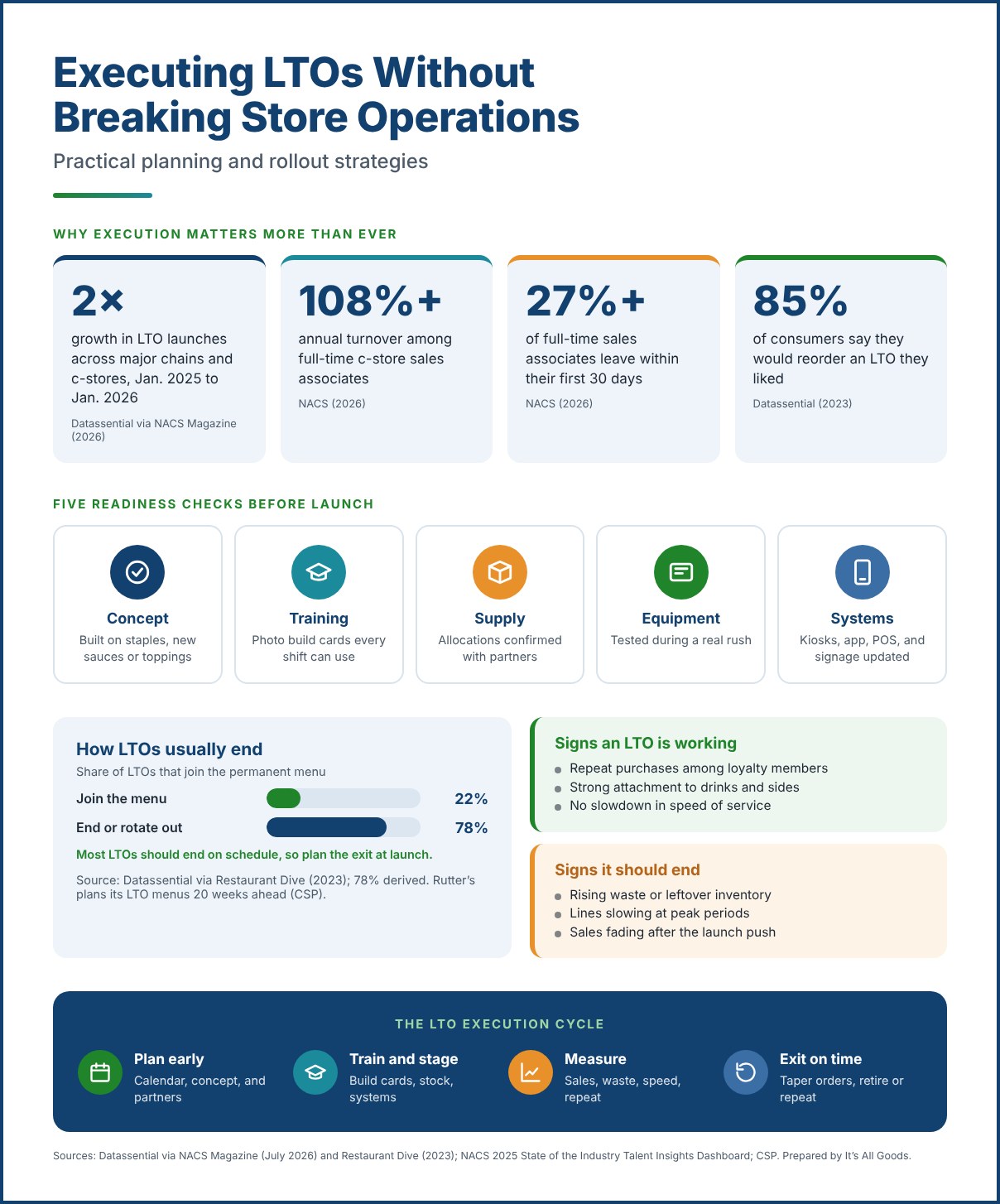
The pace of LTO activity makes discipline more important, not less. According to Datassential, as reported by NACS Magazine, the number of LTO launches across major chains and c-stores doubled from January 2025 to January 2026. With so many new items competing for attention, the temptation is to chase whatever is trending. The better question is whether a store can make the item well, quickly, and consistently during its busiest hour.
The most feasible concepts usually borrow heavily from the existing menu. Caitlin Root, executive vice president of customer experience at Datassential, told NACS Magazine that operators “can stick with your staple menu items” and “play with innovation around sauces or toppings.” A new sauce, seasoning, or topping on a proven sandwich, pizza, or roller grill item asks very little of the kitchen, while a new category with its own equipment and procedures asks a great deal.
Simplicity also helps the item sell. In 2023 coverage of c-store LTOs by Restaurant Dive, Ryan Bublavy, food service director at Dandy Mini Marts, said the chain’s Hot Dog Flight promotion worked because “it was easy for our teams to execute and provided great value to our guests.” Claire Conaghan, then associate director of publications at Datassential, added that “LTOs do best when grounded in the principles of safe experimentation.” Before approving a concept, operators can ask how many new ingredients it requires, how many steps it adds, whether it fits current equipment, and how long a new employee would need to learn it.
Every LTO is a training event, and c-store turnover makes that training harder. According to NACS, citing its 2025 State of the Industry Talent Insights Dashboard, more than 108% of full-time sales associates leave annually, and more than 27% leave within their first 30 days. Many of the employees who will make an LTO in its final weeks may not have been on staff when it launched.
That reality favors training that is short, visual, and easy to repeat. A one-page build card with photos, portion sizes, and holding times can be posted at the station and reused for every new hire. Brief demonstrations during shift changes reach employees who never attend formal meetings. Store managers should taste the product and see it made correctly before launch day, because they set the standard their teams follow.
Communication also has to reach the people who sell the item. Cashiers should know what the LTO is, what it costs, how long it runs, and how to suggest it. Ordering kiosks, apps, menu boards, and point-of-sale buttons need to be updated at the same time, so customers do not see an item the kitchen cannot make or miss one it can.
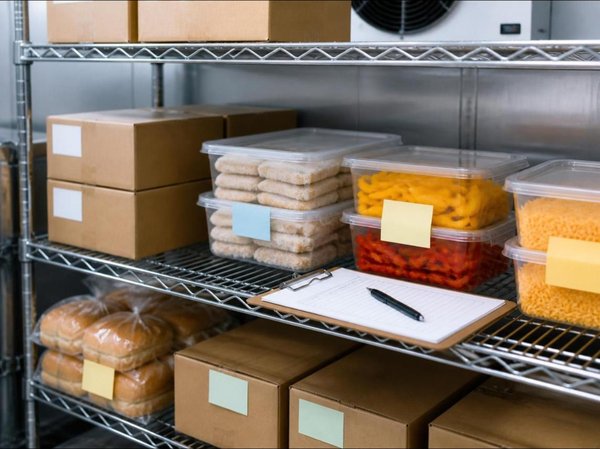
Supply problems are among the fastest ways to undermine an LTO. Technomic’s spring 2024 C-Store Foodservice Update recommended that operators confirm suggested price, brand fit, supply chain availability, customer fit, expected impact on traffic, sales, and margin, and item and ingredient cost with suppliers before committing to a promotion. The same report found that 69% of c-store LTOs featured national or regional brands, which makes supplier coordination even more important.
Ingredient planning should account for both ends of the promotion. Operators need enough product in distribution to support a strong launch, especially when marketing drives early demand, and a clear plan for what happens to remaining inventory when the offer ends. Ingredients that also appear on the core menu reduce that risk because leftovers can be used rather than discarded. Manufacturers, distributors, and brokers can help by confirming allocations early, flagging substitution risks, and supplying build guides and point-of-sale materials that match the product stores will actually receive.
Equipment deserves the same attention. A new item that needs a longer oven cycle, an extra holding cabinet slot, or a blender that is already busy during peak periods can slow every order behind it. Testing the LTO in a few stores during real rush periods, not just in a test kitchen, shows whether the equipment and layout can absorb the extra work.
An LTO should start with a clear definition of success. Some offers are meant to build traffic, while others aim to raise the average ticket, strengthen a slow daypart, or test a flavor before a broader launch. Each goal calls for different measures, and deciding on them before launch keeps the review honest.
Useful measures usually include unit sales by store and daypart, attachment to drinks and sides, waste, speed of service, and repeat purchases among loyalty members. Restaurant Dive, citing Datassential research, reported that about 85% of consumers say they would return to a restaurant or c-store and reorder an LTO they liked, so repeat purchase is an especially telling sign. Store teams can add what the numbers miss, such as whether an item slows the line or confuses customers at the counter.
Collecting data is the easy part. The value comes from reviewing it on a set schedule, comparing results across stores, and acting quickly when an item is underperforming or causing operational problems.
The end date is part of what makes an LTO work. A defined run creates urgency for customers and gives operators a natural point to evaluate results. Datassential has found that around 22% of LTOs perform well enough to join the menu permanently, which means most should end on schedule.
Exiting well requires planning. Ordering should taper before the end date so stores are not left with excess inventory, and kiosks, apps, and signage should be updated the same day the item comes off the menu. Strong performers can be scheduled to return the following season, a pattern that rewards customers who missed them and builds anticipation. Items that join the permanent menu should still earn their place, since every addition makes the core menu more complex.
Rutter’s, the York, Pennsylvania–based convenience chain, offers a useful model for disciplined LTO execution. Speaking at the 2025 NACS Show in Chicago, Philip Santini, the chain’s senior director of food service and bar strategy, explained that Rutter’s plans its LTO menus 20 weeks in advance, according to CSP. That window gives the team time for training and the physical rollout work that takes most of the effort, while leaving room for backup plans when unplanned opportunities arise. Santini noted, for example, that a pizza program “wasn’t necessarily in our plan for 2025, and then it came to be.”
Santini also emphasized that a launch needs a story for customers, not just a new item on the menu, and that Rutter’s pushes new items to its most loyal customers through its app and loyalty program to gather feedback. Gathering that data is not the hard part, he said: “It’s much harder to do something with it.” One example is the chain’s cheeseburger sub topped with fried pickles, which launched as a summer LTO, left the menu for the first half of the next year, and returned as part of a larger burger menu. Santini explained why that kind of scarcity matters:
“The idea of ‘try before it’s gone’ is very, very powerful.”
— Philip Santini, Senior Director of Food Service and Bar Strategy, Rutter’s
The same approach is visible in Rutter’s 2026 promotions. In July 2026, the chain rolled out a limited-time chicken menu featuring a Hot Pepperoni Pepper Jack Chicken sandwich and Nashville hot chicken options, available through its in-store ordering kiosks and app, as NACS reported. Built largely around fried chicken the kitchen already prepares, the lineup shows how a well-planned LTO can add excitement through new flavors rather than new processes. Rutter’s has not published results for that menu, but its planning model offers a practical template: set the calendar early, train before launch, measure deliberately, and decide in advance how each item will end.
Successful LTOs are built on ordinary operational discipline. Operators that choose concepts close to their existing menus, train teams with simple tools, confirm supply and equipment capacity, and define success before launch can introduce new items without disrupting the rest of the store. Planning the exit is just as important as planning the launch.
The final article in this series looks ahead at how menu innovation may evolve, from data-led product development and modular menu design to regional testing and stronger consumer feedback loops.
Many operators plan months ahead. Rutter’s plans its LTO menus 20 weeks in advance, and Technomic has found that nearly seven in 10 c-store operators develop an annual LTO calendar.
The most feasible LTOs use existing ingredients and equipment, add few steps, and vary familiar items through new sauces, toppings, or flavors rather than introducing entirely new processes.
Short, visual tools such as photo build cards and quick shift-change demonstrations work best, because many employees who make an LTO late in its run may have joined after launch.
Operators should set goals before launch and track unit sales, attachment, waste, speed of service, and repeat purchases, then review results on a set schedule.
Only when it performs well over time without straining operations. Datassential research has found that about 22% of LTOs end up joining the menu permanently.

Subscribe to receive latest news
12968 Vallejo Circle, Westminster CO. 80234
Phone: (303) 604-1064





