






dding a daypart looks simple on a menu board. A store that sells breakfast adds lunch items, or a store with a strong lunch program stays open for dinner. Behind the counter, though, every new meal occasion brings more recipes to learn, more products to hold, more changeovers to manage, and more decisions for a team that is often already stretched.
The retailers that run several dayparts well rarely do it by building separate programs for each one. They design one food operation that flexes across the day, sharing ingredients, equipment, people, and routines wherever they can. Here is how that works in practice.
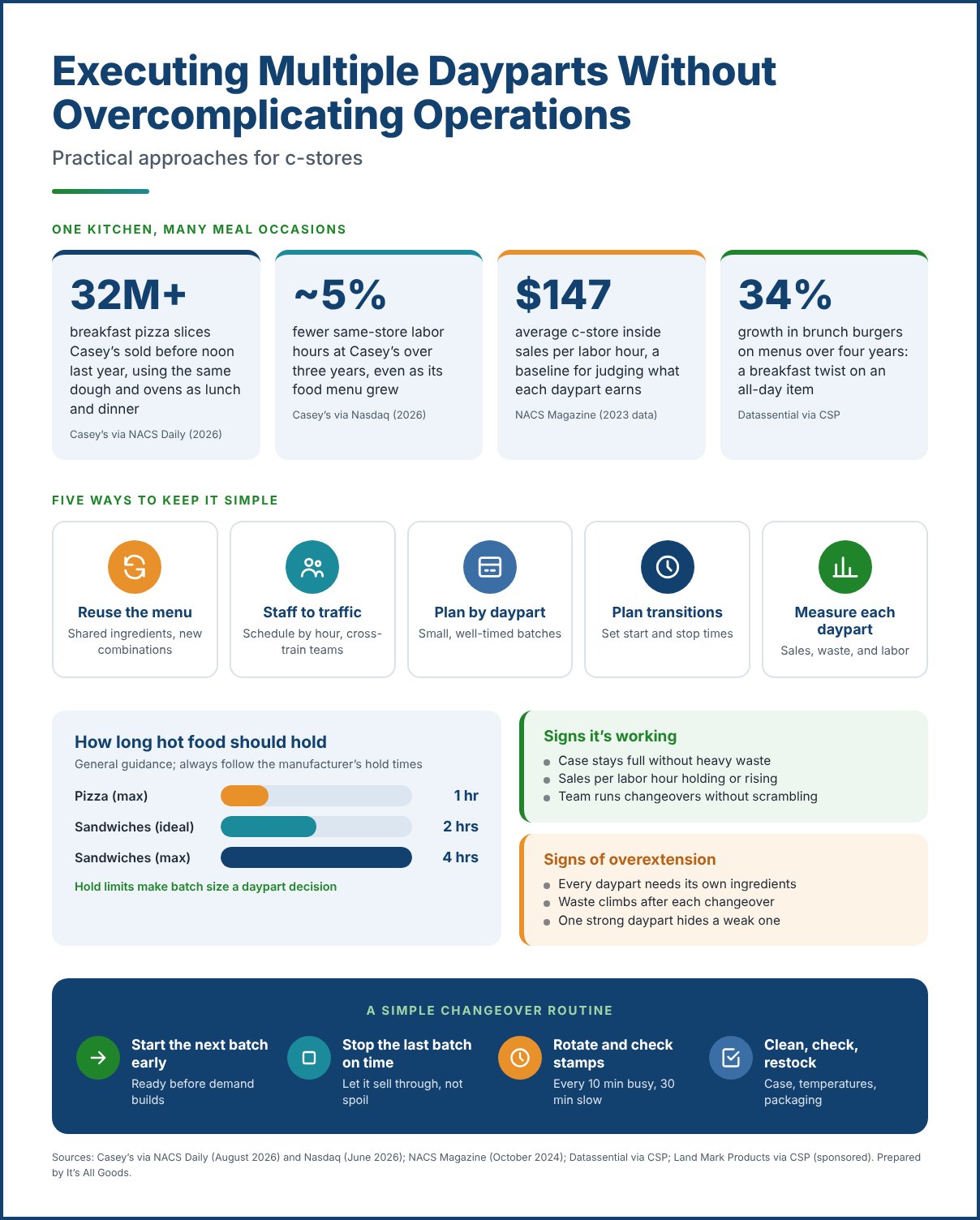
The simplest way to add a daypart is to need very little that is new. When the same core items and ingredients show up across breakfast, lunch, and dinner, a store adds selling time without adding much complexity. Stephanie Sandlin, strategic account lead for foodservice at Cargill, told CSP that retailers should keep operations easy for employees by using all-day platforms such as pizza, burgers, and chicken in different ways, from a breakfast pizza to a brunch burger topped with a fried egg. Datassential data she cited showed brunch burgers on menus grew 18% in 2024 and 34% over four years.
Overlap works in both directions. A breakfast program can stretch into lunch by carrying its proteins, breads, and cheeses into sandwiches and wraps. A lunch program can reach back into the morning with heartier items for customers who start work early. Joy Almekies, senior director of foodservices at Global Partners, told CSP that non-breakfast items such as burgers, crispy chicken sandwiches, and potato wedges are essential during breakfast hours for those workers. Her stores also sell refrigerated sandwiches that customers can microwave later, so one morning visit covers two meals. “Now they have breakfast and lunch,” she said.
A useful test before adding any item is to count how many new components it requires. An item that uses ingredients, packaging, and equipment the store already has is a low-risk addition. An item that needs a new sauce, a new bread, and a new cooking step adds inventory to manage, prep to train, and another product that may go to waste. Most strong multi-daypart menus are built from a short list of components combined in different ways, not a long list of items that each stand alone.
Labor is usually the deciding factor in whether a new daypart succeeds. A store can buy equipment once, but it has to staff a daypart every day. The goal is to schedule people around real demand, not around the hours the kitchen happens to be open.
That starts with knowing when customers actually arrive. Billy Colemire, vice president of marketing and brand at Stinker Stores, told CSP that breakfast traffic at the 105-store chain now spreads from about 5:30 to 9 a.m., instead of the tighter 5:30 to 7:30 a.m. window it once had. That shift made both production planning and labor scheduling easier. “There’s less of the peaks and valleys,” he said. A store that tracks traffic by hour can see whether its own dayparts have changed the same way and move shifts to match.
Cross-training matters just as much. When the same employees can prepare breakfast items, assemble lunch sandwiches, and stock the evening hot case, a store can cover more dayparts without adding a separate crew for each one. Simple, repeatable recipes and clear build guides make that possible, especially in a channel where turnover is high and new employees need to be productive quickly.
Not every daypart needs full kitchen staffing. A store can run made-to-order food during its busiest windows and rely on grab-and-go items during slower ones. Jessica Williams, founder and CEO of Food Forward Thinking, noted in the same CSP report that it is hard to specialize without adding labor, and suggested lower-labor options such as bakery items produced off-site and easy coffee programs.
“Choose a lane and do your very best at it.”
— Jessica Williams, Founder and CEO, Food Forward Thinking
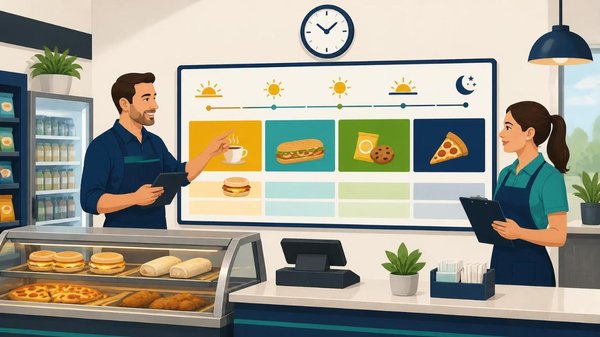
Running several dayparts means making food in smaller, better-timed batches instead of large ones at the start of the day. The aim is to have enough product in the case when customers arrive without carrying leftovers from one meal into the next.
Good production planning starts with sales by time of day. Al Koep of Land Mark Products advised in a sponsored CSP article on hot-case management that stores track what each product sells at each time of day and use that history to decide how much to make for each daypart. His guidance on hold times shows why timing matters: pizza generally should not be held longer than an hour, and sandwiches and calzones should ideally sell within two hours and be discarded after four at most.
Those limits make batch size a daypart decision. A breakfast batch sized for the 7 a.m. rush may be too large for the slower stretch at 10 a.m., and food made for lunch may not last to dinner. A simple production chart that lists each item, its batch size, and its cook times for each daypart turns those decisions into a routine the whole team can follow. Grouping items that share a base, such as several sandwiches built on the same bread and protein, keeps prep efficient.
Planning also means accepting a small amount of waste. Koep cautioned that stale food and empty-looking warmers cost more in lost customers than a reasonable level of waste does. “No one wants to buy the last sandwich lying around,” he said. The right production plan keeps the case full enough to sell, while keeping waste low enough to protect margin.
The handoff between dayparts is where many multi-daypart programs run into trouble. Breakfast items linger past their best, lunch items are not ready when the first lunch customers arrive, and employees are cleaning, restocking, and cooking at the same time.
Planned transitions solve most of these problems. Stores can set a specific time to start the next daypart’s first batch, so it is ready before demand builds, and a time to stop cooking the previous daypart’s items, so the last batch sells through instead of being thrown away. Koep recommended checking time stamps and rotation every 10 minutes during busy mornings and about every half hour in slower dayparts, which gives teams a natural rhythm for spotting what needs to come out of the case and what needs to go in.
Bridge items make transitions smoother. Products that sell well in both the late morning and the early afternoon, such as breakfast sandwiches, pizza slices, or handheld chicken items, keep the case looking full while the menu changes over.
Transition times are also a good place for routine tasks such as cleaning the hot case, checking temperatures, and restocking packaging. Building those tasks into a short checklist for each changeover helps employees know what to do and when, instead of improvising during the busiest parts of the day.
Every daypart should be measured on its own. A strong breakfast can hide a weak dinner if a store only looks at total foodservice sales. Tracking sales, units, waste, and labor by daypart shows which meal occasions are growing, which are breaking even, and which may need to be changed or cut.
Labor productivity is one of the most useful measures. According to NACS Magazine, the average convenience store generated $147.31 in inside sales per labor hour in 2023. Looking at sales per labor hour by daypart, rather than for the whole day, can show whether a late-night or dinner program is paying for the people scheduled to run it.
Waste should be measured by daypart, too. If a store throws away a large share of its dinner production every night, the issue may be batch size, timing, or the menu itself. Other useful measures include average ticket by daypart, attachment rates for drinks and sides, and how quickly the case sells through after each batch.
Measurement also tells a store when to stop. A daypart that has been given a fair test with good execution and still does not cover its labor and waste may not be the right fit for that location. Pulling back on one occasion can free up people and equipment to strengthen another. For more on choosing which dayparts to pursue in the first place, see Why Daypart Strategy Matters in Convenience Store Foodservice.
Casey’s, the Iowa-based convenience chain best known for its pizza, shows how a retailer can serve several dayparts from one core food platform. Pizza made from scratch-made dough sits at the center of its program, and Casey’s has extended that platform into the morning instead of creating a separate breakfast operation. When it relaunched breakfast in 2021, its new signature handheld wrapped that same dough around eggs, sausage or bacon, and cheese, and was baked in the stores’ existing kitchens, according to the company’s announcement.
“Casey’s has always set an early morning alarm to start the coffee and roll out our made-from-scratch dough.”
— Tom Brennan, Chief Merchandising Officer, Casey’s
Breakfast pizza is the clearest example of that reuse. Casey’s sold more than 32 million breakfast pizza slices before noon in its last fiscal year, according to NACS Daily, and it now markets the product as the “Official Pizza of Noon Kickoffs” for college football Saturdays. The same ovens, dough, and team that serve lunch and dinner pizza also serve the morning.
The operating results show the benefit of that focus. In its fiscal year ended April 30, 2026, Casey’s grew prepared food and dispensed beverage same-store sales 5.2%, and company leaders cited improved waste management as a main driver of higher margins, according to Nasdaq’s summary of the earnings call. Over its three-year strategic plan, Casey’s reduced same-store labor hours by about 5% while adding new items such as wings. Building every daypart on shared ingredients and equipment helped the chain grow food sales without adding a matching amount of labor.
Expanding dayparts does not have to mean running several separate food programs. The stores that execute well keep the menu built on shared components, schedule people around real traffic, plan production in small batches, manage transitions on purpose, and measure each daypart on its own.
That discipline keeps added meal occasions from overwhelming store teams. It also makes growth more profitable, because each new daypart uses the ingredients, equipment, and skills the store already has. For most operators, the right question is not how many dayparts the store can open, but how many it can run well.
Build the new daypart from ingredients, equipment, and packaging the store already uses. Items that recombine existing components are faster to train, easier to prep, and less likely to create waste.
Use traffic and sales by hour to place staff where demand actually falls, cross-train employees to work across dayparts, and rely on grab-and-go items during slower periods instead of full kitchen staffing.
Follow the manufacturer’s guidelines. As a general rule cited in industry guidance, pizza should not be held longer than about an hour, and sandwiches and calzones should ideally sell within two hours and be discarded after four at most.
Set planned start and stop times for each daypart’s batches, keep bridge items such as breakfast sandwiches or pizza available through the changeover, and use a short checklist for cleaning, restocking, and rotation.
Track sales, units, waste, average ticket, and sales per labor hour by daypart. A daypart that does not cover its labor and waste after a fair test may need to be changed or cut.

Subscribe to receive latest news
12968 Vallejo Circle, Westminster CO. 80234
Phone: (303) 604-1064





