





ost convenience stores sell food from early morning until late at night, but customers do not want the same thing all day. The commuter grabbing a breakfast sandwich at 6:30 a.m. has different needs than the worker looking for lunch at noon or the parent picking up dinner on the way home. Each of those moments is a different meal occasion, with its own expectations for speed, value, and quality.
That is why daypart strategy matters. Stores that understand when their customers buy food, and what they expect at each time of day, can put their menus, equipment, and labor where they will earn the most. Stores that try to serve every daypart equally often end up serving none of them especially well.
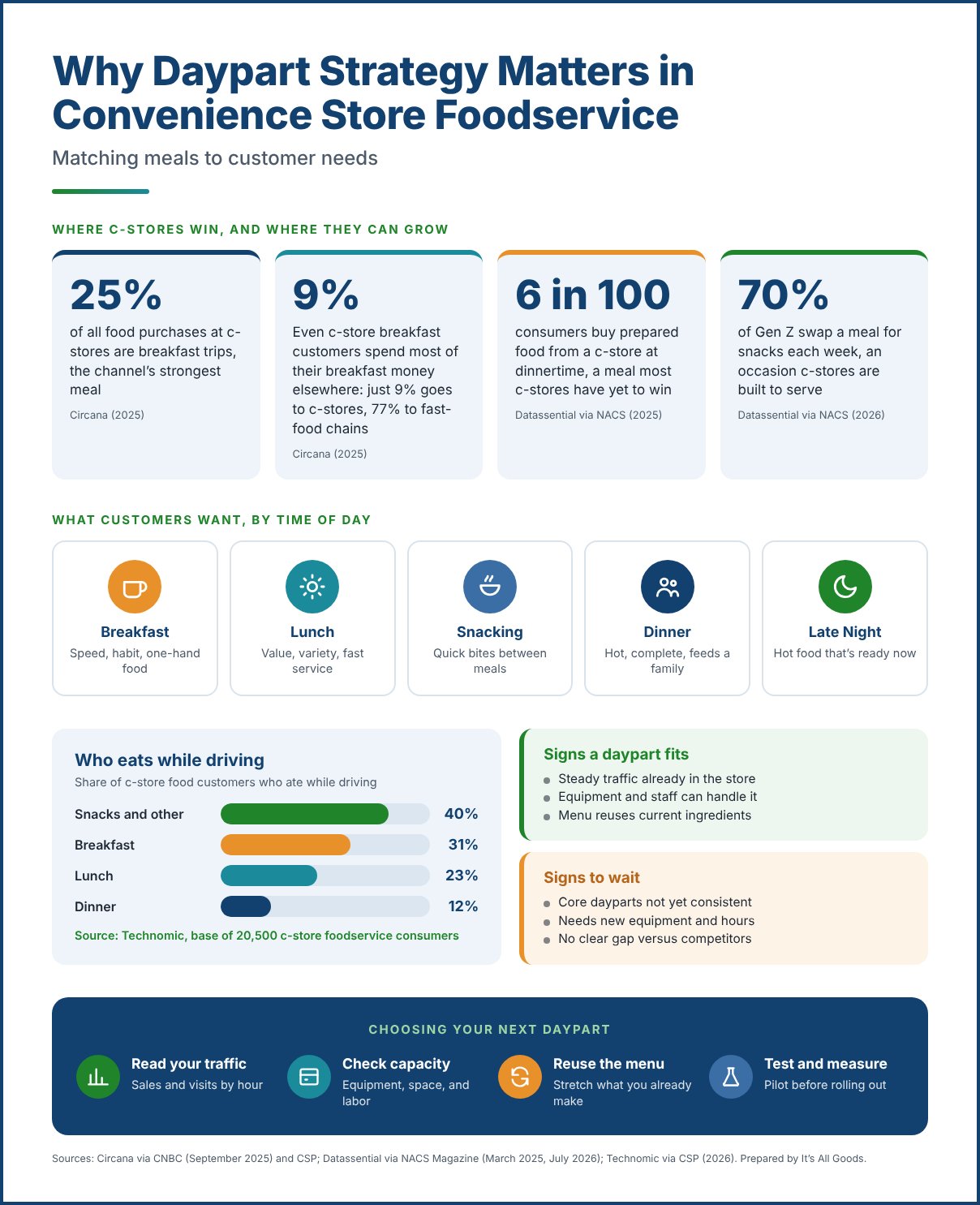
Breakfast is the convenience channel’s strongest food daypart. According to Circana data reported by CNBC, breakfast trips make up 25% of all convenience store food purchases, and morning meal trips at c-stores grew while quick-service restaurant breakfast visits declined. Circana also identified breakfast as the best-performing daypart in 2025, as noted in CStore Decisions.
Even at breakfast, there is room to grow. Circana’s David Portalatin told a CSP foodservice forum that among shoppers who buy breakfast at c-stores, convenience stores capture only about 9 cents of every dollar those customers spend on breakfast out. Quick-service restaurants get 77 cents.
Dinner is the opposite story. Datassential found that just 6% of U.S. consumers order prepared food and beverages from convenience stores during traditional dinner hours, according to NACS Magazine’s look at the dinner opportunity. The gap between those two numbers is the core of daypart strategy: knowing where the store already wins and where growth will take real effort.
Each daypart plays a different role. Breakfast drives habit and frequency, often anchored by coffee and a hot handheld. Lunch competes directly with quick-service restaurants and depends on fast, filling, well-priced options. Dinner asks more of the store, because customers want a complete meal, often for more than one person.
Between those meals sit the snacking occasions, which are growing in importance. According to Datassential research reported in NACS Magazine, 50% of consumers snack regularly, and 70% of Gen Z say they replace meals with snacks at least once a week. That matters for convenience stores: when younger customers treat a snack as a meal, the store with quick, portable food is competing for that occasion. Mid-morning, afternoon, and late-night occasions can extend the value of a food program without requiring a full meal menu.
Traffic patterns shift, too. Circana data shared at the same CSP forum showed that c-store meal traffic held steady in the morning during the first quarter of 2025, while lunch and dinner declined. Daypart performance is not fixed, so operators need to watch their own numbers rather than assume last year’s pattern still holds.
What customers value changes with the clock. At breakfast, speed and consistency come first. Lunch customers want value and enough variety to return several times a week. At dinner, expectations rise: Datassential found consumers are more likely to eat a main entrée at dinner (36%) than at lunch (24%) or breakfast (16%), and dinner is the meal most likely to be planned in advance. Late-night customers tend to value availability above all: hot food that is ready when they arrive, at hours when few restaurants nearby are open.
How people eat also differs. Technomic data reported by CSP’s look at daypart strategy found that 31% of c-store breakfast customers ate while driving, compared with 23% at lunch and just 12% at dinner. Breakfast food has to work in one hand. Dinner food has to travel well and hold up at home.
“When you think about dinner, you start to get into feeding families. The first thing you think about is something hot. Traditionally we don’t eat a cold sandwich for dinner.”
— Liza Salaria, Senior Vice President of Category Management and Foodservice, W. Capra
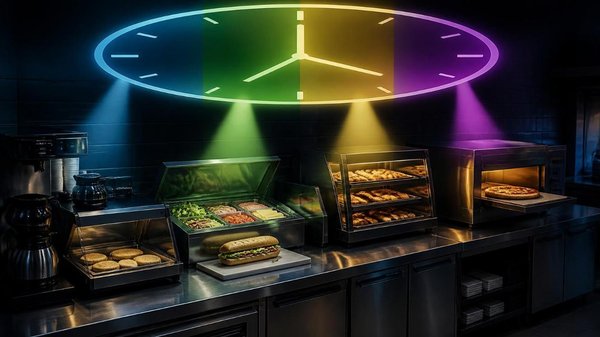
Every daypart a store adds brings its own equipment, labor, and waste requirements. As Salaria noted in the same CSP report, retailers launching a new daypart must account for “different equipment and operational requirements.” A breakfast program built around ovens and warmers may not have the capacity or the holding equipment that a dinner program needs.
Labor is the bigger constraint. In Datassential’s third-quarter c-store tracker, reported by CStore Decisions, 59% of retailers named rising labor and food costs as their top operational challenges, and 53% said labor and staffing is their top priority. NACS data cited in a 2026 NACS Daily report put average store employee turnover at 108.8% in 2025.
Those pressures make focus valuable. When equipment and labor are matched to the dayparts a store actually serves, both work harder. As It’s All Goods explained in Choosing Equipment That Supports Real-World Foodservice Execution, equipment should be chosen for the store’s menu, mix, and dayparts, with capacity judged against peak demand rather than feature lists.
Daypart expansion is a strategic choice, not a default growth tactic. The strongest food programs usually win one daypart before adding another, using the same ingredients, equipment, and team to stretch into the next occasion.
A few questions can guide the decision. When does the store already see traffic, and what are those customers buying? Which daypart has the clearest gap compared with nearby competitors? Can the current kitchen and staffing model support it, or would it need new equipment and hours? Can the new menu reuse ingredients from the existing one? And how will the store measure whether the new daypart is working?
Menu overlap is often the deciding factor. A store that already toasts sandwiches for breakfast can extend those ingredients into lunch with little added labor. A pizza program built for lunch may carry naturally into dinner and late night. When a new daypart can borrow most of what the store already makes, the cost and risk of testing it drop sharply.
For many operators, the answer is to strengthen breakfast and lunch first, then test snacking or dinner occasions in stores with the right traffic, space, and team. Expansion that is deliberate tends to improve labor and equipment use. Expansion that is unfocused tends to spread both too thin.
Rutter’s, the Pennsylvania-based chain of nearly 100 convenience stores, offers a clear example of daypart strategy in practice. Breakfast and lunch are the core of its food program, and the company is candid that dinner is still a work in progress. “Dinner is one of those areas we have yet to conquer,” Philip Santini, Rutter’s senior director of food service and bar strategy, told CSP in early 2026, adding that its pasta menu, introduced about a year earlier, was “starting to pick up steam.” Santini described designing dinner around how customers actually eat, favoring food that can be eaten with a fork rather than a fork and knife, so it works on the go or at home.
“Technically, a sandwich is portable, but would I like to eat a meatball sub while I’m in the car? Probably not.”
— Philip Santini, Senior Director of Food Service and Bar Strategy, Rutter’s
Rutter’s has also built dinner-friendly formats, with five locations featuring sports bars and lounges where customers can sit down and eat. In October 2026, the chain expanded its Italian menu with pasta dishes such as Buffalo fried chicken fettuccine Alfredo, along with chicken parmesan, according to C-Store Dive. Rutter’s approach shows how a retailer can treat dinner as a long-term build, adding menu depth and the right formats step by step rather than assuming success will come from simply extending hours.
Daypart strategy determines where a convenience store’s food program earns its sales. Breakfast is the channel’s strongest occasion, lunch competes head-on with restaurants, snacking keeps growing, and dinner remains a real but demanding opportunity.
The operators who grow meal occasions profitably are the ones who choose them deliberately. They match menus to what customers want at each time of day, size equipment and labor to real demand, and expand only when the store can execute. Done that way, daypart strategy turns a long day of open hours into a series of occasions the store can actually win.
A daypart is a time-of-day meal occasion, such as breakfast, lunch, afternoon snack, dinner, or late night. Each has different customer expectations, menu needs, and operational requirements.
Breakfast. Circana data shows breakfast trips make up about a quarter of c-store food purchases, and breakfast was the best-performing daypart in 2025.
Dinner customers expect a complete meal, often for a family, and are more likely to plan ahead. Only about 6% of U.S. consumers buy c-store prepared food at dinner, and the daypart often requires different equipment, menus, and staffing.
Not necessarily. Most stores do better by winning one or two dayparts first, then expanding where traffic, equipment, and labor can support it.
Look at current traffic and sales by hour, local competition, kitchen capacity, labor availability, and how much of the existing menu and equipment can be reused. Then test and measure before rolling out widely.

Subscribe to receive latest news
12968 Vallejo Circle, Westminster CO. 80234
Phone: (303) 604-1064





