onvenience store foodservice has spent two decades moving from the roller grill to the center of the business. According to 2025 State of the Industry data from NACS, foodservice accounted for 28.5% of U.S. convenience in-store sales in 2025, up from 11.9% in 2005, and generated 38.9% of in-store gross profit dollars. Prepared food alone made up 73.9% of foodservice sales, up from 66.4% in 2021. Those numbers settle the question of whether food matters. The harder question for the next phase is what will shape it: who c-stores now compete against, what customers expect, how costs and traffic are moving, where technology fits, and how consolidation is redrawing the industry.
This article, the first in It’s All Goods’ final cluster of 2026, examines those five forces and closes with a case study of RaceTrac’s acquisition of the Potbelly sandwich chain, one of the clearest signals of where c-store foodservice is heading.
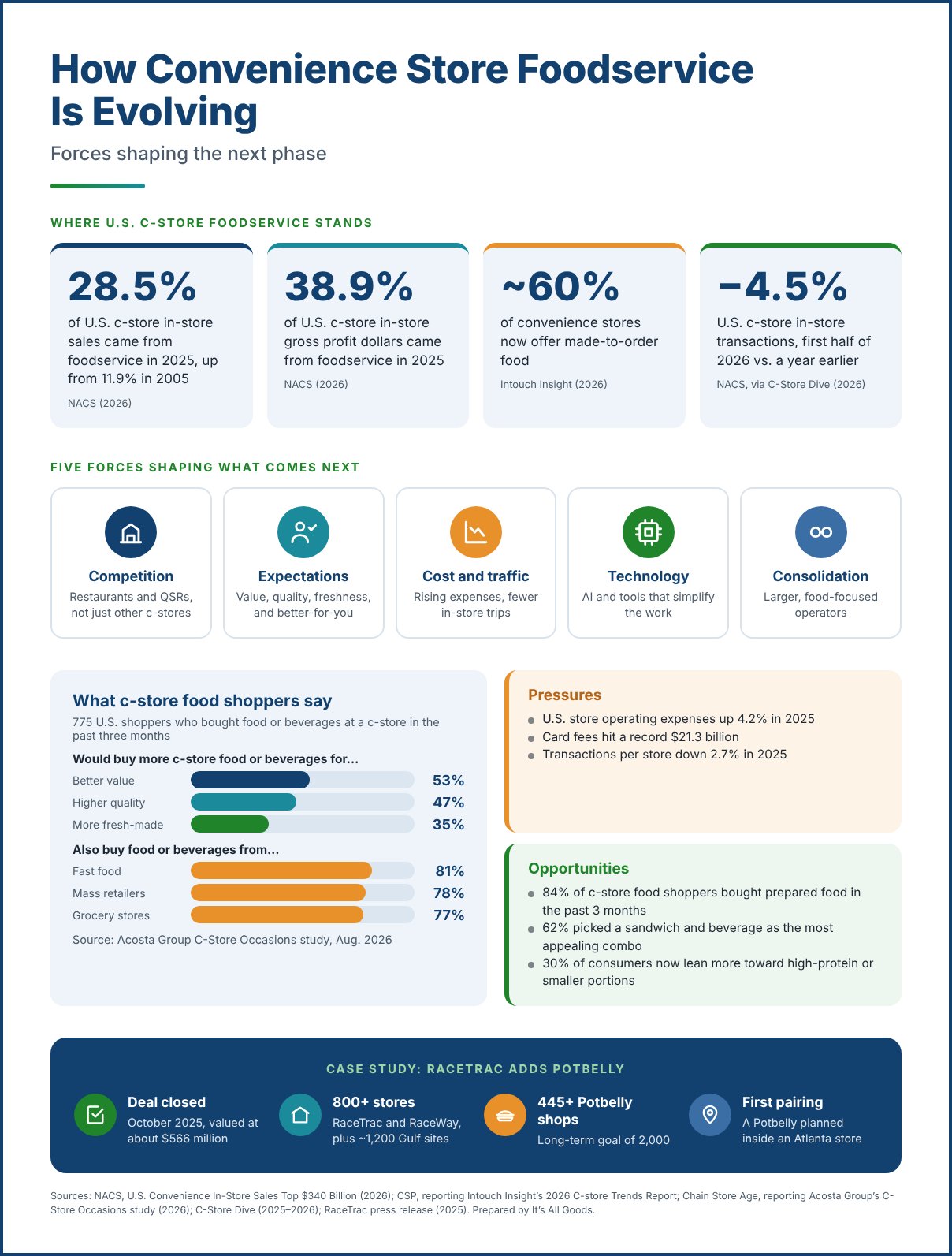
The competitive set for c-store food is no longer limited to other gas stations. Intouch Insight’s 2026 C-store Trends Report, as reported by CSP, found that convenience stores increasingly compete with restaurants, quick-service chains, and specialty beverage retailers, and that nearly 60% of convenience stores now offer made-to-order food. About 58% of consumers in Intouch’s survey said they would choose a brand over a closer competitor because of its exclusive food offerings, a sign that a signature item can outweigh a convenient location.
Shoppers also move freely between channels. In Acosta Group’s C-Store Occasions study, fielded in late August 2026 among 775 U.S. shoppers who had bought food or beverages at a convenience store in the prior three months, 81% also bought food or beverages from fast-food restaurants, 78% from mass merchandisers, and 77% from traditional grocery stores. For operators, that means every breakfast sandwich and lunch combo is judged against the best alternative nearby, not just the c-store down the road.
As noted in It’s All Goods’ look at what’s next for convenience store foodservice, foodservice now operates in a comparative marketplace rather than a protected one. The 2026 data supports that view, and it raises the bar for consistency as much as for quality.
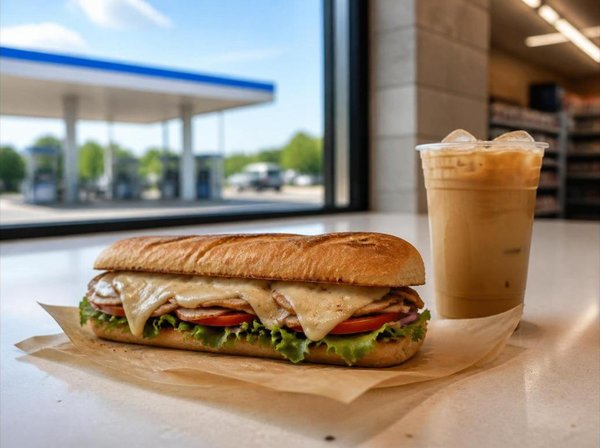
Customers are already buying food at c-stores; the opportunity lies in what would make them buy more often. In the Acosta study, 84% of respondents had purchased prepared food from a convenience store in the past three months. Asked what would make them more likely to buy food and beverages from c-stores in the future, 53% pointed to better value for the money, 47% to higher-quality food, and 35% to more freshly prepared meals and snacks. A sandwich paired with a beverage was the most appealing meal combination tested, chosen by 62% of respondents.
Health is also moving from niche to expectation. Nearly three-quarters of Acosta’s respondents said healthier or better-for-you foods are at least somewhat important when they shop at c-stores, and Intouch found that 30% of consumers had increased their preference for high-protein options or smaller, portion-controlled packaging at c-stores over the previous 12 months. NACS reported that sales of alternative snacks such as jerky, seeds, and nuts rose 7.9% in 2025, reflecting stronger demand for protein that NACS attributed to the rise in GLP-1 users. Kathy Risch of Acosta Group summed up what this shift means for the channel:
“Convenience stores have earned an incredibly valuable position with shoppers because they solve real needs quickly, but convenience alone isn't enough to win every occasion.”
— Kathy Risch, Senior Vice President, Shopper Insights and Thought Leadership, Acosta Group
For operators, the message is that speed and location may earn the first visit, while value, quality, freshness, and better-for-you choices determine how many meal occasions follow.
Rising expectations are arriving at a difficult moment for store economics. NACS reported that direct store operating expenses, which include wages and benefits, card fees, utilities, maintenance, and merchandise shrink, rose 4.2% in 2025, the slowest increase since the pandemic, while credit and debit card fees reached a record $21.3 billion. Store-level hourly wages averaged $15.04. At the same time, the average store recorded 45,160 transactions a month, 2.7% fewer than in 2024.
The traffic decline has continued into 2026. At the October NACS Show, Chris Rapanick, managing director of NACS Research, reported that in-store transactions in the first half of 2026 fell 4.5% from a year earlier, or more than 1,100 fewer transactions per store on average, according to C-Store Dive’s coverage of his presentation. He noted that more customers are fueling without going inside and that strong fuel margins are currently helping carry the industry.
These pressures push foodservice in two directions. Food is one of the few reasons a fuel customer walks through the door, which makes a strong program more valuable than ever. Yet every new item, daypart, or format also adds labor, training, and waste risk at a time when margins leave little room for error. Intouch Insight CEO Cameron Watt made a similar point in the trends report, noting that execution is becoming both more difficult and more important as the c-store model grows more complex.
Technology is moving from experiment to infrastructure. In Toast’s 2026 Voice of the Retail Industry Survey of 340 convenience, grocery, and bottle shop decision-makers operating 16 or fewer locations, nine in ten said they were experimenting with AI. The same survey found that 31% now rank simplifying operations among their top three goals, up 12 points from the prior year, and that inventory management had become their biggest pain point.
That combination matters for foodservice. The most useful tools in the next phase are likely to be the ones that remove work rather than add it: kitchen display systems tied directly to ordering, forecasting that sizes production to demand, digital food safety checklists, and kiosks that capture made-to-order tickets accurately. Tools that require extra steps from stretched teams, or that sit outside the point-of-sale and kitchen workflow, risk adding friction instead of removing it.
Sequence still matters. Operators that simplify menus and processes first, then layer technology on top, give their teams tools that support consistent execution. Those that try to solve structural problems with software often end up with more complexity, not less.
The industry is also becoming more concentrated. According to C-Store Dive’s review of the deals that defined 2025, mergers and acquisitions continue to dominate convenience retail as rising expenses and labor challenges push operators either to grow through acquisition or to sell, and industry experts did not expect the trend to slow in 2026. The largest acquisition by a U.S. convenience retailer that year was Alimentation Couche-Tard’s $1.6 billion purchase of GetGo Café + Markets, which added more than 270 sites across Pennsylvania, Ohio, West Virginia, Maryland, and Indiana, and Couche-Tard is leaning heavily into GetGo’s foodservice capabilities. Sunoco also closed its $9.1 billion acquisition of Parkland in October 2025.
Store counts reflect the same pressure. NACS counted 151,975 U.S. convenience stores in its 2026 store count, 280 fewer than the year before, and Rapanick reported that 356 stores without fuel closed in the first half of 2026 while 573 locations offering fuel opened.
For foodservice, scale cuts both ways. Larger chains can spread the cost of commissaries, test kitchens, technology, and food safety programs across more stores, and acquired chains with strong food programs can carry that expertise into a bigger network. Smaller operators can still compete, but they will need to be more deliberate about where they focus, often by doing fewer things exceptionally well and relying on distributor and supplier partners for capabilities they cannot build alone.
RaceTrac, a family-owned Atlanta retailer that has served guests since 1934, operates more than 800 RaceTrac and RaceWay convenience stores and about 1,200 Gulf-branded locations. On October 23, 2025, it completed its acquisition of Potbelly Corporation, the neighborhood sandwich chain that opened its first shop in Chicago in 1977. At the time, Potbelly had more than 445 company and franchise-owned shops and a long-term goal of reaching 2,000. The all-cash deal was valued at about $566 million.
RaceTrac CEO and Chairman Natalie Morhous described the purchase as a natural evolution of the company’s growth strategy that adds fast-casual expertise to its portfolio, and RaceTrac said the combination would bring together both brands’ capabilities in real estate, franchising, operations, food innovation, and marketing. C-Store Dive called it the most surprising and potentially industry-shifting acquisition of 2025, noting that it could set the stage for other c-store retailers to buy restaurant chains to improve their foodservice capabilities.
The first sign of how the two brands may work together came in June 2026, when RaceTrac confirmed to C-Store Dive that it plans to open a Potbelly inside a large-format store near its Atlanta headquarters. RaceTrac bought the Cobb Parkway site for $12.5 million in December 2024 and described it to county officials as a testing ground for new services, vendor meetings, and employee training. Plans for the existing two-story, 31,894-square-foot building include the convenience store and restaurant, corporate offices, a meeting space, 16 fuel pumps, and 12 EV charging stations. RaceTrac has not announced an opening date.
The case brings several of this article’s forces together. RaceTrac is answering restaurant competition by owning a restaurant brand, using its scale and real estate expertise to support that brand’s growth, and testing the combined format in a single flagship store rather than rolling it out everywhere at once. Few operators can buy a fast-casual chain, but the underlying lesson applies broadly: the next phase of c-store foodservice will reward operators who decide clearly what kind of food business they want to be and then build the capabilities to deliver it.
Convenience store foodservice enters its next phase from a position of strength. It leads in-store sales, produces nearly 40% of in-store gross profit dollars, and reaches most c-store food shoppers through prepared items. The forces now shaping it are restaurant-level competition, customers who want better value, quality, and freshness, rising costs alongside falling store traffic, technology that is becoming infrastructure, and an industry consolidating around larger, food-focused operators.
Operators that prepare well will treat these forces as a planning framework rather than a list of trends to chase. That means choosing which customers and meal occasions to win, protecting execution as complexity grows, adopting technology that simplifies work, and deciding where scale or partnership can supply what a single store cannot. The rest of this cluster turns those forces into practical steps for store operations and a long-term strategic roadmap.
According to NACS, foodservice accounted for 28.5% of U.S. convenience in-store sales and 38.9% of in-store gross profit dollars in 2025, up from 11.9% of in-store sales in 2005.
C-stores increasingly compete with restaurants, quick-service chains, and specialty beverage retailers. Most c-store food shoppers also buy from fast-food restaurants, mass merchandisers, and grocery stores.
In Acosta Group’s 2026 study, shoppers said better value (53%), higher-quality food (47%), and more freshly prepared meals and snacks (35%) would make them more likely to buy.
Larger operators can spread the cost of commissaries, technology, and food safety programs across more stores, and acquisitions such as Couche-Tard’s purchase of GetGo can bring strong food programs into bigger networks.
RaceTrac said the deal adds fast-casual expertise and combines both brands’ strengths in real estate, operations, food innovation, and marketing. It plans a Potbelly inside a large-format Atlanta store.

Subscribe to receive latest news
12968 Vallejo Circle, Westminster CO. 80234
Phone: (303) 604-1064