





onvenience store foodservice looks very different depending on who owns the store. A large chain can build a commissary, write one set of recipes, and roll a new item across hundreds of locations. A franchisee works inside a system someone else designed but still runs the store day to day. An independent operator with one or two locations decides everything, from the menu to the oven, often with no corporate team behind them. Each model brings real advantages and real constraints, and those differences shape what kind of food program a store can realistically run. Yet the stores that perform best in every model tend to share something more basic than their structure: a clear strategy and the discipline to execute it consistently.
This article examines the structural differences between franchise, chain, and independent operators, how each balances standardization and flexibility, how quickly each can make decisions, what resources each can draw on, and the execution challenges they share.
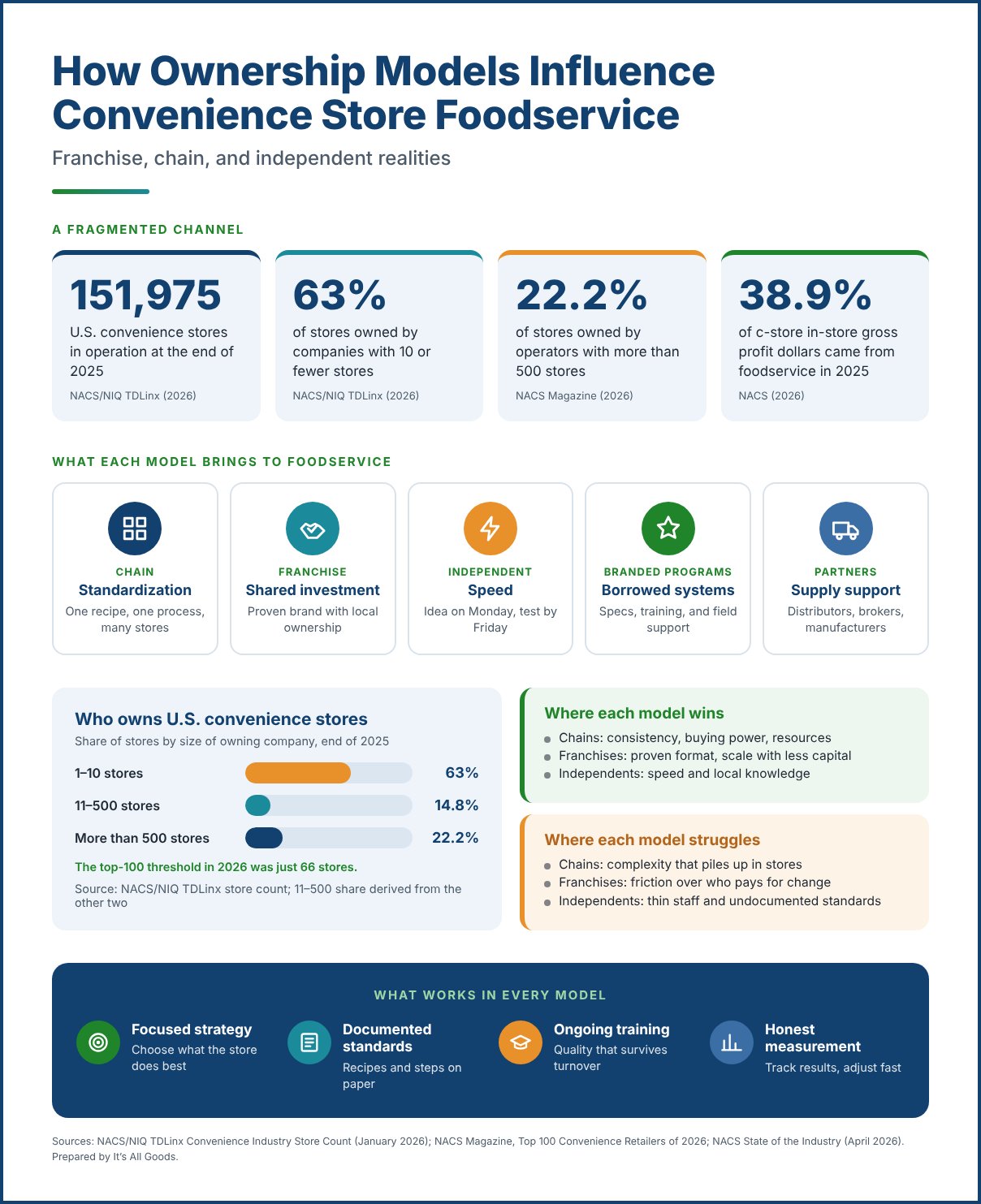
The convenience channel is far more fragmented than its best-known brands suggest. According to the 2026 NACS/NIQ TDLinx convenience store count, the U.S. had 151,975 convenience stores at the end of 2025, and 95,672 of them, or 63%, were owned by companies with 10 or fewer stores. At the other end of the spectrum, NACS Magazine reports that operators with more than 500 stores accounted for 22.2% of the total. The threshold for joining the industry’s top 100 retailers this year was just 66 stores.
Those numbers matter because foodservice now carries a large share of the business. NACS reports that foodservice accounted for 28.5% of in-store sales and 38.9% of in-store gross profit dollars in 2025, according to its State of the Industry data. Whether a store is part of a national chain, a franchise system, or a family business, its food program is increasingly central to how it makes money.
Ownership structure determines who makes the decisions behind that program. In a company-operated chain, headquarters typically sets the menu, selects equipment, negotiates supply, and trains the teams. In a franchise system, the franchisor supplies the brand, proprietary items, and operating standards, while the franchisee owns the store’s economics and much of its daily execution. Independents carry both roles themselves, which gives them full control but also full responsibility.
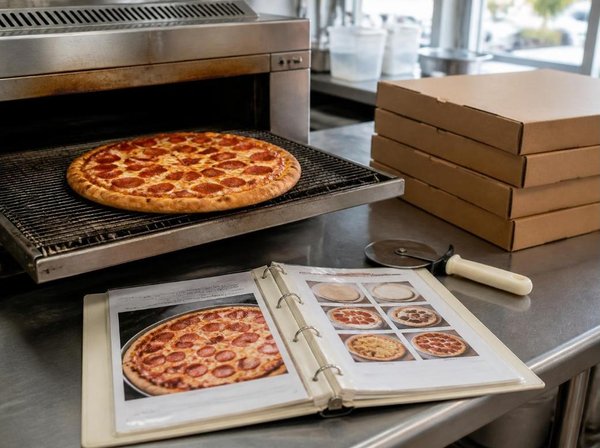
Standardization is the chain’s great strength. When every store uses the same recipes, equipment, and procedures, customers get a predictable product, training can be repeated across locations, and purchasing volume lowers costs. The tradeoff is rigidity. A menu designed to work in hundreds of stores may not fit a rural location with a lunch rush from a nearby plant or an urban store with heavy late-night traffic.
Franchise systems sit in the middle, and the balance can be more flexible than outsiders assume. Dennis Lane, a longtime 7-Eleven franchisee who served as chairman of the National Coalition of Associations of 7-Eleven Franchisees, told CSP that apart from proprietary products, franchisees had “pretty much sole discretion on what we carry.” That autonomy lets a franchisee respond to the neighborhood. It also means a franchisor cannot simply mandate a new food standard and expect it to appear in every store. As Lane put it, “In a franchise world, we are tied at the hip,” and progress depends on the relationship.
Independents have the most flexibility of all. They can add a local bakery’s pastries, adjust portions for regular customers, or drop an item that is not selling without asking anyone. The risk is inconsistency. Without documented standards, quality can drift from shift to shift, and a program built around one manager’s know-how can falter when that person leaves.
Independents usually move fastest. An owner who sees a new opportunity on Monday can test it by Friday, because the person who spots the idea is often the person who approves it. That speed is a genuine competitive advantage in foodservice, where local tastes and seasonal demand shift quickly.
Chains move more slowly because they must protect consistency across many locations. A new item typically passes through product development, supplier qualification, food safety review, equipment checks, pilot testing, and training before it reaches every store. The process takes time, but it reduces the risk that a weak idea spreads across the network. When a chain does commit, it can scale quickly and support the launch with marketing that few independents can match.
Franchise systems often move at the pace of agreement. Corporate teams can develop programs centrally, but adoption may depend on franchisees choosing to invest their own money and labor. Speed, in other words, is not only about structure. It reflects who carries the cost of a decision and who benefits from it.
Resources are where the gap between models is widest. Large chains can fund commissaries, test kitchens, category managers, data analysts, and dedicated foodservice trainers. Independents usually rely on a handful of people who also handle fuel, ordering, payroll, and maintenance. That difference shapes not just what a store can afford but what it can realistically manage.
Outside partners help close the gap. Branded foodservice programs, distributors, manufacturers, and brokers can supply the menus, specifications, training, and marketing support that a small operator could not build alone. As It’s All Goods explained in Why Supplier Strategy Matters in Convenience Store Foodservice, the right sourcing partners help translate menu standards into repeatable store-level performance.
Hunt Brothers Pizza offers a clear example of a program built for operators without corporate resources. The Nashville-based company now partners with more than 10,000 locations across 33 states, according to NACS, and attributes its growth to helping store partners achieve a quick return through a low-labor foodservice program. In a 2021 interview with CSP, CEO Scott Hunt explained that the company deliberately began with smaller operators rather than large chains:
“We frankly worked our way up. And what we realized is most chains that are 50 locations, they want to do their own foodservice programs, they want to have their own branded products, so we created a 100% branded pizza program from A to Z.”
— Scott Hunt, CEO, Hunt Brothers Pizza
Hunt told CSP that the company trains store employees through Hunt Brothers University and on site, and that its representatives visit stores weekly or biweekly. In effect, the program gives an independent store a brand, product specifications, training, and field support that resemble what a chain provides internally. The independent supplies the location, the labor, and the commitment to follow the system.
Despite their differences, all three models struggle with the same core problems. Labor is the most persistent. Every food program depends on employees who can prepare, hold, and serve food correctly during busy periods, and turnover can erode that capability in any type of store. Food safety, waste control, and equipment maintenance create similar pressures regardless of who owns the building.
Each model also has a characteristic weak point. Chains can drift into complexity, layering new items and procedures onto stores until execution suffers. Franchise systems can stall when the franchisor and franchisees disagree about who should pay for new equipment or remodels. Independents can lack the documentation, data, and backup staffing to keep quality consistent. Recognizing those weak points is the first step toward guarding against them, and it is where operators in one model can learn the most from the others.
7-Eleven, the largest U.S. convenience chain by store count, shows how ownership strategy and foodservice strategy intersect. The retailer operates, franchises, or licenses more than 13,000 stores in the U.S. and Canada and also runs the Laredo Taco Company and Raise the Roost Chicken and Biscuits restaurant brands, according to CSP. At its April 2026 investor day, parent company Seven & i Holdings said 7-Eleven is “betting big” on fresh food, targeting $1 billion in incremental fresh food sales and 1,100 new in-store restaurants by 2030.
The same presentation outlined plans to remodel at least 7,000 North American stores to 7-Eleven’s food-focused “new standard” design and to convert about 2,600 company-operated stores to franchised locations through 2030, according to C-Store Dive. Seven & i said franchised stores deliver stronger economics and leaner operating and administrative expenses, and that a strong franchise system lets the company scale with lower capital intensity. It also reported that new standard stores generate about 30% more traffic after one year and are expected to produce 44% more sales than traditional stores after four years.
The plan shows both sides of the franchise model. Franchising can spread a proven format quickly while sharing the investment, but food-forward stores require more equipment, more training, and more labor than a traditional convenience format. 7-Eleven is pursuing that transformation against a difficult backdrop: C-Store Dive reports the company also plans to close 645 North American stores in fiscal 2026. Whether the strategy succeeds will depend less on the ownership model itself than on whether franchisees and company teams execute the new food standard consistently, store by store.
Ownership models shape the starting point for convenience store foodservice. Chains bring standardization, scale, and resources. Franchise systems combine a proven brand with local ownership and shared investment. Independents bring speed, flexibility, and close knowledge of their customers. Each model also carries predictable weaknesses, from chain complexity to franchise friction to independent inconsistency.
The most useful lesson is that structure does not determine results on its own. Operators in every model succeed when they choose a focused food strategy, document clear standards, invest in training, and measure performance honestly. The next article in this series looks at what independents and chains can learn from each other, and how to apply those lessons without copying practices that do not fit.
According to the 2026 NACS/NIQ TDLinx store count, 95,672 of the 151,975 U.S. convenience stores, or 63%, were owned by companies with 10 or fewer stores at the end of 2025.
Chains can standardize recipes, equipment, and training across many locations, which supports consistency, purchasing power, and the ability to fund commissaries, test kitchens, and marketing.
Independents can make decisions quickly and tailor menus to local customers. Their main challenges are limited resources and keeping quality consistent without documented standards and backup staff.
Programs such as Hunt Brothers Pizza supply products, specifications, training, and marketing support, giving smaller operators many of the tools a chain would provide internally.
Seven & i Holdings says franchised stores deliver stronger economics and lower operating costs, allowing 7-Eleven to scale its food-focused new standard format with less capital.

Subscribe to receive latest news
12968 Vallejo Circle, Westminster CO. 80234
Phone: (303) 604-1064





