





ood food earns repeat business, but merchandising earns the first purchase. In a convenience store, where most customers arrive with a narrow mission and limited time, the way foodservice is placed, labeled, paired, and promoted often decides whether a new customer ever tries it.
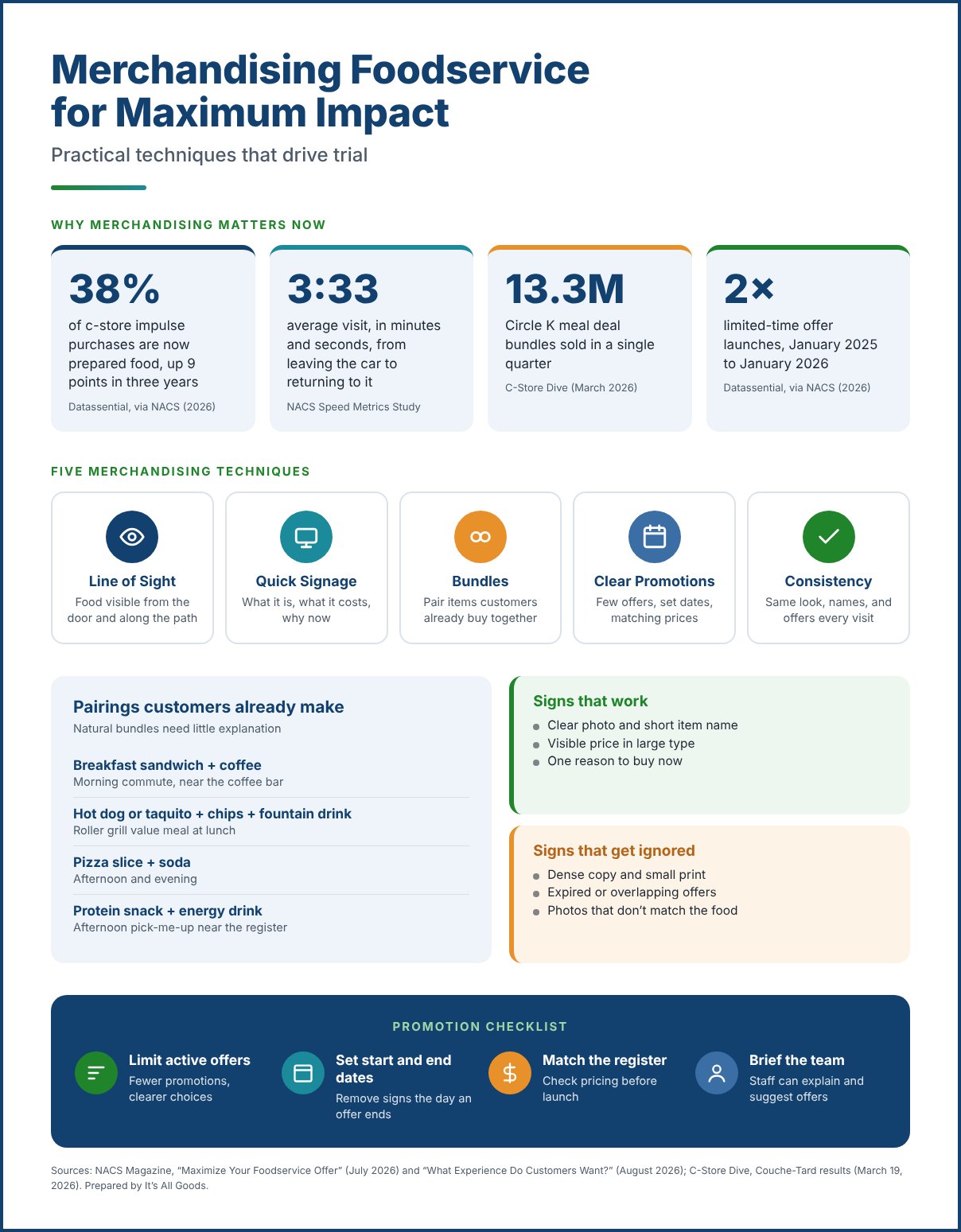
The opportunity is growing. Datassential research reported in NACS Magazine’s July 2026 foodservice coverage found that prepared food now accounts for 38% of c-store impulse purchases, up 9 points in three years, while packaged goods fell 6 points to 47%. Customers are increasingly willing to buy food on the spot. The practical question is how to make that decision easy.
The first rule of foodservice merchandising is simple: customers buy what they see. Food that sits outside the natural path through the store depends on customers who already intend to buy it. Food placed in the line of sight reaches everyone else.
In most stores, that means a few high-value locations. The view from the entrance should include at least one food signal, such as a warmer, a fresh case, or a clear photo of a signature item. The path toward the coffee bar, fountain, and cold vault should pass food, not shelving that blocks it. The register should hold one or two grab-and-go items that fit the daypart, rather than a crowded mix of unrelated products.
Height and fullness matter as much as location. Best-selling and highest-margin items belong at eye level, with enough facings to look plentiful. A case that looks full and organized signals freshness. A case with gaps and scattered items signals the opposite, even when the food was made an hour ago.
Daypart placement is often overlooked. Breakfast sandwiches beside the coffee in the morning, lunch items along the main path at midday, and snack-size portions near the register in the afternoon can all come from the same equipment. Moving a few items as the day changes keeps the most relevant food in front of the customer who is most likely to buy it.
Convenience shoppers do not spend long in the store. The NACS Speed Metrics Study cited in NACS Magazine found an average of 3 minutes and 33 seconds from leaving the car to returning to it. Foodservice signage has only a few seconds of that time to do its job.
Effective signs answer three questions at a glance: what it is, what it costs, and why to buy it now. A clear photo, a short item name, a visible price, and one benefit such as “made fresh this morning” or “ready in 60 seconds” will outperform a sign packed with copy. Large type, high contrast, and placement at eye level along the customer’s path matter more than design flourishes.
Fewer signs usually work better. Each additional message competes with the others, and stores that try to promote everything often end up promoting nothing. A practical approach is to assign each sign location one job, such as a daypart offer at the entrance, a featured item at the case, and an add-on suggestion at the register, and remove anything that does not serve that job.
“So what we need to do is highlight the quality, the freshness and the uniqueness of your foodservice program.”
— Caitlin Root, Executive Vice President, Customer Experience, Datassential
Bundles give customers a fast, easy decision. Instead of choosing an entrée, a side, and a drink separately, they choose one offer at one price. For the retailer, a bundle raises the average ticket and introduces customers to items they might not have tried on their own.
The strongest pairings are the ones customers already make: a breakfast sandwich and coffee, a hot dog and a fountain drink, a slice of pizza and a soda, or a protein snack and an energy drink. Bundles built around those habits require little explanation, which matters when customers are deciding in seconds.
Cross-promotion extends the same idea without a formal bundle. Placing chips beside the sandwich case, displaying cookies near the coffee bar, or suggesting a beverage on the warmer’s sign links categories in the customer’s mind. As covered in It’s All Goods’ Cross-Merchandising Techniques white paper, strategic pairing works best when it reflects real purchase data and stays limited to a few clear combinations.
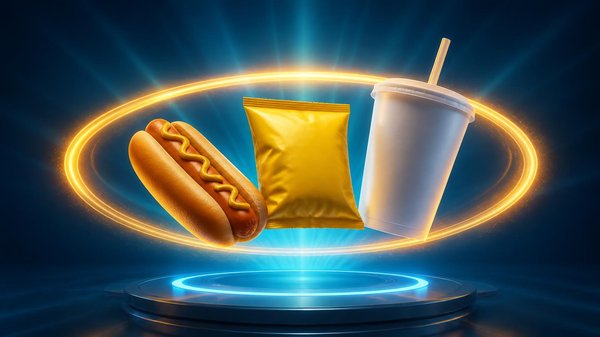
Circle K offers a clear example of bundling at scale. In October 2024 the chain introduced a permanent set of U.S. meal deals built from its most popular items. The $3 deal, for example, pairs a roller grill hot dog or taquito with a bag of chips and a fountain drink, while other price points cover breakfast and pizza combinations.
The offers are easy to understand: familiar food, a single price, and no complicated rules. That simplicity has translated into volume. According to C-Store Dive’s report on Couche-Tard’s March 2026 results, Circle K sold 13.3 million meal deal bundles in the quarter, up from 10 million in the program’s first full year, while U.S. foodservice same-store sales grew in the mid-to-high single digits. Alex Miller, president and CEO of parent company Alimentation Couche-Tard, said the meal deals “remain a key anchor of that performance.”
The lesson for smaller operators is not the scale but the structure. Circle K built its bundles from items customers already buy, kept the price points few and memorable, and made the deals a permanent part of the menu rather than a short-lived campaign. That consistency gives customers a reason to come back for the same offer.
Promotions are becoming more common across foodservice. Datassential data in the same NACS Magazine report found that limited-time offer launches across major chains and c-stores doubled from January 2025 to January 2026. More promotions create more opportunity, but they also create more room for confusion.
Confusion usually comes from overlap. When a store runs a meal deal, a loyalty offer, a supplier promotion, and a limited-time item at the same time, customers may not know which price applies or which item is featured. Staff may not know either. The result is slower transactions, frustrated customers, and promotions that underperform.
A few disciplines help. Limit the number of active foodservice promotions at one time. Give each one a clear start and end date. Remove expired signs on the day an offer ends. Make sure the register price matches the sign before the promotion goes live. Brief employees on what is running, so they can answer questions and suggest the offer at checkout.
Consistency is what turns a promotion into a habit. Customers who see the same offer, the same item names, and the same visual style every time they visit learn what to expect and are more likely to return for it. Inconsistent messaging, by contrast, makes a food program feel temporary.
For multi-store operators, consistency starts with a simple standard: approved sign templates, a defined set of locations for foodservice messages, a promotion calendar shared with every store, and a short checklist for store teams. Single-store operators can apply the same principles on a smaller scale by keeping a fixed place for featured items and refreshing signs on a regular schedule.
Consistency also applies between the sign and the food. If a sign shows a full, colorful sandwich, the product in the case should look the same. When the promise and the product match, customers trust the next promotion. When they do not, customers learn to ignore the signs.
Merchandising is where a foodservice program meets the customer. Placement determines whether food is seen, signage determines whether it is understood, bundles make the decision easier, and disciplined promotions keep the message clear. None of these techniques requires a remodel. Most require only attention, simple standards, and the willingness to remove what is not working.
Operators that place food in the line of sight, communicate quickly, pair items customers already want together, and keep their messaging consistent will give their foodservice programs more chances to earn trial, and more chances to earn the repeat visits that follow.
In the customer’s natural line of sight: visible from the entrance, along the path to coffee, fountain, and cold drinks, and at the register. Best-selling items belong at eye level with enough facings to look full and fresh.
Effective signs show what the item is, what it costs, and why to buy it now, with a clear photo, large type, and a visible price. Fewer, focused signs usually perform better than many competing messages.
Bundles built around pairings customers already make, such as breakfast sandwiches with coffee, hot dogs with fountain drinks, or pizza with soda, tend to perform best because they need little explanation and deliver clear value.
As few as needed to communicate clearly. Overlapping offers confuse customers and staff. Each promotion should have a clear start and end date, matching register pricing, and signs removed promptly when it ends.
Consistency builds recognition and trust. When customers see the same offers, names, and visual style on each visit, and the food matches the signage, they are more likely to try promotions and return for them.

Subscribe to receive latest news
12968 Vallejo Circle, Westminster CO. 80234
Phone: (303) 604-1064





