reparing for the future of convenience store foodservice rarely starts with a bold new concept. It starts with the kitchen an operator already runs. The forces described in It’s All Goods’ look at how c-store foodservice is evolving, from restaurant-level competition to rising costs and fewer in-store trips, all put more weight on the same everyday questions. Is the food fresh and consistent on every shift? Can the kitchen adapt when the menu changes? Can a new hire learn the job quickly? And can the business tell the difference between a tool worth adopting and a trend worth waiting out?
This article covers five practical steps operators can take now: strengthening core execution, investing in flexibility, training for change, evaluating new tools, and avoiding overreaction. It closes with a case study of how Weigel’s in East Tennessee has built foodservice training and product development around those basics.
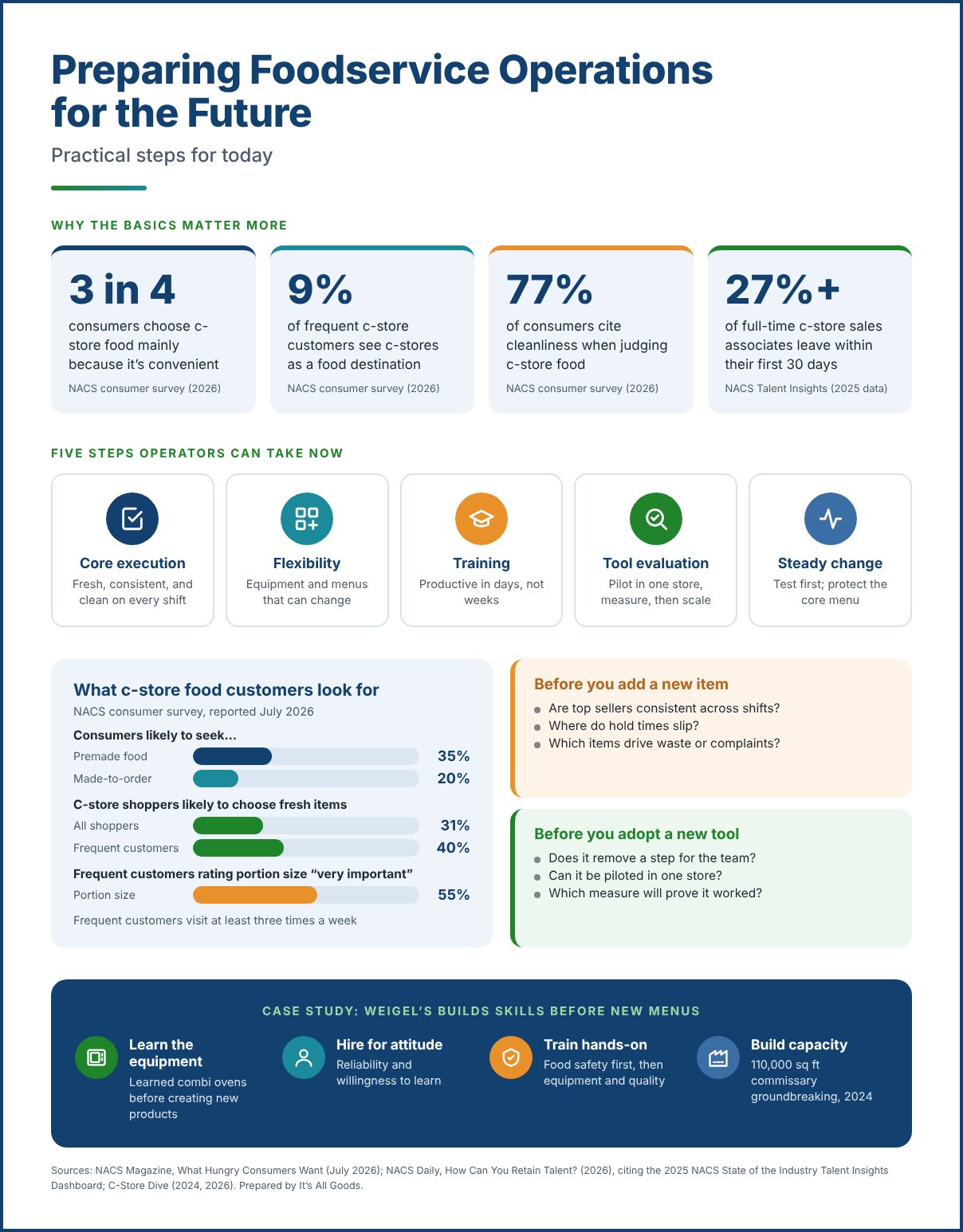
The first step is the least glamorous and the most important. According to the latest NACS consumer survey, reported in NACS Magazine’s July 2026 issue, three out of four consumers say they choose convenience store food primarily because it is convenient, and consumers see c-stores as a last resort for food rather than a destination by a margin of three to one. Even among frequent customers who visit at least three times a week, only 9% consider c-stores a food destination.
The same survey points to what changes that perception. Freshness and taste are the two factors that keep consumers coming back, and more than three in four consumers (77%) cited cleanliness. NACS noted that trust in food quality depends less on the menu itself than on what customers see in the store. For operators, that makes execution the most reliable growth lever: food held within its window, builds that look the same at 6 a.m. and 9 p.m., and prep areas and restrooms that signal care.
A practical starting point is a short audit of the current menu before anything new is added. Which top sellers are made consistently across shifts and stores? Where do hold times slip, and which items generate the most waste or complaints? Short station standards, daily checks, and simple measures such as waste logs and mystery shops turn those answers into habits.
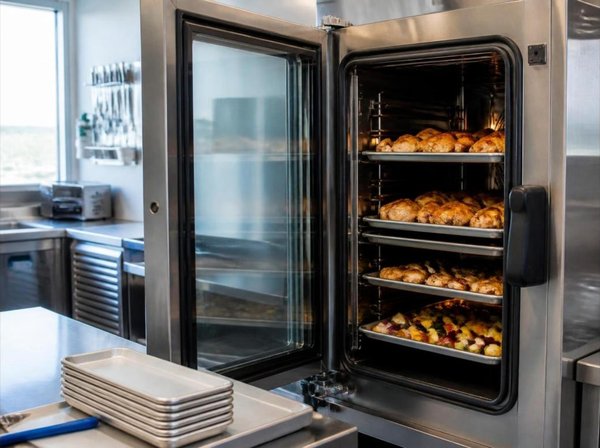
The menu that works today will not be the menu in three years, so the kitchen behind it needs room to change. Equipment is often the biggest constraint. In a sponsored NACS Daily article, Merrychef U.S. General Manager Garamy Whitmore advised operators to choose high-speed, connected ovens rather than single-purpose equipment that limits growth. He also noted that visual menu displays on ovens can reduce language barriers and shorten training, and that connected ovens let multi-store operators download new menu items to every location remotely.
Flexibility also applies to the menu itself. Building items from a shared set of ingredients lets operators add variety without adding stock-keeping units, prep steps, or waste. As C-Store Dive reported in September 2026, Matt Chappell, corporate executive chef at seven-unit Leo’s Market and Eatery in Indiana, has focused this year on cross-utilizing ingredients to reduce waste and keep costs down.
The same thinking applies to space and capital. Holding and merchandising equipment that can shift between breakfast and lunch, prep stations that can take on new items without a remodel, and equipment purchases tied to more than one menu item all give operators options when customer demand moves.
Every future-ready plan depends on people learning quickly, and the timeline is short. NACS reported in an April 2026 NACS Daily article that, according to its 2025 State of the Industry Talent Insights Dashboard, more than 27% of full-time sales associates leave within their first 30 days, and annual turnover for full-time sales associates exceeds 108%. Training that takes weeks to pay off will rarely reach the employees who need it most.
Faster training usually comes from simpler design. Task-based modules, visual build cards at each station, short videos, and on-screen guidance help new hires perform one station well before they learn the next. Sequence matters as well: food safety first, then equipment use, then product quality and speed.
Training for change also means building a repeatable routine for menu updates. When a new item launches, teams need the same steps every time: a pilot store, a short demonstration before shifts, clear build standards, and a way to report what is not working. Operators that practice that routine on small changes are better prepared when a bigger change arrives.
New technology will keep arriving, and the best protection against costly mistakes is a consistent way to evaluate it. Huck’s Market offers a useful example of disciplined rollout. According to NACS Daily, the 135-store chain, owned by Martin & Bayley, deployed an AI-native point-of-sale system first at its flagship store in Carmi, Illinois, before a chainwide rollout planned for completion by the end of 2026. The system includes an AI assistant that lets associates ask questions and pull up training videos at the register. Martin & Bayley President and CEO Murat Tokad said the cleaner design means associates no longer have to work around the screen or memorize workarounds.
Huck’s example involves the point of sale rather than the kitchen, but the same discipline applies to kitchen display systems, forecasting software, and AI cameras. Before adopting a tool, operators can ask a few direct questions. Does it remove a step for the team or add one? Does it work with existing hardware and workflows? Can it be tested in one store first? Who will own it after launch? And which measure, such as ticket times, waste, or training hours, will show whether it worked?
The answers belong in writing before the pilot starts, along with a baseline for the measure being tested. A tool that saves a manager ten minutes of paperwork but adds a step at the make line during the lunch rush may not be a net gain. A tool that looks modest on paper but removes a daily workaround for every shift may be worth far more than its price suggests. Asking store teams how the tool feels in practice, not just reviewing the dashboard, often reveals the difference.
Falling traffic, new competitors, and headlines about acquisitions can make sweeping change feel urgent. The consumer data argues for a steadier approach. In the NACS survey, speed of service ranked in the bottom half of considerations for c-store food, and consumers were nearly twice as likely to seek premade food (35%) as made-to-order food (20%). A full made-to-order program may be the right answer for some stores, but it is not automatically the answer for every store or customer base.
A few guardrails help operators move deliberately. Test a change in a small number of stores before scaling it. Change one major variable at a time so results are clear. Set exit criteria before a launch rather than after. And protect the core menu that customers rely on while new ideas are tested around it. Reacting to a short-term dip by cutting labor from the kitchen, for example, can weaken the very freshness and consistency that bring customers back.
Weigel’s, based in Powell, Tennessee, operated nearly 90 convenience stores at the start of 2026 and ranked 77th in CSP’s 2026 Top 202 list, up from 84th the year before. Its newer stores feature the Weigel’s Kitchen concept, with pizza, panini sandwiches, Mexican specialties, snacks, specialty coffees, and food-ordering kiosks.
C-Store Dive’s September 2026 report describes how Ryan Blevins, Weigel’s director of food and beverage innovation, brought a restaurant background that included large, multimillion-dollar kitchens. At Weigel’s, he adopted equipment such as combi ovens, which he had not used before, and refocused on pre-prepared grab-and-go foods and the merchandising equipment that holds them. He explained why learning the equipment came first:
“I didn't know how I was going to innovate and create new products if I didn't know how to use the ovens.”
— Ryan Blevins, Director of Food and Beverage Innovation, Weigel’s
Blevins has also reshaped how Weigel’s prepares its teams. The company shifted hiring to prioritize attitude, reliability, and willingness to learn, and made training simpler, more structured, and more hands-on, starting with food safety, equipment use, product quality, and consistent execution. About 65% of his time goes to food, including innovation and product development, and the rest goes to training, recipe building, and standard operating procedures.
Weigel’s has invested in capacity behind the stores as well. In February 2024, it broke ground on a 110,000-square-foot commissary in Loudon, Tennessee, its first food commissary and its third manufacturing facility after its bakery and dairy. The case shows the order of operations this article recommends: learn the equipment, simplify training around food safety and consistency, build standards before scaling, and invest in the infrastructure that makes new products repeatable.
Preparing foodservice operations for the future is mostly about strengthening what already exists. Operators that make freshness, taste, and cleanliness consistent on every shift, choose equipment and menus that can adapt, and design training that works within an employee’s first weeks will be ready for whatever the next menu or market shift requires.
The same discipline applies to change itself. Test new tools in one store, measure what matters, and resist the urge to overhaul everything at once. The final article in this cluster turns these steps into a long-term strategic roadmap for the next generation of c-store foodservice.
Strengthen core execution. NACS survey data shows freshness and taste keep customers coming back, and 77% of consumers cited cleanliness, so consistent basics come before new concepts.
Choose multipurpose, connected equipment over single-purpose units, build menus from shared ingredients, and select holding and prep equipment that can shift between dayparts and new items.
According to NACS, more than 27% of full-time sales associates leave within their first 30 days, so training has to make new hires productive within days, not weeks.
Ask whether the tool removes a step, fits existing hardware and workflows, can be piloted in one store, has a clear owner, and will be judged by a defined measure.
Weigel’s learned its equipment before creating new products, simplified hands-on training around food safety and consistency, and invested in a commissary to support its food program.

Subscribe to receive latest news
12968 Vallejo Circle, Westminster CO. 80234
Phone: (303) 604-1064