





he convenience store beverage program is changing faster than at any point since the arrival of the self-serve fountain. Customers who once accepted a pot of drip coffee and a dozen soda valves now expect lattes, cold foam, refreshers, protein-added drinks, and the ability to build a beverage exactly the way they like it. At the same time, new equipment is making it possible to offer that variety without adding baristas, and health-minded shoppers are paying closer attention to what goes into their cup.
As It’s All Goods explained in Designing Beverage Programs That Drive Foodservice Sales, the strongest non-alcoholic beverage programs are built on daily execution. This article looks ahead at the trends most likely to shape those programs over the next several years, including premium drinks, customization, health and transparency, technology, and the discipline needed to scale new ideas profitably.
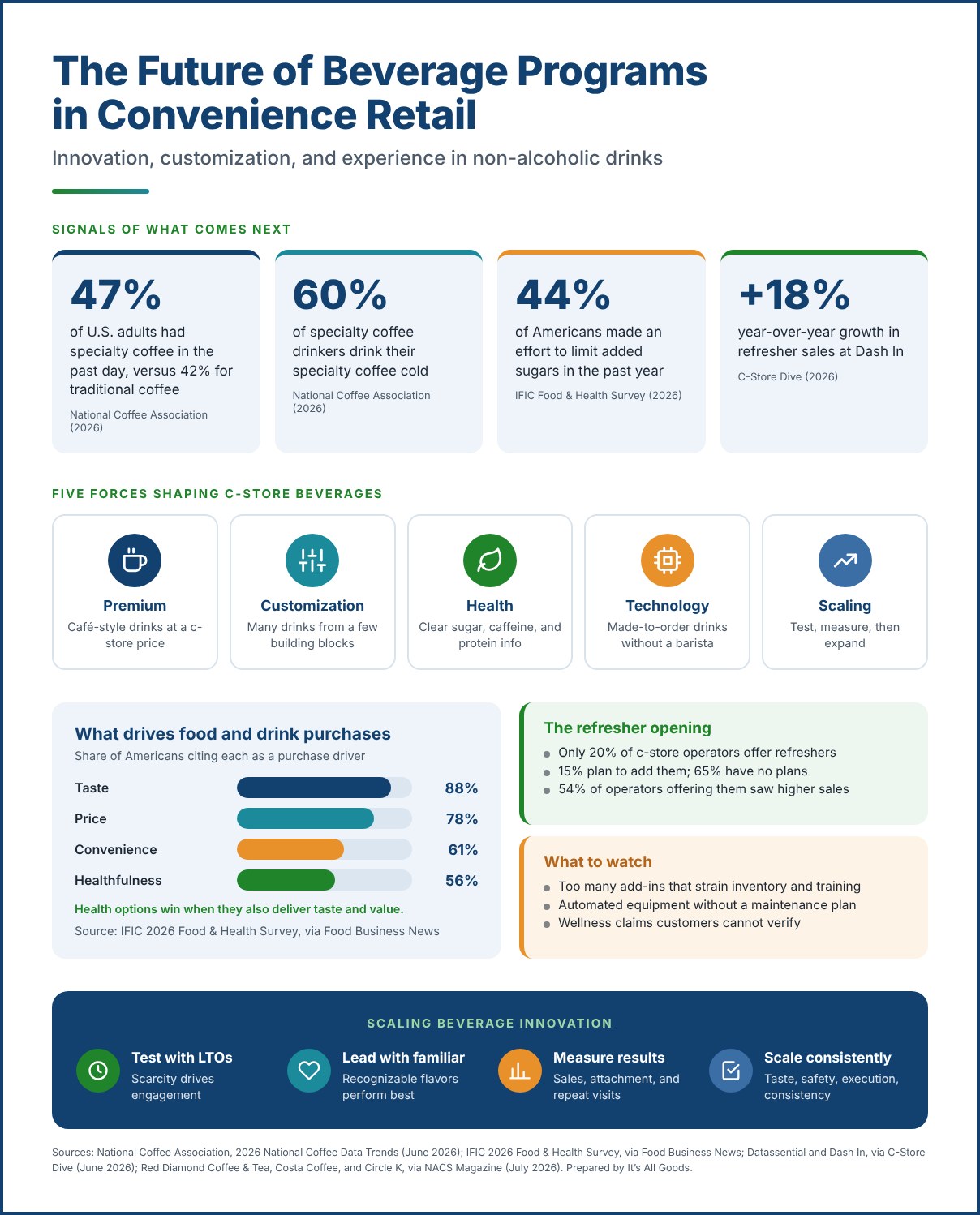
Specialty coffee has become the everyday standard for many Americans. According to the National Coffee Association’s 2026 National Coffee Data Trends findings, 47% of U.S. adults had specialty coffee in the past day, matching the record set in 2025, compared with 42% who had traditional coffee. Specialty drinkers are also more likely to buy away from home: 36% had their coffee prepared outside the home, versus 23% of traditional coffee drinkers. Among adults ages 25 to 39, 69% had specialty coffee in the past week.
Suppliers see the same shift in convenience stores. “Convenience shoppers increasingly expect premium coffee beverages like lattes, cappuccinos and mochas,” Joe Gaines, senior director of U.S. sales for Costa Coffee, told NACS Magazine in its July 2026 look at the c-store coffee bar. The same report noted that hot dispensed beverages held flat at 8.5% of c-store foodservice sales in NACS’s 2025 State of the Industry Report, while their gross profits dipped 5.4%. That combination suggests traditional coffee programs alone may no longer be enough to grow the category.
The opportunity for c-stores lies in offering premium drinks at a convenience-store value. The report pointed to Wawa’s 12-ounce matcha drinks starting at a little over $4, while some independent coffee shops charge up to $8 for similar drinks. Retailers that can deliver specialty quality at that kind of price gap are well positioned to win customers who want café-style drinks without the café stop.
Customization is moving from a nice extra to a baseline expectation, especially for younger customers. Javier Carro, senior product manager for coffee and beverages at The McLane Company, told NACS Magazine that “customization will continue in 2027, 2028 and beyond,” adding that younger generations want to mix assorted flavors with cold coffee. Cold drinks are central to that shift: the NCA found that 60% of specialty coffee drinkers drank their specialty coffee cold.
The challenge for operators is to offer choice without creating chaos. Add-in stations, flavor shots, cold foam, and syrup combinations give customers a sense of ownership over their drink, but every new option adds inventory, cleaning, and training. The most sustainable approach is a curated set of building blocks, such as a handful of syrups, milks, and toppings that work across coffee, refreshers, and sodas, so customers get many combinations from a manageable number of ingredients.
Health is shaping beverage choices, though rarely at the expense of taste or value. In the International Food Information Council’s 2026 Food & Health Survey of 3,005 Americans, 44% said they made an effort to limit added sugars in the past year, and 56% said they use the ingredient list to judge whether a food is ultra-processed. Yet taste (88%), price (78%), and convenience (61%) all ranked ahead of healthfulness (56%) as purchase drivers, and convenience outranked healthfulness for the first time since the survey began in 2006.
Functional drinks are where health and convenience meet. NACS Magazine cited Cargill research showing 61% of U.S. consumers said they increased their protein intake in 2024, up from 48% in 2019, and protein-added coffee has moved from niche to mainstream at major chains. In a C-Store Dive report on dispensed beverage trends, Shauna Seidenberg, category manager for dispensed beverage at EG America, said of customers, “They want beverages that offer additional health benefits,” pointing to interest in clean energy drinks made with lower sugar and natural caffeine sources.
For c-stores, the practical response is transparency rather than reinvention. Clear information on sugar, caffeine, and protein content at the point of sale, zero-sugar sweetener options, and a few better-for-you choices alongside indulgent favorites let customers make their own decisions quickly. As with food, credibility matters more than claims: a simple, accurate description builds more trust than a wellness label that customers cannot verify.
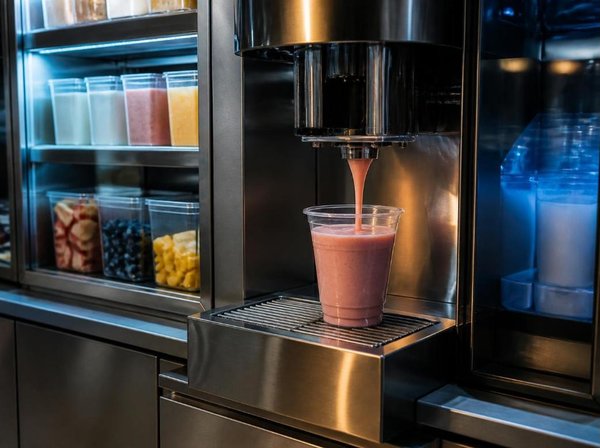
Technology is making specialty drinks possible in stores that could never staff a barista counter. Parker’s Kitchen introduced a made-to-order beverage program at its new prototype store in Port Wentworth, Georgia, in January 2026, offering hot and frozen coffees, smoothies, boba drinks, and energy drinks through a Botrista machine that measures, dispenses, and blends each drink, according to C-Store Dive’s report on Parker’s new beverage program. Botrista says the system makes a drink in under 20 seconds.
Large chains are investing as well. In the NACS Magazine report, a 7-Eleven spokesperson said its Coffee of the Future machine “supports a consistent coffee experience while streamlining operations.” Emily Wood Bowron Forehand, senior vice president of Red Diamond Coffee & Tea, summed up the task facing operators:
“The challenge is to offer the right product mix, a rich storyline and personalization options without a barista.”
— Emily Wood Bowron Forehand, Senior Vice President, Red Diamond Coffee & Tea
Automation also brings new responsibilities. Touchscreen and made-to-order machines need reliable maintenance, ingredient restocking, and cleaning routines, and they work best when the menu they serve is focused. Retailers should evaluate equipment by its total cost, including service, training, and downtime, not just by the variety it promises. Digital ordering and loyalty data can then help operators see which drinks, add-ins, and food pairings are actually selling.
New drinks attract attention, but scaling them across dozens or hundreds of stores requires discipline. Shawn Barnes, head of dispensed beverages for Circle K North America, told NACS Magazine, “We evaluate enhancements through the lens of taste, safety, operational execution and consistency.” That filter is useful for any operator, because a drink that cannot be made the same way in every store will undermine the program it was meant to strengthen.
Limited-time offers are one of the safest ways to test ideas. Forehand noted that “scarcity drives engagement,” while Gaines observed that “in convenience retail, where decisions are often made quickly, recognizable flavors tend to perform best.” Together, those views point to a practical model: rotate familiar flavors in new formats, measure the results, and promote only the winners to the permanent menu.
Refreshers show both the opportunity and the gap. According to C-Store Dive’s coverage of the refresher boom, Datassential found that only 20% of c-store operators offer refreshers, 15% plan to, and 65% have no plans to add them, even though 54% of operators that offer refreshers reported higher sales over the past year. Retailers that move early, with tested recipes and simple execution, have room to build a clear beverage advantage.
Dash In offers an example of a retailer redesigning its beverage program around the trends described here. As part of a food and beverage overhaul that began in 2023, many Dash In stores now feature a 22-foot beverage wall with proprietary “bubbler” drinks, fruit-based beverages such as mango-peach limeade, tap-dispensed soda, bean-to-cup coffee machines, and a smoothie maker, according to C-Store Dive. A dedicated section of the wall features refreshers, and the chain’s refresher sales have grown 18% year over year.
Josh Campbell, category manager for Dash In, said customers “were looking for something beyond traditional fountain drinks and coffee,” and that refreshers allowed the chain to offer a fresh, flavorful option that feels more like something found at a specialty café. He added that guests are increasingly seeking unique flavors, customization, and higher-quality ingredients, which aligns with the direction Dash In has taken its beverage program.
The Dash In approach brings premium flavors, customization, and a broad but organized set of platforms together in one visible place in the store. It shows how a beverage program can become a reason to visit on its own, while still keeping customers close to the food that completes the trip.
The future of c-store beverage programs will be defined by premium quality at a convenience price, customization built from a manageable set of ingredients, honest information for health-minded shoppers, and technology that delivers café-style drinks without café-style labor. Each of these trends rewards retailers that plan carefully rather than chase every new idea.
The operators best positioned for what comes next will test before they scale, judge innovation by taste, safety, execution, and consistency, and keep beverages tied to the food programs they support. Done well, the beverage program becomes not just a profitable category but one of the strongest reasons customers choose a convenience store at all.
According to the National Coffee Association’s 2026 findings, 47% of U.S. adults had specialty coffee in the past day, a record-matching level, compared with 42% who had traditional coffee.
Younger customers expect to build their own drinks, especially cold coffee and refreshers. A curated set of syrups, milks, and toppings lets stores offer choice without excessive complexity.
Yes. In IFIC’s 2026 survey, 44% of Americans tried to limit added sugars, but taste, price, and convenience still ranked ahead of healthfulness, so clear options and information work best.
Automated made-to-order machines, like the Botrista system at Parker’s Kitchen, can blend specialty drinks in seconds, letting stores offer café-style beverages without adding baristas.
Test with limited-time offers, focus on recognizable flavors, measure results, and expand only drinks that can be made consistently, safely, and profitably in every store.

Subscribe to receive latest news
12968 Vallejo Circle, Westminster CO. 80234
Phone: (303) 604-1064





