

onvenience-store foodservice is becoming more varied, more digital, and more interconnected. Retailers are expanding fresh and made-to-order menus, sourcing ingredients through complex supply networks, using connected equipment, accepting mobile orders, and serving customers across multiple channels. These developments create new opportunities, but they also require food-safety systems capable of operating with greater speed, visibility, and precision.
The future will not be defined by technology replacing employees or managers. It will be defined by better systems that help people identify risks earlier, respond more consistently, and learn from information collected across the operation. Traceability, sensors, predictive analytics, digital training, equipment design, and food-safety culture will increasingly work together rather than function as separate initiatives.
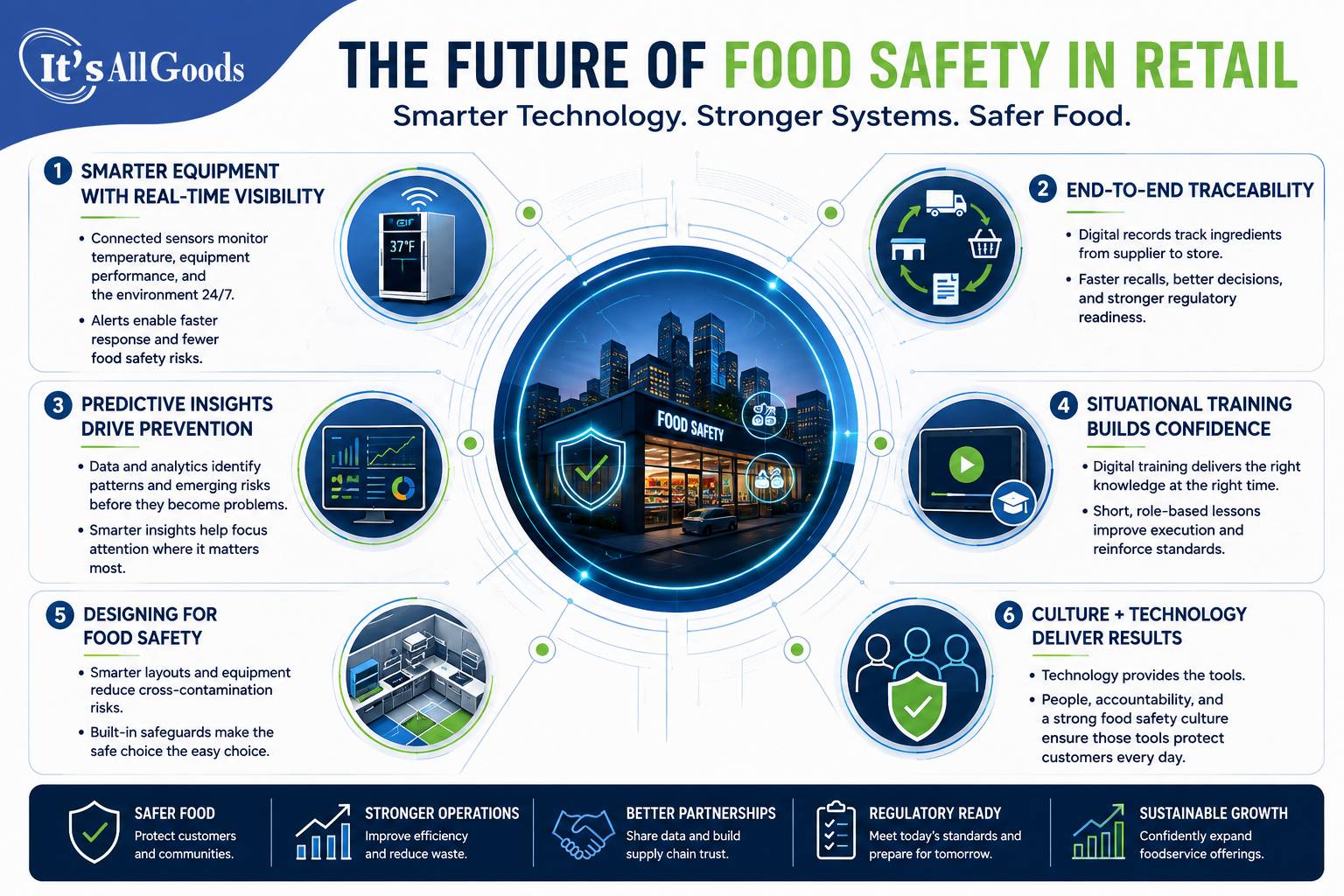
Traditional food-safety programs often focus on detecting failures after they occur. A manager finds an unsafe temperature during an inspection, discovers that a cleaning task was missed, or learns that a recalled ingredient may be present in the store. Corrective action then begins.
The next stage of food safety will place greater emphasis on identifying the conditions that precede failure. A connected refrigerator may reveal gradual temperature drift before food becomes unsafe. Digital task records may show that checks are repeatedly missed during one daypart. Maintenance data may indicate that a particular equipment model is generating an unusual number of alerts. Training records may reveal that stores with high employee turnover are also producing more sanitation deviations.
The U.S. Food and Drug Administration’s New Era of Smarter Food Safety Blueprint describes a more digital and traceable food system built around technology-enabled traceability, smarter prevention and outbreak-response tools, retail modernization, and food-safety culture. The FDA specifically identifies artificial intelligence, connected sensors, analytics, and other emerging technologies as tools that may improve prediction, prevention, and response.
For convenience retailers, predictive food safety will develop gradually. The first step is not necessarily adopting advanced artificial intelligence. It is collecting reliable information in consistent formats and using it to recognize patterns. Poor data entered inconsistently into disconnected systems cannot support meaningful prediction, no matter how sophisticated the software may be.
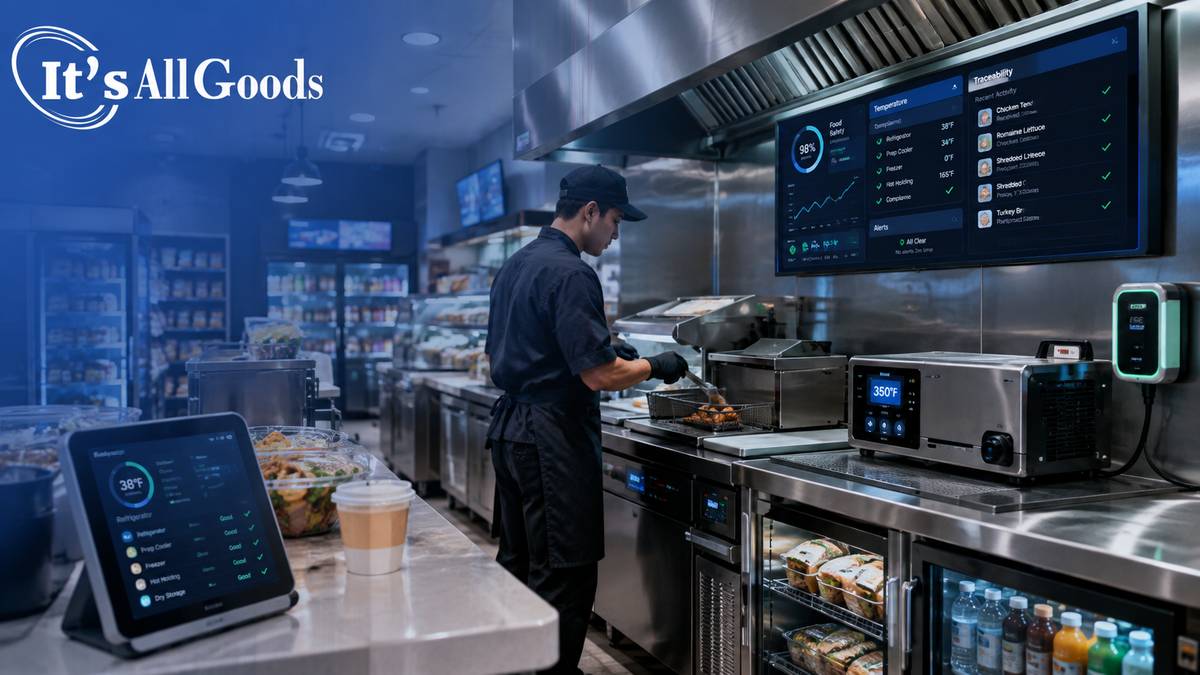
Temperature control is especially suited to automation because refrigeration, freezers, hot-holding units, and other equipment operate continuously. Manual checks provide important verification, but they capture conditions only at specific moments. A unit may perform properly during a scheduled check and fail shortly afterward.
Connected sensors can monitor equipment around the clock, identify deviations, and notify employees or managers when attention is required. Future systems may combine temperature data with information about door openings, product loading, ambient conditions, equipment age, and maintenance history. That context can help determine whether an alert represents a temporary fluctuation, an operating mistake, or a developing mechanical problem.
Smart equipment can also guide corrective action. Instead of merely reporting that a cooler is warm, a system could direct the employee to recheck the unit, assess affected products, relocate food, document its disposition, and initiate maintenance. Escalation rules could notify a district manager when the store does not respond within an established period.
The FDA’s modernization blueprint encourages commercial smart-kitchen equipment capable of automatically monitoring time and temperature processes. It also recognizes that technology must remain practical for operations of different sizes and that no single approach will fit every food business.
The value of connected equipment depends on implementation. Sensors must be positioned correctly, limits must reflect the products being protected, alerts must reach someone with authority to act, and employees must understand the required response. An ignored alert is simply a digital version of an unread paper log.
When a food recall occurs, retailers must determine whether affected products reached their stores, where those products were used, and whether prepared foods containing the ingredient remain available for sale. In fragmented systems, that process may require reviewing invoices, contacting distributors, inspecting storage areas, and relying on employee memory.
Digital traceability is intended to make that process faster and more precise. The FDA’s Food Traceability Rule establishes additional recordkeeping requirements for foods on the Food Traceability List, using standardized Critical Tracking Events and Key Data Elements. Covered records are designed to help identify and remove potentially contaminated products more rapidly. FDA currently states that it does not intend to enforce the rule before July 20, 2028, following a congressional directive establishing that date.
The delayed enforcement date should not be interpreted as a reason to postpone all traceability planning. Retailers can use the additional time to understand which ingredients and suppliers are affected, map the flow of products through distribution and stores, evaluate existing records, and determine how information will be exchanged with trading partners.
Traceability also has operational value beyond regulatory compliance. Better product identification can support inventory rotation, waste reduction, supplier evaluation, recall execution, and customer communication. A retailer able to identify exactly which stores and products are affected may avoid unnecessarily discarding unrelated inventory or suspending an entire menu category.
The longer-term objective identified by FDA is interoperable, end-to-end traceability that allows different participants and technology systems to exchange meaningful information. For convenience retailers, that means technology decisions should consider how data will move among manufacturers, distributors, commissaries, stores, and regulators—not merely how it will be stored internally.
Food safety is often managed through separate systems: temperature logs, cleaning checklists, maintenance tickets, training records, audit findings, supplier documents, and incident reports. When those records remain isolated, organizations can miss relationships among them.
A more integrated system could reveal that stores with repeated refrigeration alarms also have delayed maintenance response times. It could show that sanitation findings increase after a menu expansion or equipment installation. It could connect incomplete closing procedures with staffing levels, training completion, or unusually high transaction volume.
This is where automation and analytics can provide significant value. Software can organize large volumes of records, identify recurring conditions, and direct management attention toward the locations or processes presenting the greatest risk. It can also distinguish an isolated deviation from a pattern requiring broader intervention.
Integration should not lead to indiscriminate data collection. Every metric should have a clear operational purpose. Retailers need to decide which conditions require immediate response, which patterns warrant investigation, and which information is merely interesting. Too many dashboards and alerts can make a system less useful by obscuring the issues that matter most.
The foundation remains the store-level discipline described in Building Food Safety Systems That Work at Store Level. Technology strengthens food safety only when responsibilities, corrective actions, and verification procedures are already clear.
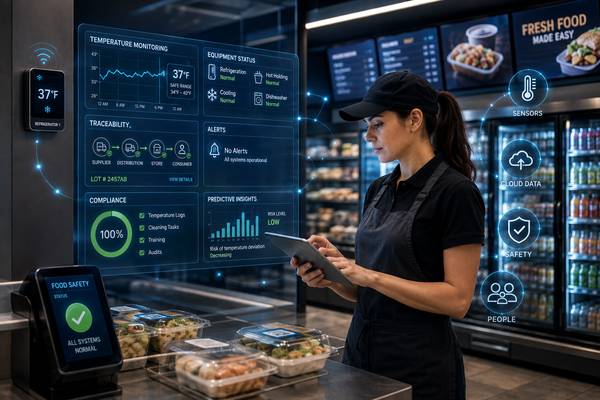
Annual training programs will remain important, but future food-safety education will increasingly occur in shorter, more targeted moments. Employees may receive instructions when beginning a task, scanning an ingredient, responding to an alert, or using unfamiliar equipment.
Digital platforms can assign training according to role, menu, location, language, or observed performance. A store with recurring sanitizer errors might receive a focused refresher. An employee preparing a new product could access a brief demonstration at the workstation. A manager responding to a refrigeration failure could be guided through the proper evaluation and documentation procedure.
Simulation and interactive learning may also improve preparation for events that occur too infrequently for employees to practice routinely, such as recalls, power outages, water interruptions, allergen incidents, or suspected foodborne illness complaints.
These systems should reinforce rather than replace coaching. Managers still need to observe employees, answer questions, and correct behavior in context. Technology can deliver consistent information, but leadership determines whether that information becomes part of everyday execution.
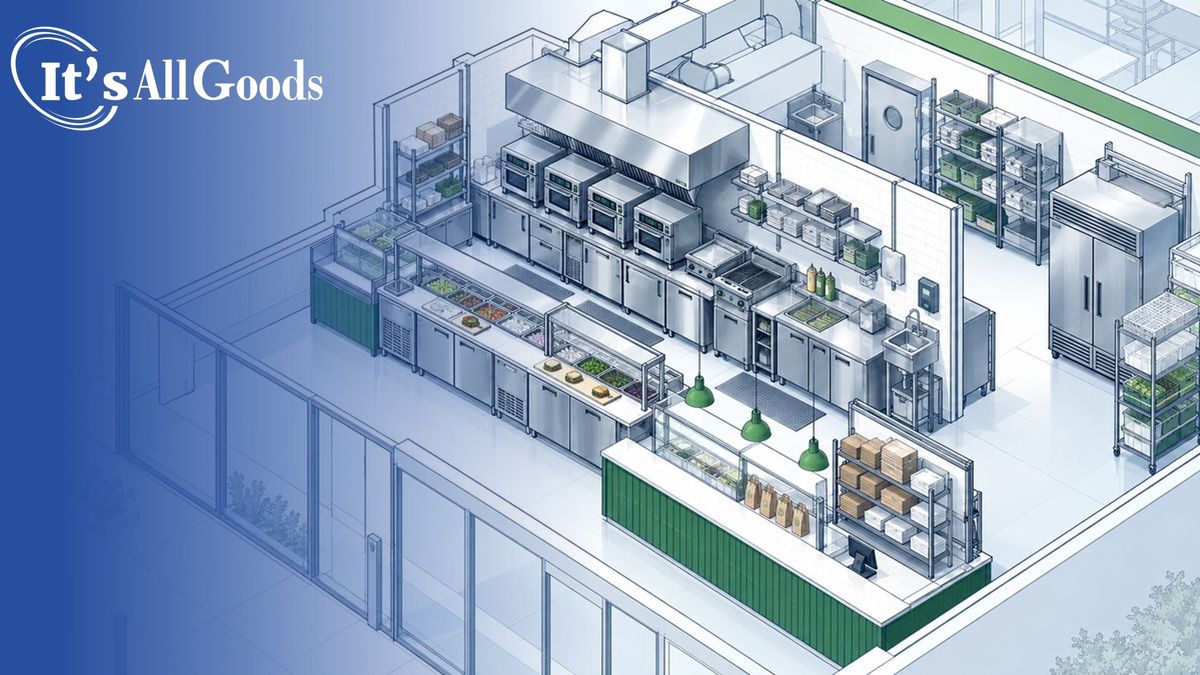
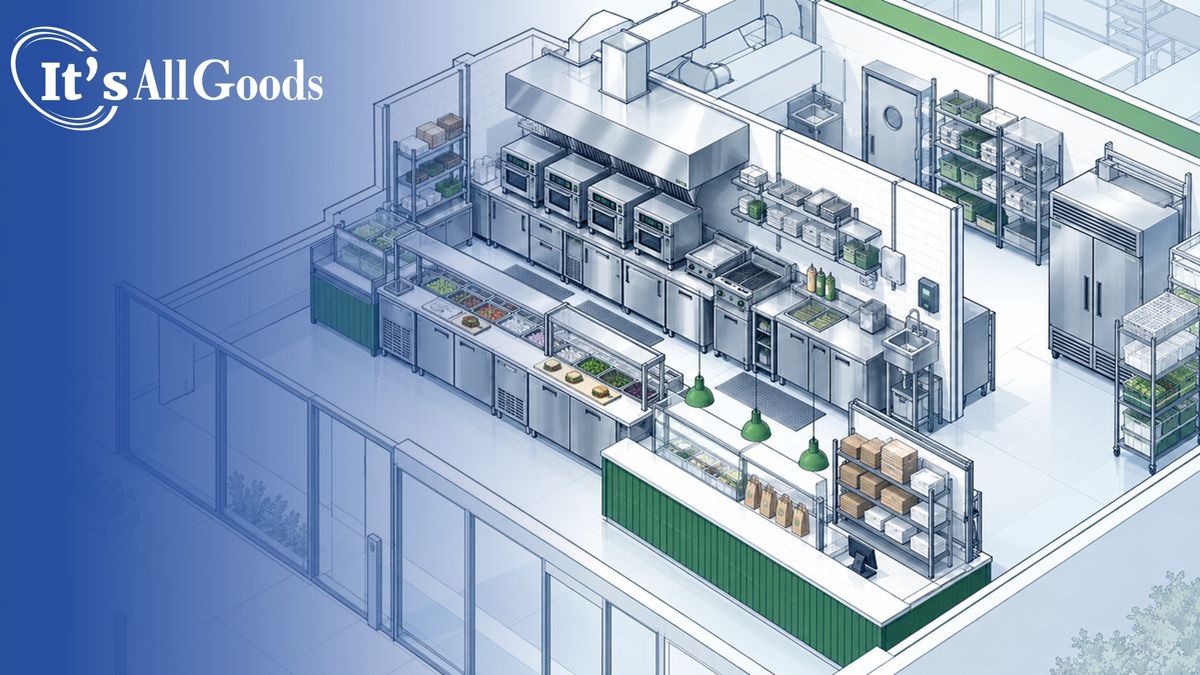
Future food-safety improvement will not depend only on asking employees to remember more rules. Retailers will increasingly use physical design to make safe practices easier and mistakes less likely.
Preparation areas can be arranged to separate raw and ready-to-eat foods. Handwashing sinks can be positioned directly within the workflow. Utensils and cleaning supplies can be stored at the point of use. Equipment can be designed with fewer difficult-to-clean components. Refrigeration can provide clear visual warnings. Dispensing and holding systems can reduce unnecessary hand contact.
These engineering controls matter because training and supervision are never perfect. Stores experience turnover, high-volume periods, and unexpected disruptions. A well-designed environment continues to guide behavior even when employees are under pressure.
FDA’s retail-modernization goals specifically include greater emphasis on facility and equipment design as preventive controls, along with digital tools that encourage behaviors such as handwashing and temperature monitoring.
For retailers planning remodels or new stores, food-safety teams should therefore participate early. Correcting a poor workflow after equipment has been installed is more expensive and less effective than designing the space around safe execution from the beginning.
As food-safety systems become more automated, organizations may be tempted to believe technology has assumed responsibility for the outcome. It has not. Sensors, software, and digital records can reveal risk, but people still decide whether to respond, report a problem, discard food, stop equipment, or challenge an unsafe shortcut.
The strongest future systems will combine technical capability with an organizational culture that values transparency and corrective action. Employees must feel comfortable reporting illness, damaged products, missed tasks, and equipment failures. Managers must respond to those reports without encouraging concealment or treating every error as misconduct.
FDA’s smarter-food-safety framework places food-safety culture alongside traceability, predictive tools, and retail modernization as one of its four core elements. The agency’s vision is explicitly people-led as well as technology-enabled.
Former FDA Commissioner Stephen Hahn expressed that forward-looking principle simply:
“Smarter Food Safety to me means always looking to the future.”
The destination remains unchanged: food that customers can trust. The tools used to reach that destination will continue evolving, but leadership, responsibility, and human judgment will remain central.
Convenience retailers do not need to adopt every emerging technology at once. A more practical approach is to build a strong digital and operational foundation.
Retailers can begin by standardizing records, evaluating connected-equipment opportunities, mapping traceability requirements, clarifying corrective actions, and integrating food-safety information with maintenance and training systems. Pilot programs can test whether a tool genuinely improves response time, employee execution, or management visibility before it is expanded across the network.
Technology decisions should also consider interoperability, cybersecurity, data ownership, maintenance requirements, and employee usability. A system that cannot exchange information with suppliers or that becomes unreliable when connectivity fails may create new vulnerabilities. Manual contingencies will remain necessary even in highly automated operations.
The most successful retailers will not pursue technology because it appears innovative. They will adopt tools that solve defined operational problems and measurably strengthen customer protection.
The future of convenience-retail food safety will be more connected, more traceable, and more predictive. Equipment will provide continuous visibility, records will move more quickly through the supply chain, training will become more situational, and analytics will help organizations identify patterns before they become serious failures.
Yet the fundamental requirement will remain the same: employees and managers must act on the information the system provides. Technology can make risk easier to see and safe action easier to complete, but it cannot create accountability by itself.
Convenience retailers that combine modern tools with sound operating systems and a strong food-safety culture will be better prepared to protect customers, respond to disruption, and expand foodservice confidently.

Subscribe to receive latest news
12968 Vallejo Circle, Westminster CO. 80234
Phone: (303) 604-1064
Contact Us