





he lines between convenience store ownership models are starting to blur. Large chains are handing stores to franchisees and dealers to lower costs, regional chains are expanding into new states with food as their calling card, and independent operators are gaining access to tools and programs that once required a corporate budget. At the same time, every model faces the same pressures: fewer in-store transactions, persistent labor turnover, and customers who now judge a store largely by its food. The next few years are likely to reward operators who match their ownership structure to a clear foodservice strategy, rather than those who assume their model alone will carry them.
This article looks at five forces shaping that future: hybrid operating models, technology as an equalizer, regionalization, talent and labor, and strategic planning across models. It concludes the series that began with how ownership shapes foodservice and continued with It’s All Goods’ look at what independents and chains can learn from each other.
The clean division between company-operated chains, franchise systems, and independents is giving way to mixed portfolios. Some large operators now keep their best-performing, food-forward stores under company control while shifting other sites to franchisees or independent dealers who run them day to day. The logic is straightforward. Foodservice requires investment, training, and close management, so operators are concentrating those resources where the return is strongest and handing the rest to owner-operators with lower overhead.
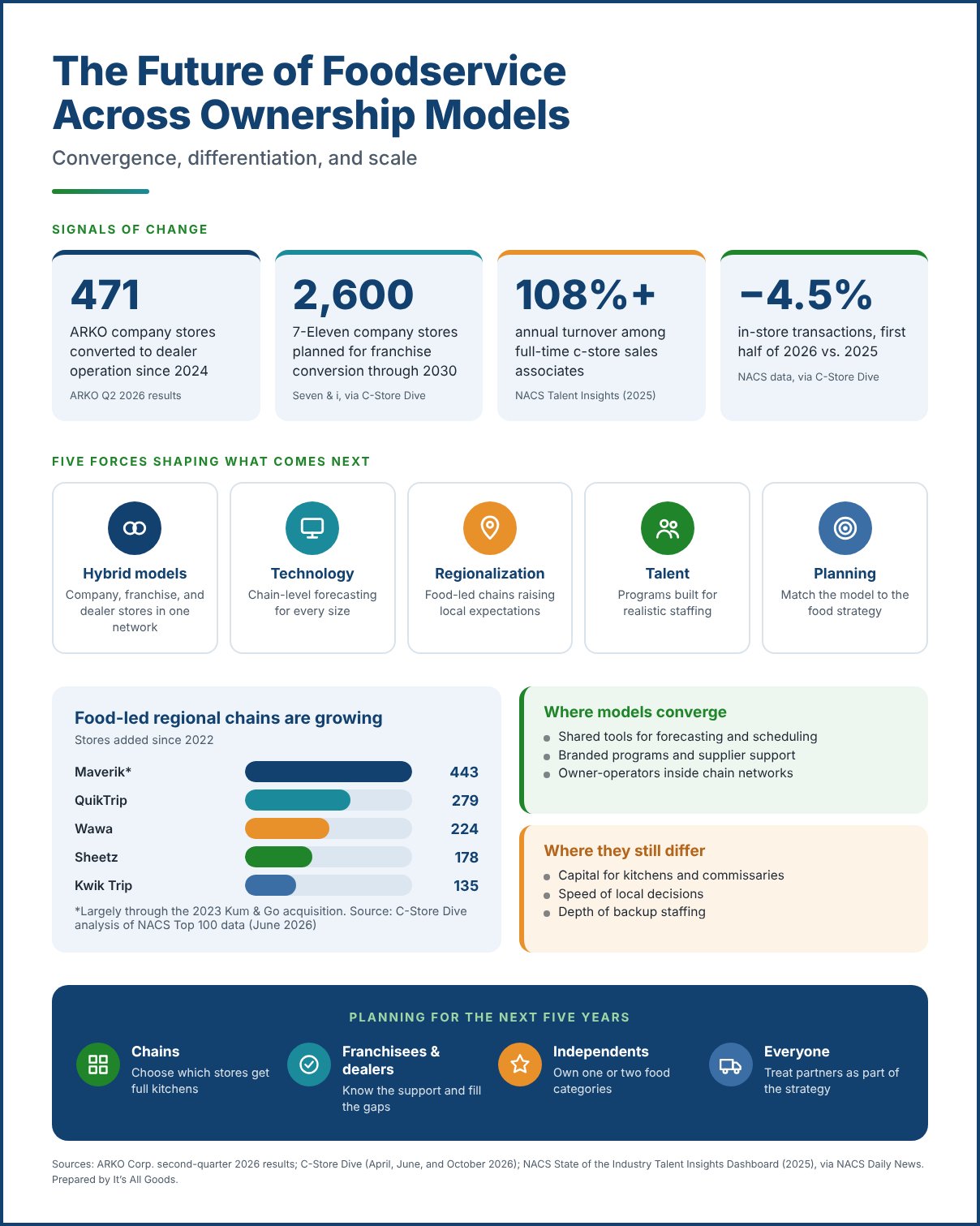
The largest chain in the country is moving in the same direction. As the first article in this series noted, 7-Eleven plans to convert about 2,600 company-operated stores to franchised locations through 2030, even as it pursues an ambitious fresh food strategy. Franchisees and dealers will therefore carry a growing share of responsibility for executing food programs designed at headquarters, which makes clear standards, practical training, and reliable supply more important than ever.
This shift has implications for foodservice on both sides of the transaction. Stores that stay company-operated are likely to receive more kitchen investment and more ambitious menus. Stores that move to franchise or dealer operation may rely more on branded programs, supplier support, and simpler formats that a smaller team can execute. In the future, the question for many sites will not be whether they belong to a chain or an independent, but which parts of the operation are centralized and which are local.
Technology is narrowing the gap between large and small operators. Tools for demand forecasting, labor scheduling, ordering, and loyalty that once required custom systems are increasingly available as subscription software. That matters for foodservice, where accurate production planning separates profitable programs from wasteful ones.
Restaurant operators offer an early look at what this can mean. Maggie Gordon, co-owner of the quesadilla brand Dillas Quesadillas, told NACS that her stores use PreciTaste, an AI tool that predicts how much product to prep each day based on factors such as weather, holidays, and local events. She said the forecasts are 80% to 90% accurate, compared with 60% to 70% for human predictions. “It takes this burden away from the hourly workers and makes their job so much easier,” Gordon said.
For convenience retailers, similar tools can help a single-store operator set production levels with the kind of precision that chains have built through years of data. Technology will not replace judgment or close the resource gap entirely, but it can make disciplined execution more accessible to operators of every size. The challenge will be choosing tools that fit existing workflows rather than adding complexity to already stretched store teams.
Some of the most significant growth in convenience retail is coming from regional chains with strong food reputations. According to C-Store Dive, which analyzed NACS Top 100 data, Wawa has added 224 stores since 2022, QuikTrip 279, Sheetz 178, Kwik Trip 135, and Maverik 443, largely through its 2023 acquisition of Kum & Go. Wawa and QuikTrip have grown mainly through new stores, while Sheetz has combined new-state entry with density in existing markets. Foodservice is a central part of how these chains win customers in new territory.
For independents and smaller chains, the arrival of a food-focused regional competitor can change local expectations quickly. Customers who try a well-run made-to-order program may hold every nearby store to a higher standard. The response does not have to be imitation. Local operators can compete with signature items, community connections, and speed, while strengthening the basics of freshness and consistency that regional chains have made table stakes.
Regionalization also pressures national chains. As 7-Eleven and others work to improve their food, regional players are showing that a tightly focused geographic footprint, with nearby distribution and kitchens, can support a level of foodservice quality that is difficult to replicate at national scale.
Labor remains the constraint that affects every model. According to NACS, citing its 2025 State of the Industry Talent Insights Dashboard, annual turnover among full-time sales associates exceeds 108%, and more than 27% leave within their first month. Foodservice magnifies the problem because preparation, holding, and food safety require skills that take time to build.
The future of foodservice across ownership models will depend partly on how each model addresses that challenge. Chains are investing in simpler procedures, centralized production, and automation that reduce the skills required at store level. Franchise and dealer systems may rely more on owner-operators whose personal stake encourages them to retain good employees. Independents can compete on culture and flexibility, but they have less margin for error when a key employee leaves. In every case, foodservice programs designed around realistic staffing will outperform those that assume a fully trained team on every shift.
The business environment is adding urgency to these decisions. According to C-Store Dive, NACS data shows in-store transactions fell 4.5% in the first half of 2026 compared with the same period a year earlier, an average of more than 1,100 fewer transactions per store. Chris Rapanick, managing director of NACS Research, described the decline bluntly: “It’s not pretty.” Fewer trips mean each visit must work harder, and foodservice is one of the strongest tools retailers have to create a reason to come inside.
Planning for the next five years means matching foodservice ambitions to the ownership structure that will deliver them. A chain should decide which stores deserve full kitchens and which are better served by simpler programs or a different operator. A franchisee or dealer should understand what support the brand or supplier provides and where local execution must fill the gaps. An independent should identify the one or two food categories it can own in its market, then invest in the systems and partners that make them consistent.
Partners will play a larger role in all three cases. Manufacturers, distributors, brokers, and branded programs can supply product development, specifications, training materials, and market insight that individual operators would struggle to build alone. The operators that benefit most will treat those partners as part of their foodservice strategy, not just as vendors.
ARKO Corp., parent of GPM Investments, offers a clear example of a large operator reshaping its ownership mix while doubling down on foodservice. Since 2024, the company has converted 471 company-operated convenience stores into dealer locations run by independent operators, according to its second-quarter 2026 results, and it ended that quarter with 1,057 company-operated retail stores. As C-Store Dive reported, converting a site requires shifting rent and maintenance responsibilities, transferring alcohol and tobacco licenses, and moving store employees to the dealer. ARKO said the program cuts fixed costs and creates a more focused, regionally concentrated retail base. Arie Kotler, ARKO’s chairman, president, and CEO, described the results:
“Dealerization has sharpened our focus, improved execution, and it’s now flowing through to financial performance.”
— Arie Kotler, Chairman, President, and CEO, ARKO Corp.
At the same time, ARKO is investing in food at the stores it keeps. Its fas craves program, a proprietary foodservice offer launched in a food-focused store format near Richmond, Virginia, features hot and cold grab-and-go items such as chicken biscuits, wings, chicken sandwiches, and burgers, along with dispensed beverages and bean-to-cup coffee, according to C-Store Dive’s coverage of the pilot. “The name of the game is going to be foodservice and cold categories,” Kotler said. ARKO plans roughly 25 remodels this year, all featuring fas craves food and beverage elements.
The strategy illustrates the hybrid future described in this article. ARKO is letting independent dealers operate sites where a lighter model makes sense, while concentrating capital, foodservice, and management attention on a smaller network of company stores. Whether the approach succeeds will depend on execution at both ends: dealers who keep their stores competitive and company stores that deliver food customers want to come back for.
The future of convenience foodservice is unlikely to belong to a single ownership model. Chains will keep their advantages in scale and systems but will increasingly share operations with franchisees and dealers. Independents will gain access to technology and partners that narrow the resource gap. Regional chains with strong food reputations will continue to raise customer expectations wherever they expand, and labor will remain the constraint every model must design around.
Across all of these shifts, the conclusion of this series holds. Ownership structure shapes the starting point, but consistent execution and a clear foodservice strategy determine results. Operators who decide what their stores should be known for, build realistic systems to deliver it, and choose partners that fill their gaps will be best positioned for whatever the next five years bring.
A hybrid model mixes company-operated stores with franchised or dealer-operated sites. Operators keep direct control where investment pays off and shift other stores to owner-operators with lower overhead.
Yes. Subscription tools for forecasting, scheduling, and ordering bring chain-level planning within reach. One restaurant operator told NACS its AI prep forecasts are 80% to 90% accurate, versus 60% to 70% for human estimates.
According to C-Store Dive’s analysis of NACS data, Maverik, QuikTrip, Wawa, Sheetz, and Kwik Trip have each added well over 100 stores since 2022, with foodservice central to their growth.
NACS reports that annual turnover among full-time sales associates exceeds 108%, and more than 27% leave within a month of starting, which makes simple, trainable foodservice programs essential.
ARKO has converted 471 company-operated stores into dealer-run locations since 2024 to cut costs and focus its retail network, while investing in its fas craves foodservice program at the stores it keeps.

Subscribe to receive latest news
12968 Vallejo Circle, Westminster CO. 80234
Phone: (303) 604-1064





