





very convenience store operator is good at something. Large chains are good at building systems that produce the same sandwich in hundreds of locations. Independent operators are often good at knowing exactly what their customers want and serving it with a personal touch that no corporate playbook can script. The most useful foodservice lessons often come from the other side of that divide. A chain can recover some of the local relevance it gave up for scale, and an independent can borrow the discipline that keeps quality steady when the owner is not in the building. The challenge is borrowing selectively, so a practice that works in one model does not become a burden in another.
In How Ownership Models Influence Convenience Store Foodservice, It’s All Goods looked at the structural differences between franchise, chain, and independent operators. This article turns to practice: where each model excels, how to adapt those strengths without overreaching, how to avoid copy-and-paste mistakes, and how to measure whether a borrowed idea is working.
Chains are built for repeatability. Their greatest foodservice strength is the system behind the counter: documented recipes, defined portion sizes, holding times, equipment standards, and training programs that let a new employee produce an acceptable product within days. That system protects quality at scale and makes it possible to launch a new item across many stores at once.
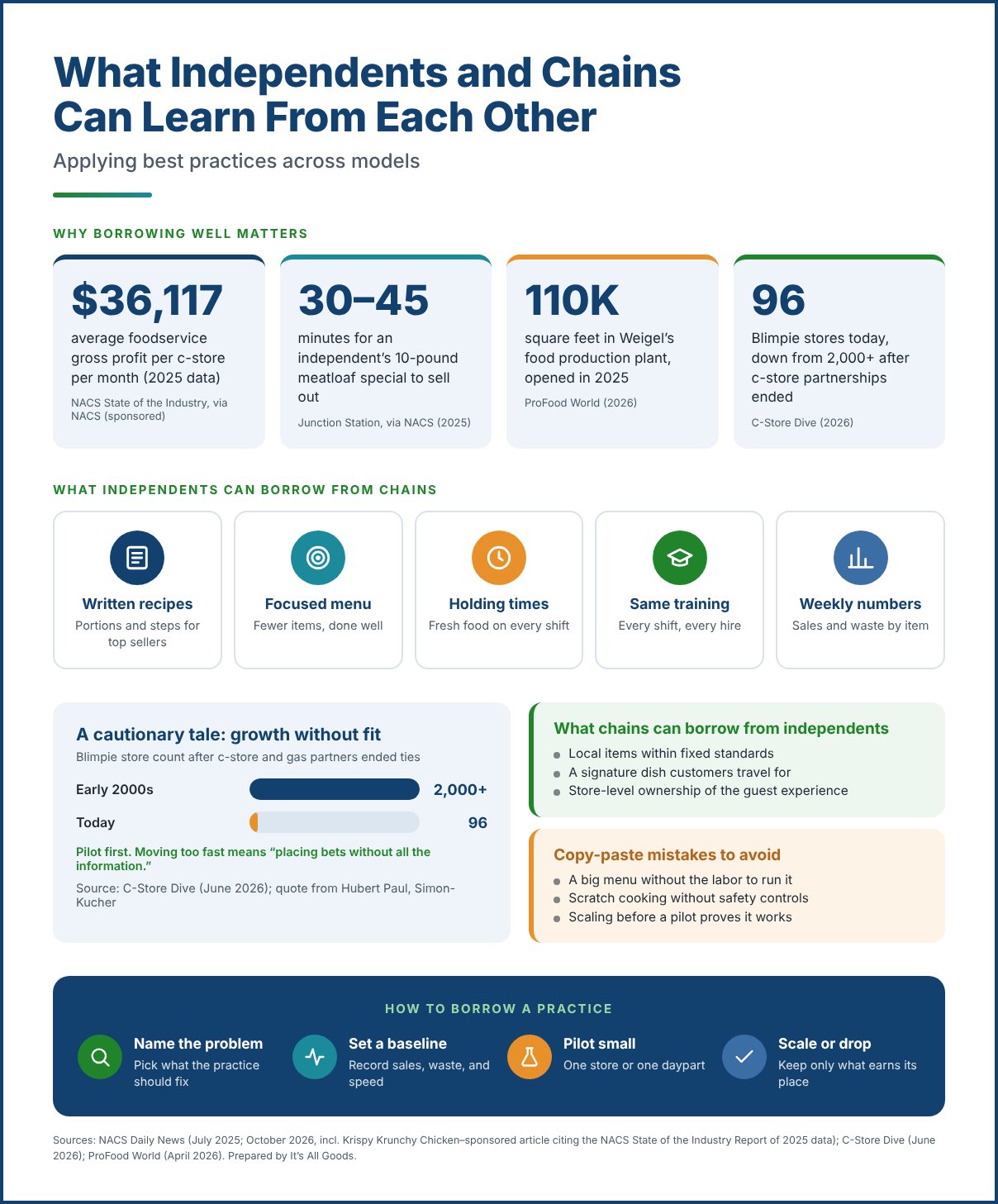
Chains also tend to be disciplined about menu focus. Mike Kostyo, vice president of foodservice consultancy Menu Matters, told NACS that “focused quality is better than mediocre breadth.” Huy Do, research and insights manager at Datassential, added in the same article that focused menus work in limited-service settings “because they are easier for consumers to understand and easier for operators to execute.” Many independents can benefit from that lesson. A shorter menu that is executed well usually serves a small team better than a long menu that is executed inconsistently.
Finally, chains measure. They track sales by item and daypart, waste, labor hours, and customer feedback, and they use that data to decide what stays on the menu. Independents rarely have analysts on staff, but the habit of reviewing a few key numbers every week is one of the most transferable practices in the industry.
Independents excel at local relevance and personal standards. Without layers of approval, an owner can respond to what the community wants, cook from scratch where it makes sense, and build a reputation on a signature item. Those strengths are hard for large organizations to reproduce because they depend on proximity to the customer and on owners who are present in the store.
Junction Station offers a vivid example. The family-owned business operates two locations, a flagship in Albany, Kentucky, and a smaller store in Byrdstown, Tennessee, and both are open around the clock. According to NACS, the Albany store runs two dining rooms and has the feel of a full-service restaurant. Staff grind meat in-house for hamburgers and meatloaf, and the meatloaf special often sells out within 30 to 45 minutes. Co-owner Linda Crouch explained what built the business:
“Hamburgers were the thing that got us started. If you have good food, people will come back.”
— Linda Crouch, Co-Owner, Junction Station
Crouch also emphasized clean stores, clean restrooms, and staff trained in good service. Those priorities are simple, but they reflect something chains work hard to recreate: a clear identity, a few dishes customers will travel for, and standards set by people who see the results every day. A chain cannot copy an owner’s presence, but it can give store managers more room to adapt to local tastes and more responsibility for the guest experience.
Borrowing a practice works best when it is scaled to the operator’s resources. For an independent, adopting chain discipline does not mean building a corporate infrastructure. It might mean writing down the recipes and portions for the five best-selling items, setting holding times, and training every shift the same way. Those steps cost little but protect the signature items that brought customers in.
Outside partners can also supply chain-like support. Branded programs and foodservice suppliers increasingly tailor menus, equipment, and program scope to each location. Dave Yarbrough, a key account manager at Krispy Krunchy Chicken, told NACS that “foodservice success isn’t about building the perfect program on day one.” That mindset fits independents well: start with a manageable program, then refine it.
For chains, adapting independent strengths usually means controlled flexibility. A chain can keep core recipes and safety standards fixed while allowing regional items, local suppliers, or store-level specials within defined limits. The guardrails matter. Flexibility without standards quickly becomes inconsistency, which is the problem chains were built to solve.
The most common error is copying a practice without the conditions that made it work. An independent that adds a chain-style menu of 30 items without the labor or equipment to support it will likely see quality fall and waste rise. A chain that encourages scratch cooking in every store without the staffing, training, and food safety controls an owner-operator provides may create risk rather than relevance.
Foodservice partnerships offer a cautionary example. According to C-Store Dive, Blimpie once had partnerships with Kum & Go, Texaco Food Marts, and other c-store and gas chains, but when those partners ended their ties, the sandwich brand had to close most of its stores, shrinking from more than 2,000 locations in the early 2000s to 96 today. David Bloom, chief development and growth officer at Capriotti’s, said those partnerships “diluted the brand.” The lesson applies in both directions: a concept that grows quickly without a fit for each location can leave both parties worse off.
Hubert Paul, a partner at Simon-Kucher, urged brands in the same article to run pilot programs before expanding in convenience stores, warning that moving too quickly means “you’re placing bets without all the information.” That advice holds for any operator borrowing an idea. Test it in one store or one daypart before committing the whole business.
A borrowed practice should earn its place with results. The stakes are meaningful: according to a sponsored NACS article citing the NACS State of the Industry Report of 2025 data, foodservice produced an average of $36,117 in gross profit per store per month. Even small changes in execution can move that number.
The right measures depend on what the practice is meant to fix. A recipe standard should reduce customer complaints and variation between shifts. A shorter menu should lower waste and speed up service without reducing total foodservice sales. A local menu item should attract repeat purchases without slowing the kitchen. Operators should record a baseline before the change, track the same numbers for several weeks afterward, and compare results with stores or dayparts that did not change. Independents can do this with point-of-sale reports and a simple waste log. Chains can do it at scale, but they should also listen to store teams, who often see problems before the data does.
Weigel’s, a family-owned convenience retailer in eastern Tennessee, shows how one operator can blend the strengths of both models. The company began as a dairy and has grown into a nearly 100-store retailer that NACS describes as an established local player, known for flavored milks tied to its dairy roots, according to NACS. It has kept that local identity while adding the kind of production system usually associated with much larger chains.
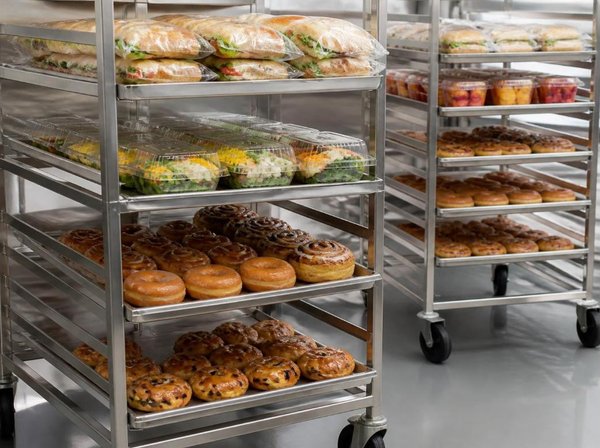
In March 2025, Weigel’s opened a roughly 110,000-square-foot manufacturing facility in Loudon, Tennessee, according to ProFood World. The plant produces baked goods such as donuts, muffins, and cinnamon rolls along with sandwiches, pizzas, and salads, with daily deliveries to the stores it supplies. Weigel’s set it up as a separate company, Harvest Station Foods. “We did make this a separate company, Harvest Station Foods, because we view Weigel’s as a customer for us,” said Beth Hoffer, Weigel’s vice president of foodservice.
Centralized production gives Weigel’s the consistency of a chain without asking each store to cook everything from scratch. CEO Doug Yawberry told CSP that the commissary lets employees “serve our day-to-day guests that come in the store without having burdensome admin work,” and that the company wants food to become “primary and a huge percentage of our total contribution to sales.” The approach reflects the central idea of this article. Weigel’s borrowed a chain’s production discipline to protect consistency and free up store labor, while keeping the local products and family-business identity that set it apart from national competitors.
Chains and independents each have something the other needs. Chains offer documented standards, focused menus, and the habit of measurement. Independents offer local relevance, signature items, and owners who set the tone in person. The best operators in either model borrow deliberately, choosing practices that solve a specific problem and scaling them to fit their own resources.
Start small, test before expanding, and measure against a clear baseline. Keep the core standards that protect safety and consistency, and allow flexibility where it adds local value. The final article in this series looks ahead at how ownership models may evolve, and how technology, regionalization, and labor pressures may narrow the gap between chains and independents.
Independents can borrow documented recipes and portions, focused menus, consistent training, and regular review of sales and waste data. These practices protect quality without requiring a corporate structure.
Chains can learn local relevance, signature items, and owner-level attention to the guest experience. Controlled flexibility, such as regional items within fixed standards, helps chains apply those lessons.
Pilot the change in one store or daypart, record a baseline first, and compare sales, waste, speed, and complaints for several weeks before expanding.
According to C-Store Dive, Blimpie had to close most of its stores after c-store and gas partners ended their ties, and a Capriotti’s executive said the partnerships diluted the brand.
Weigel’s opened a 110,000-square-foot food production facility in 2025 to supply its stores consistently, while keeping the local products and family-business identity rooted in its dairy history.

Subscribe to receive latest news
12968 Vallejo Circle, Westminster CO. 80234
Phone: (303) 604-1064





