





or decades, foodservice planning followed a simple rhythm: breakfast, lunch, and dinner, with a snack or two in between. That rhythm is breaking down. Customers skip meals, replace them with snacks, eat later at night, and make food choices shaped by health goals and, increasingly, by weight-loss medications. The traditional dayparts still matter, but they no longer describe how many people actually eat.
For convenience retailers, that shift is both an opportunity and a risk. Stores that are open early, open late, and built for quick decisions are well positioned for a less structured eating day. But chasing every new occasion can stretch menus, equipment, and teams too thin. This article looks at where meal occasions appear to be heading and how operators can plan for them without overextending.
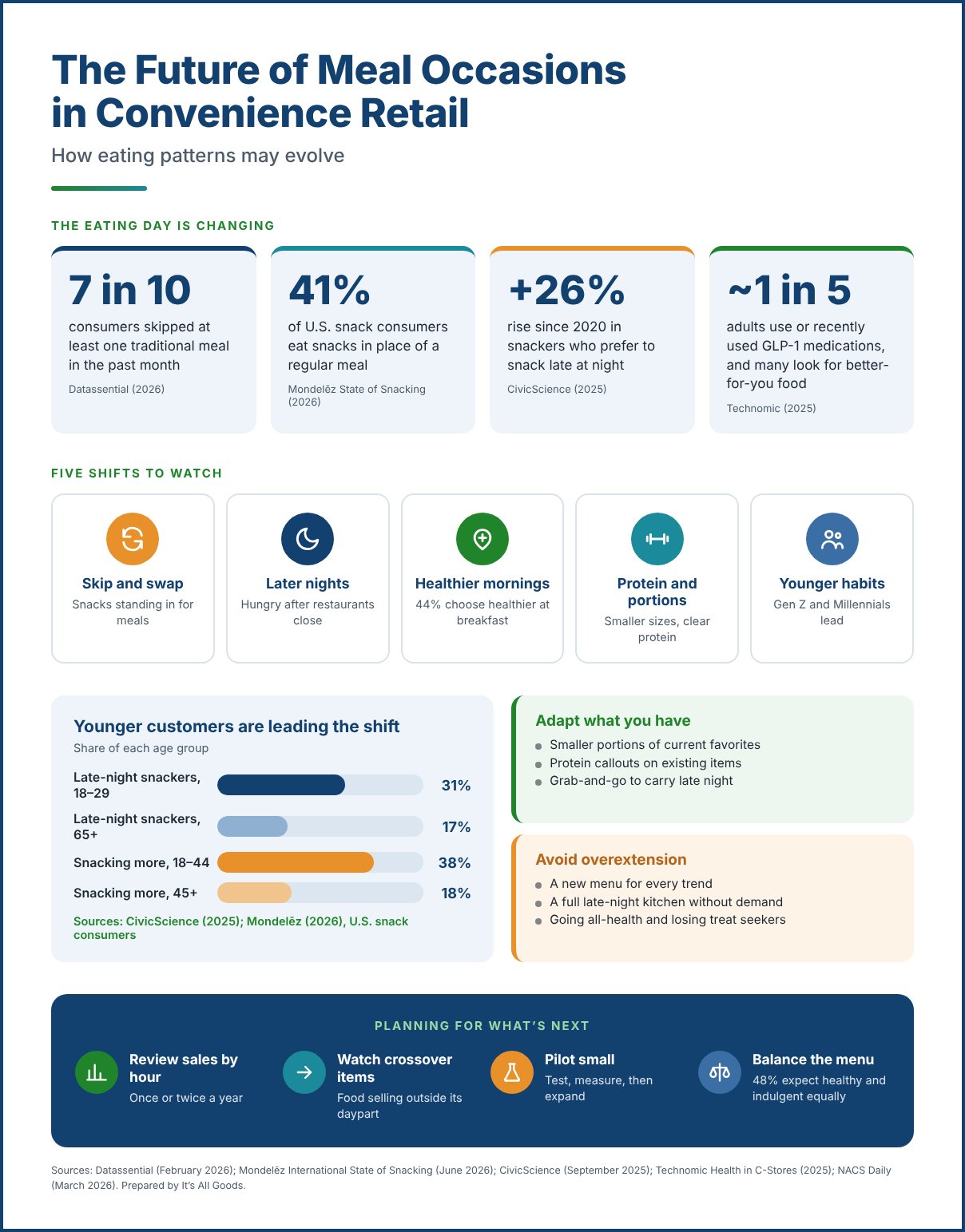
The clearest change is that fewer people eat three set meals a day. In a January 2026 survey reported in Datassential’s foodservice trends for 2026, more than seven in ten consumers said they had skipped at least one traditional meal in the past month. The same report noted that snacking, late-night eating, and nontraditional dayparts continue to rise, and that snacking occasions are increasingly influential even when they are not formal menu categories.
Snacks are filling the space those skipped meals leave behind. According to Mondelēz International’s State of Snacking 2026 report, 41% of U.S. snack consumers now eat snacks in place of a regular meal, and 66% snack every day. Younger adults are driving the change: 38% of U.S. snack consumers ages 18 to 44 say they snack more than a year ago, compared with 18% of those over 45, and 57% of those ages 25 to 34 see snacks as better value than a full meal.
For convenience stores, this blurs the line between the snack aisle and the food counter. A customer who skips lunch and buys a protein box, a hot handheld, or a slice of pizza at 2:30 p.m. is not making a snack purchase or a lunch purchase in the traditional sense. They are meeting a need at the moment it arises. Operators that think in terms of need states, such as quick fuel, a small treat, or a full meal on the go, may find those categories more useful for planning than the clock alone.
The eating day is also getting longer. CivicScience research published in September 2025 found that nearly one-quarter of snackers now prefer to snack late at night, a 26% jump since 2020, while early-evening snacking after dinner declined. Late-night snacking is especially common among younger adults: 31% of 18- to 29-year-olds snack late, compared with 17% of adults 65 and older.
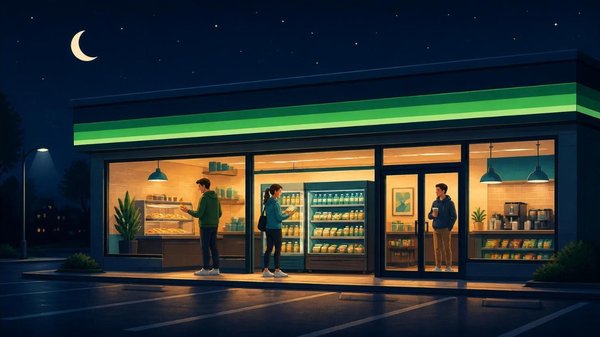
There is also unmet demand. In the same research, 46% of U.S. adults who order food or dine out said they would do so somewhat or much more often if more late-night options were available near them. Many restaurants close their kitchens well before that demand peaks. Convenience stores that are already open, already lit, and already staffed have a natural advantage.
That does not mean every store should add a late-night menu. Late-night customers tend to want simple, satisfying food that is ready now, which makes grab-and-go items, roller grill products, pizza by the slice, and hot case handhelds a better fit than a full made-to-order program. The opportunity is often about keeping the right products available and fresh after 9 p.m., not about building a new kitchen operation.
Health is reshaping what customers want at each time of day. Technomic’s Health in C-Stores report found that 52% of c-store foodservice consumers are more interested in healthy eating than they were a year earlier, and that 63% are more likely to visit a c-store if they know healthy options are available. The shift is strongest in the morning: 44% of consumers are likely to choose more healthful items at breakfast, up 16 points from 2022, while the afternoon snack remains the occasion where customers are least likely to look for healthy choices.
Consumers are also specific about what healthy means. In Technomic’s research, high protein ranked as the second most important attribute of a healthy foodservice item, behind low sugar, while operators were more likely to emphasize general claims such as organic and all-natural. Calling out protein on items a store already sells may close part of that gap at little cost.
“Consumers will not sacrifice taste and flavor for health.”
— Donna Hood Crecca, Senior Principal, Technomic
Weight-loss medications add a new layer. Technomic estimates that nearly 20% of adults currently use or have recently used GLP-1 medications, and that those users are more likely to enter a c-store actively looking for better-for-you food and beverages. A March 2026 NACS Daily report described how these shoppers tend to eat when they are actually hungry, often on the way somewhere, and look for single-serve portions, protein, and quick breakfasts. Circana’s Sally Lyons Watt noted that these customers visit mostly in the morning and through “almost lunch,” which makes the morning occasion especially important for this group.
The common thread is portion and purpose. Smaller sizes, clear protein content, and options that feel lighter without giving up flavor fit both health-minded customers and GLP-1 users. They also suit the growing number of people who replace meals with snacks.
The temptation with every new trend is to add something: a late-night menu, a health menu, a new snack line. Each addition brings ingredients, equipment, training, and waste. As It’s All Goods explained in Executing Multiple Dayparts Without Overcomplicating Operations, the stores that serve many occasions well usually do it by reusing what they already have rather than building separate programs.
The same principle applies to emerging occasions. Many of these shifts can be met by adjusting the current menu rather than expanding it. A breakfast sandwich can be offered on a smaller roll or with egg whites. Existing proteins can be packed into grab-and-go snack boxes. Pizza slices and handhelds can carry the late-night window. Protein and portion information can be added to labels and menu boards without changing the food at all.
Balance matters, too. Technomic found that 48% of consumers expect healthy and indulgent items to be equally available at c-stores, and another 31% want both but expect the selection to lean indulgent. A store that swings too far toward health risks losing the treat-seeking customer, especially in the afternoon. The goal is a menu where customers can choose either direction from the same core ingredients.
Because eating patterns are still changing, daypart plans work best when they are reviewed regularly rather than set once. A practical approach is to look at sales by hour and by item at least once or twice a year and ask a few questions. Which hours are growing? Which items are selling outside their intended daypart? Are customers buying smaller portions, more protein, or more snacks in place of meals?
Store-level data matters more than national trends. A store near a college campus may see real late-night demand, while a commuter location may see its strongest growth in the morning. Operators can treat national research as a list of possibilities to test, then let their own sales decide which ones deserve investment.
Testing should be small and reversible. A late-night grab-and-go assortment, a protein callout on existing sandwiches, or a smaller portion size can be piloted in a few stores, measured for sales, waste, and labor, and then expanded or dropped. Manufacturers, distributors, and brokers can help by sharing category data and suggesting products that fit new occasions without adding prep.
7-Eleven offers a clear example of adapting to new eating patterns largely through the products and menus it already runs. The chain, which operates, franchises, or licenses more than 13,000 stores in the U.S. and Canada, sells more than 62,000 protein drinks a day, according to CSP. Rather than launching a separate health menu, it has expanded protein snacks such as protein packs, fresh protein bars, yogurt, and overnight oats, and added protein callouts to fresh sandwiches, breakfast sandwiches, and wraps.
“It’s all about giving customers more ways to snack purposefully and get more out of every bite.”
— 7-Eleven
That approach fits several of the shifts described above at once. Protein callouts serve health-minded customers and GLP-1 users without new recipes. Portable protein snacks fit customers who replace meals with snacks at any hour. And because the products sit within existing grab-and-go and fresh food programs, the chain can meet new occasions without adding a new daypart. 7-Eleven is also investing for the long term: its parent company plans to add 1,300 new 7-Eleven stores and 1,100 restaurants by 2030 to strengthen its food offerings.
Meal occasions in convenience retail are becoming more flexible, more spread out across the day, and more shaped by health. Customers skip meals, snack in their place, eat later at night, and look for protein and smaller portions. Those changes favor stores that are open when people are hungry and can serve them quickly.
The operators who benefit most will not be the ones who add the most new programs. They will be the ones who adapt what they already do well, watch their own sales closely, and test new ideas on a small scale before committing. In a less predictable eating day, flexibility and focus are worth more than another daypart.
More consumers are skipping traditional meals, replacing them with snacks, and eating later at night. Datassential found that more than seven in ten consumers skipped at least one traditional meal in a recent month.
Yes. CivicScience found that nearly one-quarter of snackers prefer to snack late at night, a 26% increase since 2020, with younger adults leading the trend.
GLP-1 users tend to eat smaller amounts, look for protein and single-serve portions, and visit most often in the morning. Many are actively looking for better-for-you food and beverages when they enter a c-store.
Not necessarily. Many stores can meet health-driven demand by offering smaller portions, highlighting protein on existing items, and balancing healthy and indulgent choices from the same core ingredients.
At least once or twice a year. Reviewing sales by hour and by item shows which occasions are growing, so operators can test small changes and expand only what works.

Subscribe to receive latest news
12968 Vallejo Circle, Westminster CO. 80234
Phone: (303) 604-1064





