






enu innovation in convenience stores has long depended on instinct, supplier pitches, and a fair amount of trial and error. That approach is giving way to something more deliberate. Retailers now have more data about what customers buy, more ways to test ideas in a few markets before committing chainwide, and more direct channels for hearing what customers think. At the same time, labor constraints and rising complexity make every new item harder to justify. The operators that innovate best over the next several years are likely to be the ones that turn innovation into a repeatable system, with smarter cycles and fewer surprises for both customers and store teams. As It’s All Goods discussed in Executing LTOs Without Breaking Store Operations, how a new item reaches the counter matters as much as the idea behind it.
This article looks at five forces likely to shape that future: data-led innovation, modular menu design, regional and seasonal testing, consumer feedback loops, and long-term innovation planning.
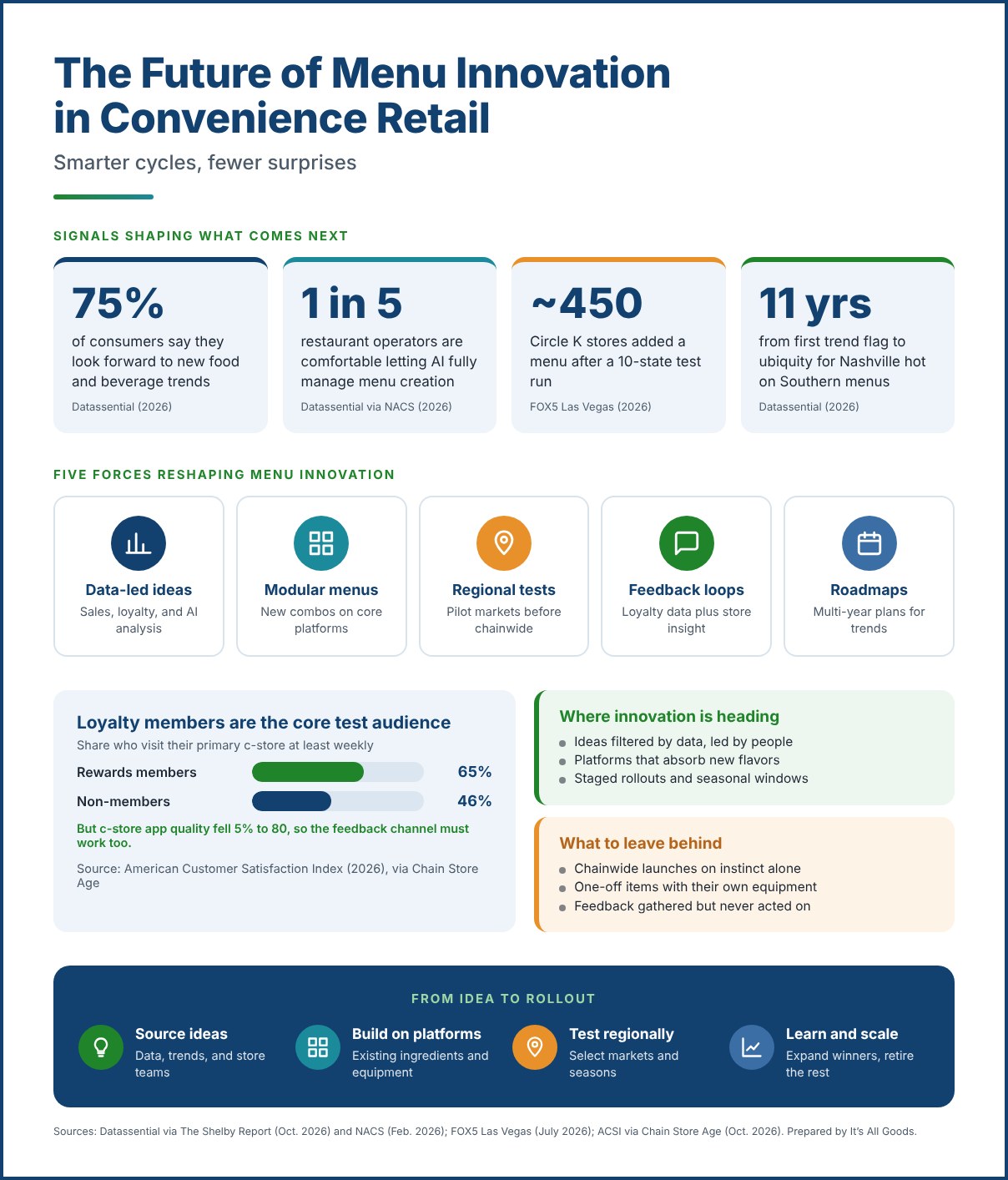
Data is changing how ideas are found and filtered. Sales history, loyalty records, and menu tracking services can show which flavors are gaining momentum, which dayparts are underserved, and which items customers buy together. Artificial intelligence is beginning to speed that analysis. In a February 2026 report on AI in menu development, NACS quoted Mike Kostyo, vice president of foodservice consultancy Menu Matters, who said AI can “crunch the numbers and point the team in the right direction.”
Operators are approaching the technology carefully, however. The same NACS report, citing Datassential, found that only one in five restaurant operators are comfortable letting AI fully manage menu or recipe creation, and only about a quarter are comfortable sharing sensitive business data to train AI models. Samantha Des Jardins, content marketing manager at Datassential, summed up the likely direction: “We expect the most successful brands, including c-stores, to use AI as an enhancer of craft, not a replacement for it.”
For convenience retailers, the practical opportunity is narrower but valuable: using data to decide which ideas deserve a test, which markets should get them, and how quickly results should be reviewed. The creative concept still comes from people who understand the brand and the customer.
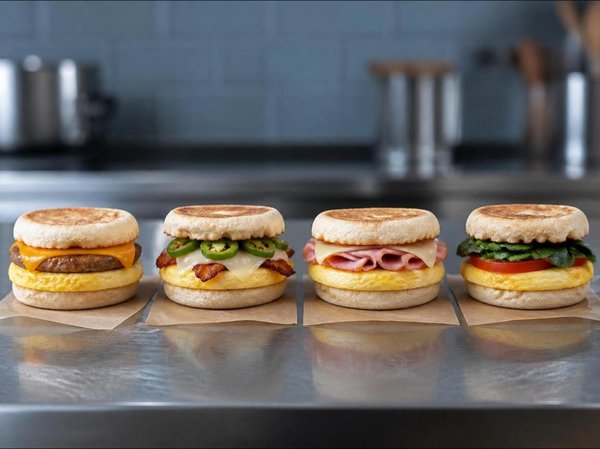
The most efficient innovation often looks less like a new menu item and more like a new combination. A modular menu is built on a small number of core platforms, such as a breakfast sandwich, a pizza, a roller grill item, or a grilled sandwich, each designed to accept new sauces, proteins, and toppings without new equipment or procedures.
Recent launches show the pattern. According to C-Store Dive, RaceTrac introduced a limited-time hot honey chicken and waffle sandwich in early 2026 as a twist on its existing waffle breakfast sandwich, while Rutter’s launched a limited-time grilled cheese menu with eight hot sandwiches built on a single format. In each case, the store team works with a familiar build, and customers still get something new.
Modular design also makes it easier to retire items. When an LTO shares most of its ingredients with the core menu, ending it leaves little stranded inventory and requires little retraining. Over time, operators that design platforms deliberately can introduce more variety with less complexity than those that treat every new idea as a standalone product.
Chainwide launches are giving way to staged rollouts. Testing a new item in a limited number of markets lets operators measure demand, confirm supply, and identify execution problems before the stakes rise. It also allows menus to reflect regional tastes, which can vary widely across a large chain’s footprint.
Circle K’s Flavortown menu, developed with chef Guy Fieri, illustrates the approach. After a test run in 10 northern states in 2025, the retailer expanded the menu to nearly 450 stores in Arizona and Nevada in July 2026, according to FOX5 Las Vegas. Items such as a mac and cheese burger and a sweet heat fried chicken and waffle sandwich moved into new markets only after the concept had been tried elsewhere.
Seasonality adds a second dimension. Fall, holiday, and summer menus give operators natural windows for new flavors, while customers come to expect returning favorites at the same time each year. A testing calendar that combines regional pilots with seasonal windows can turn innovation into a predictable rhythm rather than a series of one-off bets.
Feedback is becoming faster and more direct. Loyalty programs and apps let operators see who tries a new item, whether they buy it again, and how their overall visits change. Those customers are also the most engaged. The 2026 American Customer Satisfaction Index study of convenience stores, reported by Chain Store Age, found that 65% of rewards program members visit their primary store at least weekly, compared with 46% of non-members.
The same study showed that the digital experience still needs work. Mobile order pickup scored 82 on the ACSI’s 100-point scale in its first year of measurement, while app quality fell 5% to 80. Forrest Morgeson, director of research emeritus at the ACSI, observed that “the industry has figured out what to sell” and that “now the experience of buying it has to catch up.” For innovation, the lesson is that the channels used to gather feedback must work smoothly, or the data they produce will reflect frustration rather than true interest in the product.
Store teams remain an essential part of the loop. Employees see which items slow the line, confuse customers, or generate questions, and their observations often explain what sales data cannot. The strongest feedback systems combine digital signals with input from the people making and selling the food.
Trends take time to mature, and long-term planning helps operators enter at the right moment. Datassential’s 2027 trends report, covered by The Shelby Report, noted that the firm first flagged Nashville hot flavors in 2014 and saw them reach ubiquity on Southern menus by 2025. The same report found that 75% of consumers say they look forward to new food and beverage trends. Customer interest in novelty is durable, but individual flavors move through a long cycle.
That cycle argues for a multi-year innovation roadmap. Operators can track emerging flavors, decide which ones fit their brand and platforms, and schedule tests when those flavors approach mainstream acceptance. Suppliers, distributors, and brokers can contribute trend insight, product samples, and market data that help operators decide where to focus.
A roadmap also protects the core. By deciding in advance how many new items each season can support, operators keep innovation from crowding out the products that drive daily traffic.
Casey’s General Stores, which operates about 2,900 convenience stores and describes itself as the fifth-largest pizza chain in the U.S., offers a clear example of a structured innovation pipeline. Each year, team members from across its footprint enter a bracket-style pizza competition, with entries judged on visual presentation, taste, and innovation. Four finalists cook on stage at the company’s annual Casey’s Commitment Conference for a panel that includes executive chef and culinary director Andrew Kintigh, according to the Casey’s announcement of the most recent winner.
That winner, the Barn Burner Chicken Pizza, was created by Indianapolis-based district manager Terrell Banks and features a Sriracha base, grilled chicken, bacon, cheese, red onion, jalapeños, and a post-bake BBQ drizzle. Banks told Casey’s the idea originated with the team at a single store in Fort Loramie, Ohio, according to CSP. Brad Haga, Casey’s senior vice president of prepared food and dispensed beverages, credited the people closest to the product:
“Our team members at Casey’s aren’t just making pizzas – they’re creating the next big flavors.”
— Brad Haga, Senior Vice President of Prepared Food and Dispensed Beverages, Casey’s
Rather than launching chainwide, Casey’s introduced the pizza in January 2026 as a limited-time offer in select markets, including Indianapolis, Grand Rapids, Dayton, and several Illinois cities, with ordering available in stores and through the Casey’s app. The approach brings together several of the forces described above. The idea came from store-level experience, it used ingredients and equipment already in Casey’s pizza program, it was tested regionally rather than everywhere at once, and the app created a direct channel for measuring response. Casey’s has not reported sales results for the item, but its process shows how a large operator can make innovation both creative and controlled.
The future of menu innovation in convenience retail is likely to be more systematic and less reactive. Data and AI will help operators decide which ideas to test, modular platforms will make new items easier to execute, regional and seasonal pilots will reduce risk, and loyalty programs will shorten the time it takes to learn what works. Long-term roadmaps will help operators enter trends at the right moment without overwhelming store teams.
The operators that benefit most will treat innovation as an ongoing process with clear rules, rather than a series of surprises. For suppliers and brokers, that shift creates an opportunity to contribute earlier, bringing insight, testing support, and products designed to fit the platforms convenience stores already run.
Sales, loyalty, and menu tracking data will help operators decide which ideas to test and where. AI can speed that analysis, but most operators still want people to lead the creative work.
A modular menu is built on a few core platforms, such as a breakfast sandwich or pizza, that can accept new sauces, proteins, and toppings without new equipment or procedures.
Regional tests let operators measure demand, confirm supply, and find execution problems before a chainwide launch. Circle K tested its Flavortown menu in 10 states before expanding to nearly 450 stores in Arizona and Nevada.
Loyalty data shows who tries a new item and whether they buy it again. ACSI found that 65% of c-store rewards members visit their primary store at least weekly, compared with 46% of non-members.
Casey’s runs an annual employee pizza competition. Its recent winner, the Barn Burner Chicken Pizza, launched as a limited-time offer in select markets in January 2026.

Subscribe to receive latest news
12968 Vallejo Circle, Westminster CO. 80234
Phone: (303) 604-1064





