





everages are rarely the reason a convenience store builds a foodservice program, but they often decide whether that program reaches its potential. A morning coffee brings a customer to the counter where a breakfast sandwich is waiting, a fountain drink completes a lunch combo, and an afternoon iced coffee can turn a quick stop into a snack purchase. In c-store reporting, foodservice already includes hot, cold, and frozen dispensed beverages alongside prepared food, so drinks are part of the category on paper. The opportunity is to manage them that way in practice, with beverage programs designed to complement the food rather than run beside it as a separate business.
This article looks at how non-alcoholic drinks shape meal decisions, what they contribute to margins, how coffee, fountain, and specialty programs differ, how quality perception affects the whole food offer, and where beverages add the most value. It builds on an idea from It’s All Goods’ earlier article Merchandising Foodservice for Maximum Impact: the most effective bundles are built on pairings customers already make.
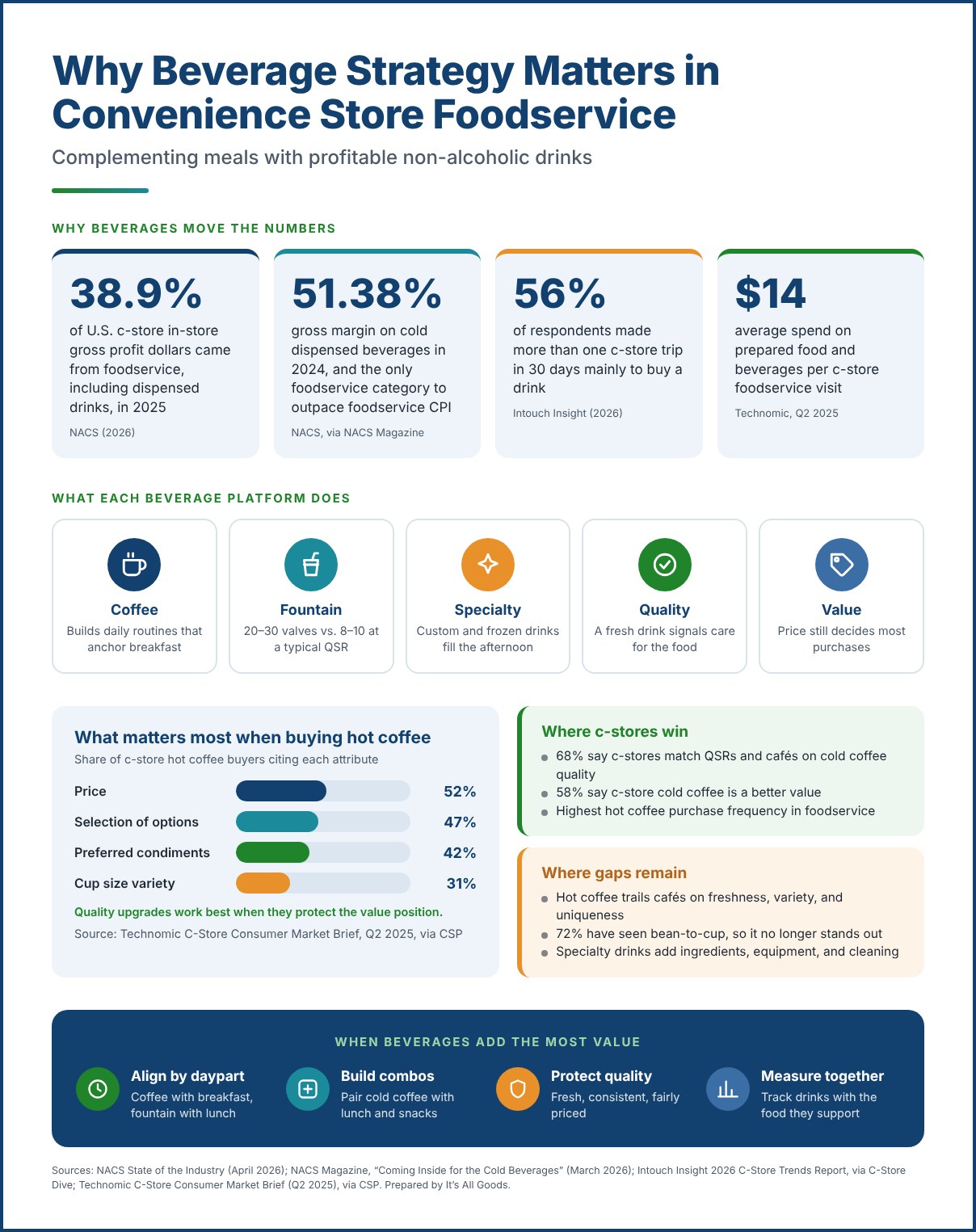
For many customers, the drink comes first. In Intouch Insight’s 2026 C-Store Trends Report, summarized by C-Store Dive, 56% of respondents said they had visited a convenience store more than once in the previous 30 days primarily to buy a drink, without buying snacks or fuel. More than a quarter made that kind of trip two or three times in a month, and 7% made more than 10. Those numbers show how often beverages bring people through the door on their own, and how many of those visits currently end without a food purchase.
Beverage habits also follow the clock, which makes them a useful guide to food pairings. According to Technomic’s C-Store Consumer Market Brief for the second quarter of 2025, reported by CSP, the morning daypart captures most c-store hot coffee sales, and customers typically pair those purchases with fresh bakery items. Cold coffee sells more evenly through the day, with particular strength at lunch and afternoon snack occasions. In practice, the drink a customer reaches for is often a good signal of which food they are most likely to add.
That relationship runs in both directions. A strong coffee program can anchor a daily breakfast routine, while the right drink can make a lunch or snack purchase feel complete. Retailers that know which drinks accompany which meals can place, price, and promote them together.
Beverages matter financially because they combine healthy margins with modest preparation effort. According to NACS, foodservice, including hot, cold, and frozen dispensed beverages, accounted for 28.5% of U.S. convenience store in-store sales and 38.9% of in-store gross profit dollars in 2025. Packaged beverages were the No. 2 in-store category, at 18.7% of in-store sales, up 0.8 points from 2024.
Dispensed drinks stand out within foodservice. NACS Magazine reports that cold dispensed beverages generate more than 8% of c-store foodservice sales, making them the second-largest foodservice category, just ahead of hot dispensed. According to Emma Tainter, research analyst and writer for NACS, cold dispensed beverages were the only foodservice category to outpace NACS’s convenience foodservice CPI of 7.8% in 2024, and they held a gross margin of 51.38% even after margins dipped from the prior year.
The attachment opportunity follows from those margins. Technomic found that on their most recent c-store foodservice occasion, consumers spent an average of $14 on prepared food and beverages, mostly during the lunch and afternoon snack dayparts, and most of those purchases were unplanned. Each drink added to a food order, and each food item added to a drink-only visit, raises the value of a trip the store has already earned. Because self-serve coffee and fountain drinks require little labor at the point of sale, even a modest gain in attachment can lift foodservice profit without a matching increase in kitchen workload.
Each beverage platform plays a different role. Coffee builds routines. Technomic reports that convenience stores have the highest hot coffee purchase frequency across foodservice, ahead of quick-service restaurants and coffee shops, with more than half of the c-store coffee customers it surveyed buying at least weekly. Hot coffee occasions are also largely planned, which suggests loyalty to a store’s coffee program and gives breakfast items a dependable daily opening.
Fountain drives variety. Rebecca Johnson, director of dispensed innovation at The Coca-Cola Company, told NACS Magazine, “A QSR has on average 8-10 valves available, and c-stores can have 20-30 valves.” Those extra valves give convenience retailers room to carry the familiar sodas customers expect with pizza, hot dogs, and sandwiches while still testing new flavors and limited-time offers that create a reason to come back.
Specialty and frozen drinks add experience. Cold coffee, refreshers, frozen beverages, and customized sodas give customers a reason to visit in the afternoon and evening, after hot coffee traffic fades. Intouch Insight found that 59% of respondents considered the ability to customize c-store beverages at least somewhat important, including 12% who called it extremely important. These drinks are where a store can show creativity, but they also add ingredients, equipment, and cleaning steps, so they work best when they reinforce the dayparts where the food program is already strong.
Beverage quality shapes how customers judge the entire foodservice offer. A stale pot of coffee or a poorly calibrated fountain sends the same message as a dried-out sandwich: no one is paying attention. A fresh, consistent drink, on the other hand, suggests that the food will be handled with the same care.
Convenience stores have made real progress, though gaps remain. In the NACS Magazine report, Donna Hood Crecca, senior principal at Technomic, noted that 68% of consumers say c-stores are just as capable of offering quality cold coffee as fast-food restaurants and coffee shops, and 58% say cold coffee is a better value at c-stores. Hot coffee is a different story. Technomic’s second-quarter 2025 brief found that “C-store hot coffee lags on freshness, variety and uniqueness perceptions vs. coffee cafes.” Equipment alone will not close that gap: Intouch Insight found that 72% of respondents had already visited a c-store with a bean-to-cup coffee machine, so fresh-ground coffee is no longer much of a differentiator.
Price remains the deciding factor for many customers. Among the c-store coffee buyers Technomic surveyed, price was the most important purchase attribute, cited by 52% for hot coffee and 51% for cold, ahead of selection and the availability of preferred condiments. Quality improvements need to protect the value position that brings customers to convenience stores in the first place. A better drink at a fair price strengthens the case for buying food at the same stop.
Beverages add the most value when they are planned as part of the meal rather than managed as a separate category. That starts with daypart alignment: coffee with breakfast sandwiches and bakery items in the morning, fountain and cold drinks with lunch and dinner items, and cold coffee or refreshers with afternoon snacks. Technomic specifically recommends “targeted combo offers that pair cold coffee with lunch or afternoon food items” to drive purchases during traditionally slower periods.
Beverages also add value when they reinforce the channel’s competitive advantage. Speaking on a panel at the 2025 NACS Show, reported by Food Business News, Micah Rupprecht, director of category management foodservice at Kwik Trip, said, “I feel like we as convenience stores can hit that advantage by emphasizing what’s outside of the cup that the local coffee shop can’t compete with.” For many c-stores, what sits outside the cup is food, fuel, and the ability to finish several errands in one stop, which makes thoughtful food and beverage pairings a natural expression of that advantage.
Finally, beverages add value when they are managed with discipline. A program that is poorly maintained, overly complicated, or priced without regard to the food it accompanies can drain labor and margin. Retailers get the best results by choosing a focused set of platforms, keeping equipment and condiments in good order, and measuring beverage performance alongside the food categories it supports.
Casey’s General Stores, the third-largest convenience store chain in the U.S., offers a clear example of beverages managed as part of foodservice. The Iowa-based retailer reports prepared food and dispensed beverages as a single category. In the first quarter of fiscal 2027, the three months ended July 31, 2026, that category’s same-store sales rose 4.8%, and its margin improved to 59.3% from 58.0% a year earlier, according to Casey’s first-quarter results. Casey’s grocery and general merchandise margin was 35.6% over the same period. The company attributed the category’s sales growth mainly to traffic led by whole pizzas, a reminder that food anchors the category while beverages strengthen it.
Casey’s has also invested directly in beverage quality. Speaking on the same 2025 NACS Show panel, Steve Kapple, senior category manager of dispensed beverages at Casey’s, said the chain moved entirely to self-serve bean-to-cup coffee machines in 2021, then began reworking its coffee assortment in November 2023 after guests said its roasts and flavor profiles were too narrow. In January 2025, Casey’s launched Darn Good Coffee, a lineup of eight blends with a range of roasts and caffeine levels, along with creamers, sweeteners, and condiments that let guests customize their drinks, according to C-Store Dive. Kapple described what the earlier equipment change accomplished:
“This transition really allowed our guests to get high-quality coffee, fresh brewed with every pour, and it helps eliminate waste and increase operational efficiencies.”
— Steve Kapple, Senior Category Manager, Dispensed Beverages, Casey’s General Stores
Kapple said Casey’s involved guests up front in building the new coffee program and is “seeing really good results” from it. The approach reflects the central point of this article. Casey’s treats coffee and fountain drinks as part of a food-led business, invests in their quality and consistency, and reports their results together with the pizza and prepared food they accompany. The outcome is a beverage program that supports the store’s foodservice reputation instead of competing with it for attention.
Beverages are a multiplier for convenience store foodservice. They bring customers in on their own, they carry strong margins, and they shape which food items customers are likely to add. Drink-only trips, time-of-day habits, and the channel’s fountain and coffee strengths all point to the same opportunity: pairing the right beverage with the right food at the right time.
Retailers that capture that opportunity treat beverages as part of the foodservice program rather than a separate category. They align drinks with dayparts, protect both quality and value, choose platforms they can execute consistently, and measure beverage performance alongside the food it supports. The next article in this series turns to execution: how to design beverage programs that drive foodservice sales day to day.
Dispensed beverages are part of c-store foodservice, which produced 38.9% of in-store gross profit dollars in 2025, according to NACS. Drinks also bring customers in on their own and influence which food items they add.
Very. According to NACS, cold dispensed beverages earned a 51.38% gross margin in 2024 and were the only foodservice category to outpace the channel’s foodservice CPI that year.
Pairings follow the clock. Technomic found that morning hot coffee buyers typically add fresh bakery items, while cold coffee sells well at lunch and afternoon snack occasions, which suits combo offers.
Usually not. In Intouch Insight’s 2026 report, 72% of respondents had already visited a c-store with bean-to-cup machines. Assortment, customization, freshness, and value now set programs apart.
Casey’s reports prepared food and dispensed beverages as one category, which earned a 59.3% margin in its fiscal 2027 first quarter, and it has upgraded its coffee program with bean-to-cup machines and eight new blends.

Subscribe to receive latest news
12968 Vallejo Circle, Westminster CO. 80234
Phone: (303) 604-1064





